

Avada Car Dealer News

Every traveler flying out of Milwaukee Mitchell International Airport (MKE) eventually faces the same decision on the morning of a trip: open a rideshare app and take whatever driver shows up, or book a dedicated Milwaukee airport limo service ahead of time and know exactly what’s coming. Both options will physically get you to the terminal. What separates them is everything that happens between booking and boarding — the price you actually pay, what occurs if your flight schedule shifts, and whether the vehicle that shows up actually fits your trip.

This isn’t a blanket argument that limo service beats rideshare in every situation, or that rideshare is something to avoid entirely. It’s a practical, side-by-side look at how each option performs across the variables that matter most on travel day, so you can make the right call for your specific trip instead of defaulting to whichever app happens to be open on your phone.

Quick Comparison Table

FactorAirport Limo ServiceRideshare (Uber/Lyft)
Pricing modelFlat rate, quoted before bookingDynamic — changes with demand
Surge/peak pricingNone — same rate day or nightCommon during rush hour, weather, events
Driver assignmentScheduled and confirmed in advanceMatched in real time, subject to availability
Flight delay handlingFlight-tracked, pickup adjusts automaticallyNo flight tracking — rider manages manually
Cancellation riskLow — dedicated fleet and driverHigher during high-demand windows
Vehicle typeMatched to trip: sedan, SUV, or Sprinter vanWhatever vehicle is nearest and available
Group & luggage capacityVehicles sized for the group, up to 14–15 passengersLimited; larger groups often split across cars
Driver vettingLicensed, insured, background-checked, localPlatform-verified, variable experience
PaymentSet in advance, no surprise totalFinal fare can shift after the ride ends
Best suited forFlights, early departures, groups, business travelShort, spontaneous, flexible local trips

Cost Breakdown: Per-Trip Flat Rate vs. Surge Pricing

How Rideshare Pricing Actually Works

Rideshare pricing is built around real-time supply and demand, not a fixed rate card. The number you see when you open the app reflects current conditions at that exact moment — how many drivers are nearby, how many other riders are requesting cars, and whether any external factor (weather, an event letting out, a holiday travel wave) is pushing demand higher than usual. That’s the mechanism behind surge pricing, and it’s precisely why the fare quoted for the same route can look completely different depending on when you check.

For a short local trip taken spontaneously, that model works fine most of the time. For an airport trip, it introduces a variable most travelers don’t want on a day that already has enough moving parts. Airport trips cluster around predictable but high-demand windows — early morning departure banks, evening arrival rushes, holiday weekends, and Milwaukee event nights when Fiserv Forum or American Family Field lets out and driver supply across the metro tightens all at once. Any of those conditions can trigger a price multiplier with little warning, and by the time you notice the surge label, you’re often already checking out.

How Flat-Rate Car Service Pricing Works

A dedicated car service prices differently: the rate is set by the route and vehicle type, not by real-time demand. Local Milwaukee transfers with Pharaoh’s Transportation start around $60, and a trip to O’Hare runs a published flat rate — the number you’re quoted when you book is the number you pay when the ride ends, regardless of whether it’s 5 AM, a holiday, or pouring rain. There’s no fuel surcharge tacked on for bad weather and no late-night premium for a red-eye pickup.

That predictability matters most when you’re budgeting a trip in advance, expensing travel for work, or simply don’t want to think about transportation costs the morning you’re trying to make a flight.

Where the Real Cost Difference Shows Up

On paper, a single rider taking a short, off-peak trip might still find rideshare cheaper than a scheduled car service — and that’s a fair trade-off if reliability isn’t a major concern for that particular trip. But the math shifts quickly once any of the following apply:

  • Peak-hour travel. Early morning and evening are exactly when MKE traffic is heaviest and rideshare demand is highest — the two conditions most likely to trigger surge pricing.
  • Group travel. A group of four or five needing two separate rideshare vehicles will often spend more combined than a single flat-rate SUV or Sprinter van built for the group.
  • Weather events. Snow, ice, or heavy rain in Wisconsin reliably pushes rideshare demand up and driver supply down simultaneously — a combination that tends to produce the steepest surge multipliers of the year.
  • Round trips booked separately. Booking a pickup and a return rideshare trip independently means paying two unpredictable fares instead of one flat, coordinated round-trip rate.

For a single traveler on a quiet weekday afternoon, rideshare may well be the cheaper option. For a business traveler catching an early flight, a family with luggage, or a group heading to the airport together, a flat-rate Milwaukee airport limo service frequently ends up costing about the same as rideshare would have anyway — except you know the number up front instead of finding out at checkout.

The Hidden Cost of “Cheap” Rides

There’s a cost dimension that rarely shows up in a fare comparison but affects the total price of a trip anyway: the cost of what happens when a cheap ride goes wrong. A missed flight because a rideshare driver cancelled at the last minute, or a rebooking fee because a connection was missed while waiting on a re-requested ride, can easily outweigh whatever was saved on the original fare. A flat rate that includes flight tracking and a guaranteed driver isn’t just a pricing model — it’s effectively a form of insurance against the more expensive outcome of an airport trip going sideways.

Reliability & Flight Delays

The Flight-Tracking Gap

This is arguably the single biggest functional difference between the two options, and it’s the one most travelers don’t think about until they’ve already been burned by it. Rideshare platforms have no connection to your flight information. If your inbound flight lands early, lands late, gets delayed on the tarmac, or gets rerouted, the rideshare app has no idea — because it was never designed to know. The responsibility to track your own flight, cancel a ride you may have pre-scheduled, and re-request a new one the moment you land falls entirely on you, often while you’re also collecting luggage, exiting a jet bridge, or trying to find signal in a crowded terminal.

A dedicated car service builds flight tracking into the reservation itself. Pharaoh’s Transportation monitors every scheduled arrival and departure tied to a booking, so if an O’Hare inbound flight runs 90 minutes behind, the pickup time adjusts automatically — no phone call needed, no extra fee, and no risk of a driver showing up (or being cancelled) before you’ve actually landed. For outbound trips, that same tracking means a chauffeur is positioned and ready ahead of an early departure rather than being dispatched only once you request a ride that morning.

If you fly often enough to have already experienced a cancelled or grounded flight in Wisconsin, it’s worth reading through what a solid ground-transportation backup plan actually looks like — the scenarios covered there are exactly the kind of disruption flight tracking is built to absorb.

Driver Cancellations and Peak-Demand Risk

Rideshare reliability isn’t just about pricing — it’s also about whether a driver accepts and completes the trip at all. During periods of high demand (holiday travel weekends, early-morning departure banks, major Milwaukee events), driver cancellation rates climb because drivers are incentivized to chase higher-paying surge trips elsewhere. A cancelled rideshare pickup for a casual dinner plan is a minor inconvenience. A cancelled pickup thirty minutes before a flight, with no backup vehicle already assigned to you, is a materially different problem.

A car service model removes that particular risk almost entirely. When you book with a dedicated fleet, a specific vehicle and chauffeur are scheduled for your trip in advance — not sourced from a shared pool of on-demand drivers competing for the next fare. That’s a structural difference, not just a marketing point: the car and driver assigned to your airport run exist to complete that run, not to weigh whether a better-paying trip appeared nearby.

Weather, Traffic, and Local Route Knowledge

Wisconsin winters and Milwaukee’s I-94/I-43/I-894 interchange traffic add another layer where local knowledge counts. A rideshare driver could be new to the area, unfamiliar with which lane backs up during a morning commute, or uncertain about the fastest current route to a specific MKE concourse. Chauffeurs who work Milwaukee airport routes daily tend to know which approach avoids backups at Concourse C, how construction detours are currently routed, and how to time a pickup so it doesn’t collide with a shift-change traffic wave. None of that shows up in an app’s estimated arrival time, but it shows up in whether you actually make your gate with time to spare. Travelers who want a fuller sense of what a professional airport pickup routine looks like day to day can check the MKE airport car service guide for a closer look at terminal logistics and timing.

Consistency Across Multiple Trips

For frequent flyers, reliability compounds over time. A single rideshare mishap is an inconvenience; a pattern of inconsistent pickups across a dozen trips a year becomes a genuine planning problem. Business travelers who fly out of MKE regularly often find that the value of a dependable chauffeur service isn’t any single ride — it’s not having to think about transportation reliability at all, trip after trip, because the same standard applies every time.

Comfort & Group Travel

Vehicle Matching vs. Vehicle Roulette

With rideshare, the vehicle that arrives is whatever is closest and available at that moment — which could be a compact economy car, an aging SUV, or anything in between. There’s no way to guarantee trunk space for extra luggage, no guarantee of a recently detailed interior, and no way to request a specific vehicle class for a specific trip without paying for a premium tier that still doesn’t promise consistency.

A car service works the opposite way: the vehicle is matched to the trip before you ever get in it. A solo business traveler heading to a downtown meeting might book a black car or executive sedan. A family flying out with several suitcases might need an SUV with real cargo room. A wedding party, corporate team, or group of friends heading to MKE together can book a single Sprinter van that seats up to 14–15 passengers with space for luggage, instead of splitting into three or four separate rideshare vehicles that inevitably arrive at different times and force the group to regroup at security.

Why Group Logistics Break Down With Rideshare

Group airport trips are where rideshare’s per-vehicle model shows its limits most clearly. Requesting multiple simultaneous rideshare cars from the same pickup point during a busy window is its own small logistical project — drivers get assigned from different directions, arrive at staggered times, and there’s no coordination between them. For a group trying to make the same flight, that turns what should be a simple pickup into a minor management task on a morning nobody wants extra tasks.

Booking one appropriately sized vehicle removes that problem entirely. Everyone leaves together, arrives together, and there’s a single point of coordination — one driver, one pickup time, one drop-off — rather than a small fleet of independently dispatched cars.

The Professionalism Factor for Business Travel

For business travelers, comfort isn’t only about legroom. Arriving at a client meeting, a conference, or an airport pickup for visiting executives in whatever vehicle a rideshare algorithm happened to assign sends a different signal than arriving in a coordinated corporate limo service vehicle with a professionally dressed chauffeur who already knows the itinerary. Companies that book recurring executive limo service for visiting clients or traveling staff tend to do so specifically because the vehicle and driver become part of a consistent, predictable travel experience — not a variable to manage on top of everything else on a business trip.

Booking Flexibility: Point-to-Point vs. Hourly

Another comfort factor rideshare doesn’t offer well: flexible scheduling around a trip. If your travel day includes a stop before the airport, a meeting that runs long, or a return trip with an uncertain end time, an hourly limo rental keeps a chauffeur and vehicle available on your timeline rather than requiring a fresh rideshare request for every leg. For simpler A-to-B trips, a point-to-point car service booking still guarantees the pickup window and vehicle in a way an on-demand app can’t.

Luggage, Comfort, and the Little Things That Add Up

Small details compound over the length of an airport trip. A car service vehicle is typically cleaned and inspected before each ride, arrives with adequate trunk space already accounted for, and comes with a driver who helps with luggage rather than leaving it entirely to the rider. None of these details individually justify choosing one option over the other, but together they explain why travelers who’ve used both tend to describe the car service experience as noticeably less stressful — not necessarily faster, just more predictable from curb to curb.
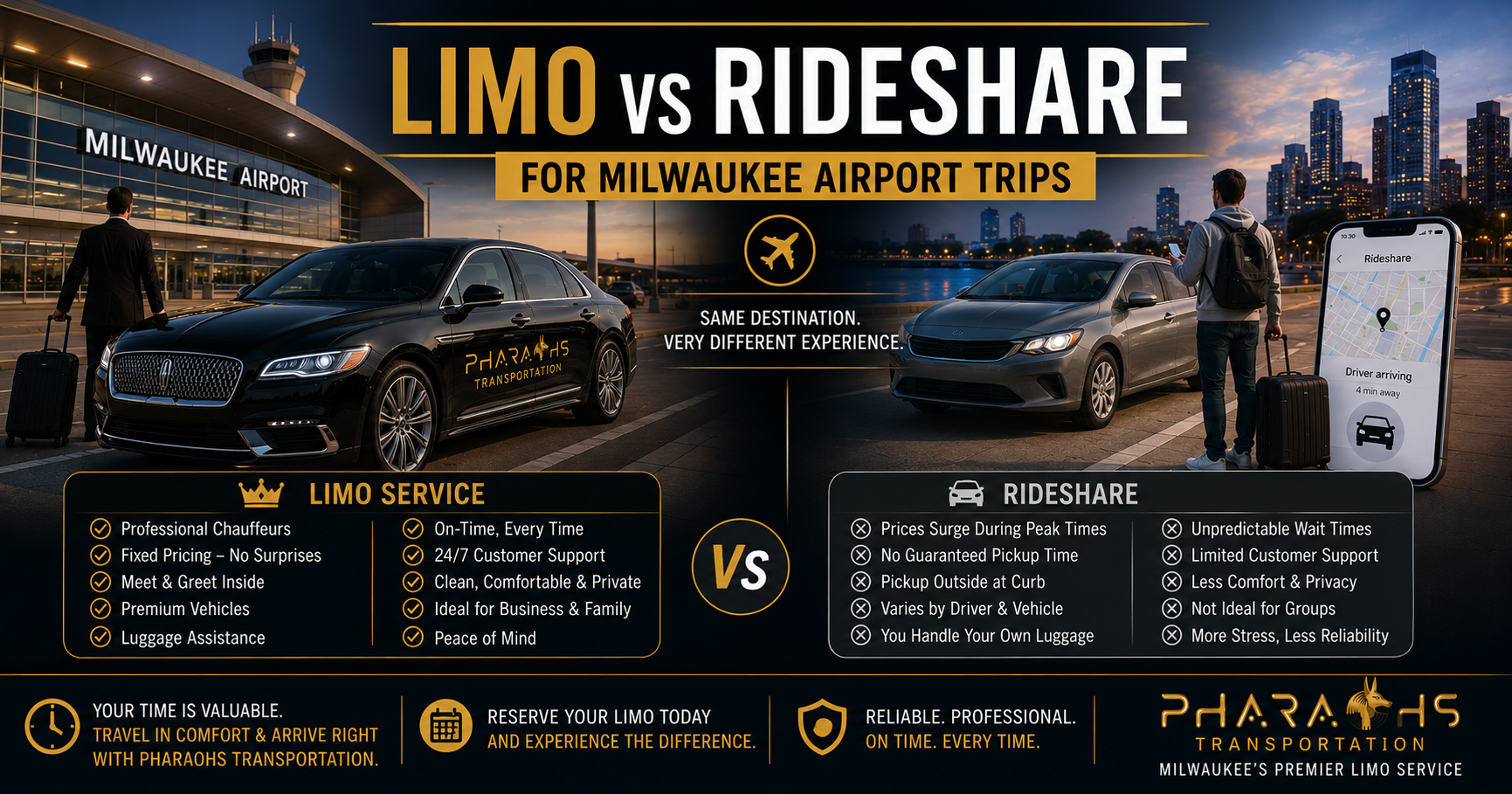
Milwaukee Airport: Limo vs Rideshare


When Rideshare Actually Makes Sense

None of this means rideshare is the wrong choice in every situation — it’s a genuinely useful option for the right kind of trip. Rideshare tends to make the most sense when:

  • The trip is short, local, and low-stakes — a quick ride across town with no flight schedule attached to it.
  • Timing is flexible. If being fifteen or thirty minutes off schedule has no real consequence, the unpredictability of rideshare matters far less.
  • You’re traveling solo with minimal luggage and don’t need a specific vehicle size or type.
  • The trip is spontaneous and you genuinely need a ride within the next few minutes with no advance planning possible.
  • Budget is the deciding factor on a quiet, off-peak trip where surge pricing is unlikely to apply.

Where rideshare tends to fall short is precisely where flights enter the picture: early departures, red-eye arrivals, tight connections, group travel, business trips where professionalism matters, or any day where being late carries a real cost. That’s the specific gap a dedicated Milwaukee Mitchell Airport limo service is built to close — not by being the fancier option, but by removing the variables rideshare structurally can’t control.

A Simple Way to Decide

If you’re still weighing which option fits your next trip, a few quick questions tend to settle it:

  1. Is a flight involved? If yes, flight tracking and guaranteed pickup timing start to matter a lot more than a marginally lower base fare.
  2. Is more than one person traveling together? If yes, a single sized vehicle usually beats splitting a group across multiple rideshare cars.
  3. Is the pickup during a peak window — early morning, evening rush, a holiday, bad weather, or a major local event? If yes, surge pricing risk rises sharply.
  4. Does arrival time actually matter — a meeting, a boarding gate, a client waiting? If yes, a scheduled, dedicated driver reduces the chance of a last-minute scramble.
  5. Would a missed pickup cost more than the ride itself? If a missed flight or rebooking fee is even a remote possibility, the flat-rate certainty of a car service tends to outweigh any potential rideshare savings.

Answering “yes” to two or more of those generally points toward booking ahead with a car service rather than relying on an app in the moment.

Real-World Scenarios: How the Two Options Play Out

Scenario 1: The Early Business Departure

A consultant has a 5:40 AM flight out of MKE for a client meeting in another city. Requesting a rideshare at 4:45 AM means competing for a limited pool of overnight drivers, with no guarantee one accepts the request quickly. A car service, by contrast, has a chauffeur already scheduled and positioned before the pickup window opens — the driver isn’t “found,” they’re already assigned. For a trip where missing the flight means missing the meeting, that difference in certainty is the entire point of booking ahead through a corporate limo service.

Scenario 2: The Delayed Inbound Flight

A family lands at MKE two hours later than scheduled after a weather delay out of a connecting city. If they’d pre-booked a rideshare pickup, that reservation likely cancelled itself hours ago, leaving them to request a fresh ride from a crowded arrivals curb at 11 PM. With a flight-tracked car service, the driver already adjusted to the new landing time automatically and is waiting when the family clears baggage claim — no app, no re-request, no guessing which curb zone has availability.

Scenario 3: The Wedding Party Heading to the Airport

Eight members of a wedding party need to reach MKE together for a group flight the morning after the reception. Coordinating eight rideshare requests from one location, at the same time, with matching arrival timing, is a genuine logistical challenge — and even a small mismatch in driver arrival times can mean the group splits up before they even leave. Booking a single Sprinter van solves this with one reservation, one departure time, and one vehicle for the whole group and their luggage.

Scenario 4: The Quick Solo Trip Downtown

A Milwaukee resident needs a ride from a downtown restaurant back to their apartment on a Tuesday night, ten minutes away, with no time pressure. This is the clearest case where rideshare is simply the more practical option — no flight involved, no group to coordinate, and a short enough trip that surge pricing risk is minimal. Not every ride needs to be booked in advance, and this is exactly the kind of trip rideshare was built for.

These four scenarios cover most of what “choosing between limo and rideshare” actually looks like in practice. The deciding factor is rarely about luxury — it’s about how much a trip depends on precise timing, group coordination, and a guaranteed vehicle showing up regardless of what the weather, the clock, or the local event calendar are doing that day.

What to Look for If You Choose a Car Service

Not every car service delivers the reliability described above, so it’s worth knowing what actually separates a dependable provider from one that just looks the part on a website. Look for a provider that:

  • Publishes flat rates rather than “starting at” pricing that changes at booking
  • Actively tracks flight numbers rather than relying on a general estimated arrival time
  • Operates and maintains its own fleet instead of subcontracting to third-party drivers
  • Confirms bookings quickly, ideally within minutes rather than requiring a callback
  • Offers vehicle options that scale from a single traveler to a full group

A closer breakdown of what separates providers on these exact points is covered in the site’s broader Milwaukee limo service comparison guide, which looks at car service providers against each other rather than against rideshare specifically.

FAQ

Is a limo more expensive than an Uber to Milwaukee Airport?

Not necessarily. Rideshare can be cheaper on a quiet day with no surge pricing in effect, but early mornings, evenings, bad weather, and event traffic frequently push rideshare fares above a flat-rate car service — and that’s before accounting for the total cost of booking multiple vehicles for a group.

What happens if my flight is delayed and I already booked a limo?

A dedicated car service tracks the flight tied to your reservation and adjusts the pickup time automatically at no additional charge. With rideshare, monitoring the flight and re-requesting a new ride once you land is entirely on you.

Can rideshare handle a group of five or more people with luggage?

Rarely in a single vehicle. Standard rideshare cars typically seat four, which means larger groups end up requesting multiple cars separately and often arrive at staggered times. A Sprinter limo or SUV keeps the entire group — and their luggage — together in one ride.

Is booking a limo worth it for a short trip within Milwaukee?

For a quick, flexible-timing local errand with no flight attached, rideshare is often the simpler and more economical choice. Car service tends to pay off most clearly for airport runs, early departures, business travel, and group trips.

How far in advance should I book Milwaukee airport car service?

Booking even a day or two ahead locks in your flat rate and guarantees a specific driver and vehicle are scheduled for your trip. Most online reservations are confirmed in under 15 minutes, and last-minute or same-day bookings can often still be accommodated.

Does a car service actually track my specific flight, or just estimate arrival time?

A proper airport car service ties the reservation directly to your flight number and monitors it in real time, adjusting the pickup automatically if the schedule shifts. That’s a meaningfully different process than an app estimating a generic arrival window based on typical flight times.

Is rideshare or limo service better for early-morning departures?

Limo service tends to hold a clear advantage for early departures specifically because the driver is scheduled and positioned in advance — waiting curbside at your pickup time — rather than being sourced from whatever limited driver pool is available at 4 or 5 AM, when rideshare supply is often thinnest.

What vehicles are available for airport transportation in Milwaukee?

A full-service provider typically offers a range that includes standard and premium sedans, SUVs for families or extra luggage, and Sprinter vans for larger groups — allowing the vehicle to be matched to the trip rather than left to chance.

Does surge pricing apply to holidays and major Milwaukee events?

Yes, for rideshare — holidays, severe weather, and event nights around venues like Fiserv Forum or American Family Field are exactly when rideshare demand spikes and surge multipliers are most likely to apply. A flat-rate car service charges the same published rate regardless of the date or event calendar.

Can I book a round trip with a car service instead of arranging pickup and drop-off separately?

Yes — round trips can typically be coordinated as a single reservation, which keeps both legs of the trip on one flat rate and one point of contact, rather than booking two separate, independently priced rideshare trips.

Do car services drive to O’Hare and Midway, or only within Milwaukee?

Full-service providers generally cover both in-state Milwaukee transfers and cross-state trips to Chicago-area airports. A Milwaukee to O’Hare limo service or a Milwaukee to Midway transfer runs on the same flat-rate, flight-tracked model as a local MKE pickup, just over a longer route.

The Bottom Line

For a short, flexible, low-stakes trip around town, rideshare remains a perfectly reasonable choice. But for anything tied to a flight — timing that actually matters, luggage that needs real room, or a group that needs to travel together without splitting up — a dedicated car service removes the three variables rideshare can’t control: surge pricing, driver cancellations, and zero visibility into your flight status.

Pharaoh’s Transportation runs flat-rate, flight-tracked Milwaukee airport limo service to MKE, O’Hare, and Midway, 24/7, with sedans, SUVs, and Sprinter vans available for any group size. Travelers heading to O’Hare specifically can also review the Milwaukee to O’Hare transportation guide for route timing and pickup details before booking.

Book Your Airport Limo Online → or call (414) 322-3751 for immediate booking.

Questions first? Contact the team directly or browse the full FAQ page.

Avada Car Dealer News

Every traveler flying out of Milwaukee Mitchell International Airport (MKE) eventually faces the same decision on the morning of a trip: open a rideshare app and take whatever driver shows up, or book a dedicated Milwaukee airport limo service ahead of time and know exactly what’s coming. Both options will physically get you to the terminal. What separates them is everything that happens between booking and boarding — the price you actually pay, what occurs if your flight schedule shifts, and whether the vehicle that shows up actually fits your trip.

This isn’t a blanket argument that limo service beats rideshare in every situation, or that rideshare is something to avoid entirely. It’s a practical, side-by-side look at how each option performs across the variables that matter most on travel day, so you can make the right call for your specific trip instead of defaulting to whichever app happens to be open on your phone.

Quick Comparison Table

FactorAirport Limo ServiceRideshare (Uber/Lyft)
Pricing modelFlat rate, quoted before bookingDynamic — changes with demand
Surge/peak pricingNone — same rate day or nightCommon during rush hour, weather, events
Driver assignmentScheduled and confirmed in advanceMatched in real time, subject to availability
Flight delay handlingFlight-tracked, pickup adjusts automaticallyNo flight tracking — rider manages manually
Cancellation riskLow — dedicated fleet and driverHigher during high-demand windows
Vehicle typeMatched to trip: sedan, SUV, or Sprinter vanWhatever vehicle is nearest and available
Group & luggage capacityVehicles sized for the group, up to 14–15 passengersLimited; larger groups often split across cars
Driver vettingLicensed, insured, background-checked, localPlatform-verified, variable experience
PaymentSet in advance, no surprise totalFinal fare can shift after the ride ends
Best suited forFlights, early departures, groups, business travelShort, spontaneous, flexible local trips

Cost Breakdown: Per-Trip Flat Rate vs. Surge Pricing

How Rideshare Pricing Actually Works

Rideshare pricing is built around real-time supply and demand, not a fixed rate card. The number you see when you open the app reflects current conditions at that exact moment — how many drivers are nearby, how many other riders are requesting cars, and whether any external factor (weather, an event letting out, a holiday travel wave) is pushing demand higher than usual. That’s the mechanism behind surge pricing, and it’s precisely why the fare quoted for the same route can look completely different depending on when you check.

For a short local trip taken spontaneously, that model works fine most of the time. For an airport trip, it introduces a variable most travelers don’t want on a day that already has enough moving parts. Airport trips cluster around predictable but high-demand windows — early morning departure banks, evening arrival rushes, holiday weekends, and Milwaukee event nights when Fiserv Forum or American Family Field lets out and driver supply across the metro tightens all at once. Any of those conditions can trigger a price multiplier with little warning, and by the time you notice the surge label, you’re often already checking out.

How Flat-Rate Car Service Pricing Works

A dedicated car service prices differently: the rate is set by the route and vehicle type, not by real-time demand. Local Milwaukee transfers with Pharaoh’s Transportation start around $60, and a trip to O’Hare runs a published flat rate — the number you’re quoted when you book is the number you pay when the ride ends, regardless of whether it’s 5 AM, a holiday, or pouring rain. There’s no fuel surcharge tacked on for bad weather and no late-night premium for a red-eye pickup.

That predictability matters most when you’re budgeting a trip in advance, expensing travel for work, or simply don’t want to think about transportation costs the morning you’re trying to make a flight.

Where the Real Cost Difference Shows Up

On paper, a single rider taking a short, off-peak trip might still find rideshare cheaper than a scheduled car service — and that’s a fair trade-off if reliability isn’t a major concern for that particular trip. But the math shifts quickly once any of the following apply:

  • Peak-hour travel. Early morning and evening are exactly when MKE traffic is heaviest and rideshare demand is highest — the two conditions most likely to trigger surge pricing.
  • Group travel. A group of four or five needing two separate rideshare vehicles will often spend more combined than a single flat-rate SUV or Sprinter van built for the group.
  • Weather events. Snow, ice, or heavy rain in Wisconsin reliably pushes rideshare demand up and driver supply down simultaneously — a combination that tends to produce the steepest surge multipliers of the year.
  • Round trips booked separately. Booking a pickup and a return rideshare trip independently means paying two unpredictable fares instead of one flat, coordinated round-trip rate.

For a single traveler on a quiet weekday afternoon, rideshare may well be the cheaper option. For a business traveler catching an early flight, a family with luggage, or a group heading to the airport together, a flat-rate Milwaukee airport limo service frequently ends up costing about the same as rideshare would have anyway — except you know the number up front instead of finding out at checkout.

The Hidden Cost of “Cheap” Rides

There’s a cost dimension that rarely shows up in a fare comparison but affects the total price of a trip anyway: the cost of what happens when a cheap ride goes wrong. A missed flight because a rideshare driver cancelled at the last minute, or a rebooking fee because a connection was missed while waiting on a re-requested ride, can easily outweigh whatever was saved on the original fare. A flat rate that includes flight tracking and a guaranteed driver isn’t just a pricing model — it’s effectively a form of insurance against the more expensive outcome of an airport trip going sideways.

Reliability & Flight Delays

The Flight-Tracking Gap

This is arguably the single biggest functional difference between the two options, and it’s the one most travelers don’t think about until they’ve already been burned by it. Rideshare platforms have no connection to your flight information. If your inbound flight lands early, lands late, gets delayed on the tarmac, or gets rerouted, the rideshare app has no idea — because it was never designed to know. The responsibility to track your own flight, cancel a ride you may have pre-scheduled, and re-request a new one the moment you land falls entirely on you, often while you’re also collecting luggage, exiting a jet bridge, or trying to find signal in a crowded terminal.

A dedicated car service builds flight tracking into the reservation itself. Pharaoh’s Transportation monitors every scheduled arrival and departure tied to a booking, so if an O’Hare inbound flight runs 90 minutes behind, the pickup time adjusts automatically — no phone call needed, no extra fee, and no risk of a driver showing up (or being cancelled) before you’ve actually landed. For outbound trips, that same tracking means a chauffeur is positioned and ready ahead of an early departure rather than being dispatched only once you request a ride that morning.

If you fly often enough to have already experienced a cancelled or grounded flight in Wisconsin, it’s worth reading through what a solid ground-transportation backup plan actually looks like — the scenarios covered there are exactly the kind of disruption flight tracking is built to absorb.

Driver Cancellations and Peak-Demand Risk

Rideshare reliability isn’t just about pricing — it’s also about whether a driver accepts and completes the trip at all. During periods of high demand (holiday travel weekends, early-morning departure banks, major Milwaukee events), driver cancellation rates climb because drivers are incentivized to chase higher-paying surge trips elsewhere. A cancelled rideshare pickup for a casual dinner plan is a minor inconvenience. A cancelled pickup thirty minutes before a flight, with no backup vehicle already assigned to you, is a materially different problem.

A car service model removes that particular risk almost entirely. When you book with a dedicated fleet, a specific vehicle and chauffeur are scheduled for your trip in advance — not sourced from a shared pool of on-demand drivers competing for the next fare. That’s a structural difference, not just a marketing point: the car and driver assigned to your airport run exist to complete that run, not to weigh whether a better-paying trip appeared nearby.

Weather, Traffic, and Local Route Knowledge

Wisconsin winters and Milwaukee’s I-94/I-43/I-894 interchange traffic add another layer where local knowledge counts. A rideshare driver could be new to the area, unfamiliar with which lane backs up during a morning commute, or uncertain about the fastest current route to a specific MKE concourse. Chauffeurs who work Milwaukee airport routes daily tend to know which approach avoids backups at Concourse C, how construction detours are currently routed, and how to time a pickup so it doesn’t collide with a shift-change traffic wave. None of that shows up in an app’s estimated arrival time, but it shows up in whether you actually make your gate with time to spare. Travelers who want a fuller sense of what a professional airport pickup routine looks like day to day can check the MKE airport car service guide for a closer look at terminal logistics and timing.

Consistency Across Multiple Trips

For frequent flyers, reliability compounds over time. A single rideshare mishap is an inconvenience; a pattern of inconsistent pickups across a dozen trips a year becomes a genuine planning problem. Business travelers who fly out of MKE regularly often find that the value of a dependable chauffeur service isn’t any single ride — it’s not having to think about transportation reliability at all, trip after trip, because the same standard applies every time.

Comfort & Group Travel

Vehicle Matching vs. Vehicle Roulette

With rideshare, the vehicle that arrives is whatever is closest and available at that moment — which could be a compact economy car, an aging SUV, or anything in between. There’s no way to guarantee trunk space for extra luggage, no guarantee of a recently detailed interior, and no way to request a specific vehicle class for a specific trip without paying for a premium tier that still doesn’t promise consistency.

A car service works the opposite way: the vehicle is matched to the trip before you ever get in it. A solo business traveler heading to a downtown meeting might book a black car or executive sedan. A family flying out with several suitcases might need an SUV with real cargo room. A wedding party, corporate team, or group of friends heading to MKE together can book a single Sprinter van that seats up to 14–15 passengers with space for luggage, instead of splitting into three or four separate rideshare vehicles that inevitably arrive at different times and force the group to regroup at security.

Why Group Logistics Break Down With Rideshare

Group airport trips are where rideshare’s per-vehicle model shows its limits most clearly. Requesting multiple simultaneous rideshare cars from the same pickup point during a busy window is its own small logistical project — drivers get assigned from different directions, arrive at staggered times, and there’s no coordination between them. For a group trying to make the same flight, that turns what should be a simple pickup into a minor management task on a morning nobody wants extra tasks.

Booking one appropriately sized vehicle removes that problem entirely. Everyone leaves together, arrives together, and there’s a single point of coordination — one driver, one pickup time, one drop-off — rather than a small fleet of independently dispatched cars.

The Professionalism Factor for Business Travel

For business travelers, comfort isn’t only about legroom. Arriving at a client meeting, a conference, or an airport pickup for visiting executives in whatever vehicle a rideshare algorithm happened to assign sends a different signal than arriving in a coordinated corporate limo service vehicle with a professionally dressed chauffeur who already knows the itinerary. Companies that book recurring executive limo service for visiting clients or traveling staff tend to do so specifically because the vehicle and driver become part of a consistent, predictable travel experience — not a variable to manage on top of everything else on a business trip.

Booking Flexibility: Point-to-Point vs. Hourly

Another comfort factor rideshare doesn’t offer well: flexible scheduling around a trip. If your travel day includes a stop before the airport, a meeting that runs long, or a return trip with an uncertain end time, an hourly limo rental keeps a chauffeur and vehicle available on your timeline rather than requiring a fresh rideshare request for every leg. For simpler A-to-B trips, a point-to-point car service booking still guarantees the pickup window and vehicle in a way an on-demand app can’t.

Luggage, Comfort, and the Little Things That Add Up

Small details compound over the length of an airport trip. A car service vehicle is typically cleaned and inspected before each ride, arrives with adequate trunk space already accounted for, and comes with a driver who helps with luggage rather than leaving it entirely to the rider. None of these details individually justify choosing one option over the other, but together they explain why travelers who’ve used both tend to describe the car service experience as noticeably less stressful — not necessarily faster, just more predictable from curb to curb.

Milwaukee Airport: Limo vs Rideshare


When Rideshare Actually Makes Sense

None of this means rideshare is the wrong choice in every situation — it’s a genuinely useful option for the right kind of trip. Rideshare tends to make the most sense when:

  • The trip is short, local, and low-stakes — a quick ride across town with no flight schedule attached to it.
  • Timing is flexible. If being fifteen or thirty minutes off schedule has no real consequence, the unpredictability of rideshare matters far less.
  • You’re traveling solo with minimal luggage and don’t need a specific vehicle size or type.
  • The trip is spontaneous and you genuinely need a ride within the next few minutes with no advance planning possible.
  • Budget is the deciding factor on a quiet, off-peak trip where surge pricing is unlikely to apply.

Where rideshare tends to fall short is precisely where flights enter the picture: early departures, red-eye arrivals, tight connections, group travel, business trips where professionalism matters, or any day where being late carries a real cost. That’s the specific gap a dedicated Milwaukee Mitchell Airport limo service is built to close — not by being the fancier option, but by removing the variables rideshare structurally can’t control.

A Simple Way to Decide

If you’re still weighing which option fits your next trip, a few quick questions tend to settle it:

  1. Is a flight involved? If yes, flight tracking and guaranteed pickup timing start to matter a lot more than a marginally lower base fare.
  2. Is more than one person traveling together? If yes, a single sized vehicle usually beats splitting a group across multiple rideshare cars.
  3. Is the pickup during a peak window — early morning, evening rush, a holiday, bad weather, or a major local event? If yes, surge pricing risk rises sharply.
  4. Does arrival time actually matter — a meeting, a boarding gate, a client waiting? If yes, a scheduled, dedicated driver reduces the chance of a last-minute scramble.
  5. Would a missed pickup cost more than the ride itself? If a missed flight or rebooking fee is even a remote possibility, the flat-rate certainty of a car service tends to outweigh any potential rideshare savings.

Answering “yes” to two or more of those generally points toward booking ahead with a car service rather than relying on an app in the moment.

Real-World Scenarios: How the Two Options Play Out

Scenario 1: The Early Business Departure

A consultant has a 5:40 AM flight out of MKE for a client meeting in another city. Requesting a rideshare at 4:45 AM means competing for a limited pool of overnight drivers, with no guarantee one accepts the request quickly. A car service, by contrast, has a chauffeur already scheduled and positioned before the pickup window opens — the driver isn’t “found,” they’re already assigned. For a trip where missing the flight means missing the meeting, that difference in certainty is the entire point of booking ahead through a corporate limo service.

Scenario 2: The Delayed Inbound Flight

A family lands at MKE two hours later than scheduled after a weather delay out of a connecting city. If they’d pre-booked a rideshare pickup, that reservation likely cancelled itself hours ago, leaving them to request a fresh ride from a crowded arrivals curb at 11 PM. With a flight-tracked car service, the driver already adjusted to the new landing time automatically and is waiting when the family clears baggage claim — no app, no re-request, no guessing which curb zone has availability.

Scenario 3: The Wedding Party Heading to the Airport

Eight members of a wedding party need to reach MKE together for a group flight the morning after the reception. Coordinating eight rideshare requests from one location, at the same time, with matching arrival timing, is a genuine logistical challenge — and even a small mismatch in driver arrival times can mean the group splits up before they even leave. Booking a single Sprinter van solves this with one reservation, one departure time, and one vehicle for the whole group and their luggage.

Scenario 4: The Quick Solo Trip Downtown

A Milwaukee resident needs a ride from a downtown restaurant back to their apartment on a Tuesday night, ten minutes away, with no time pressure. This is the clearest case where rideshare is simply the more practical option — no flight involved, no group to coordinate, and a short enough trip that surge pricing risk is minimal. Not every ride needs to be booked in advance, and this is exactly the kind of trip rideshare was built for.

These four scenarios cover most of what “choosing between limo and rideshare” actually looks like in practice. The deciding factor is rarely about luxury — it’s about how much a trip depends on precise timing, group coordination, and a guaranteed vehicle showing up regardless of what the weather, the clock, or the local event calendar are doing that day.

What to Look for If You Choose a Car Service

Not every car service delivers the reliability described above, so it’s worth knowing what actually separates a dependable provider from one that just looks the part on a website. Look for a provider that:

  • Publishes flat rates rather than “starting at” pricing that changes at booking
  • Actively tracks flight numbers rather than relying on a general estimated arrival time
  • Operates and maintains its own fleet instead of subcontracting to third-party drivers
  • Confirms bookings quickly, ideally within minutes rather than requiring a callback
  • Offers vehicle options that scale from a single traveler to a full group

A closer breakdown of what separates providers on these exact points is covered in the site’s broader Milwaukee limo service comparison guide, which looks at car service providers against each other rather than against rideshare specifically.

FAQ

Is a limo more expensive than an Uber to Milwaukee Airport?

Not necessarily. Rideshare can be cheaper on a quiet day with no surge pricing in effect, but early mornings, evenings, bad weather, and event traffic frequently push rideshare fares above a flat-rate car service — and that’s before accounting for the total cost of booking multiple vehicles for a group.

What happens if my flight is delayed and I already booked a limo?

A dedicated car service tracks the flight tied to your reservation and adjusts the pickup time automatically at no additional charge. With rideshare, monitoring the flight and re-requesting a new ride once you land is entirely on you.

Can rideshare handle a group of five or more people with luggage?

Rarely in a single vehicle. Standard rideshare cars typically seat four, which means larger groups end up requesting multiple cars separately and often arrive at staggered times. A Sprinter limo or SUV keeps the entire group — and their luggage — together in one ride.

Is booking a limo worth it for a short trip within Milwaukee?

For a quick, flexible-timing local errand with no flight attached, rideshare is often the simpler and more economical choice. Car service tends to pay off most clearly for airport runs, early departures, business travel, and group trips.

How far in advance should I book Milwaukee airport car service?

Booking even a day or two ahead locks in your flat rate and guarantees a specific driver and vehicle are scheduled for your trip. Most online reservations are confirmed in under 15 minutes, and last-minute or same-day bookings can often still be accommodated.

Does a car service actually track my specific flight, or just estimate arrival time?

A proper airport car service ties the reservation directly to your flight number and monitors it in real time, adjusting the pickup automatically if the schedule shifts. That’s a meaningfully different process than an app estimating a generic arrival window based on typical flight times.

Is rideshare or limo service better for early-morning departures?

Limo service tends to hold a clear advantage for early departures specifically because the driver is scheduled and positioned in advance — waiting curbside at your pickup time — rather than being sourced from whatever limited driver pool is available at 4 or 5 AM, when rideshare supply is often thinnest.

What vehicles are available for airport transportation in Milwaukee?

A full-service provider typically offers a range that includes standard and premium sedans, SUVs for families or extra luggage, and Sprinter vans for larger groups — allowing the vehicle to be matched to the trip rather than left to chance.

Does surge pricing apply to holidays and major Milwaukee events?

Yes, for rideshare — holidays, severe weather, and event nights around venues like Fiserv Forum or American Family Field are exactly when rideshare demand spikes and surge multipliers are most likely to apply. A flat-rate car service charges the same published rate regardless of the date or event calendar.

Can I book a round trip with a car service instead of arranging pickup and drop-off separately?

Yes — round trips can typically be coordinated as a single reservation, which keeps both legs of the trip on one flat rate and one point of contact, rather than booking two separate, independently priced rideshare trips.

Do car services drive to O’Hare and Midway, or only within Milwaukee?

Full-service providers generally cover both in-state Milwaukee transfers and cross-state trips to Chicago-area airports. A Milwaukee to O’Hare limo service or a Milwaukee to Midway transfer runs on the same flat-rate, flight-tracked model as a local MKE pickup, just over a longer route.

The Bottom Line

For a short, flexible, low-stakes trip around town, rideshare remains a perfectly reasonable choice. But for anything tied to a flight — timing that actually matters, luggage that needs real room, or a group that needs to travel together without splitting up — a dedicated car service removes the three variables rideshare can’t control: surge pricing, driver cancellations, and zero visibility into your flight status.

Pharaoh’s Transportation runs flat-rate, flight-tracked Milwaukee airport limo service to MKE, O’Hare, and Midway, 24/7, with sedans, SUVs, and Sprinter vans available for any group size. Travelers heading to O’Hare specifically can also review the Milwaukee to O’Hare transportation guide for route timing and pickup details before booking.

Book Your Airport Limo Online → or call (414) 322-3751 for immediate booking.

Questions first? Contact the team directly or browse the full FAQ page.