If you’ve searched “milwaukee limo service” recently, you’ve probably noticed three very different kinds of results: a locally-owned company with its own fleet, a rideshare black-car option through an app, and a national limo chain that dispatches your ride to a subcontractor you’ve never heard of. They can look identical on a booking page — same black SUV, same “luxury” language — but what you actually get once the vehicle shows up is not the same at all.
This guide breaks down the real differences across the four things that matter most when you’re comparing limo options in Milwaukee: who owns the vehicle, how pricing actually works, what happens if something goes wrong, and how fast each option can respond when you need a ride today — not next week.
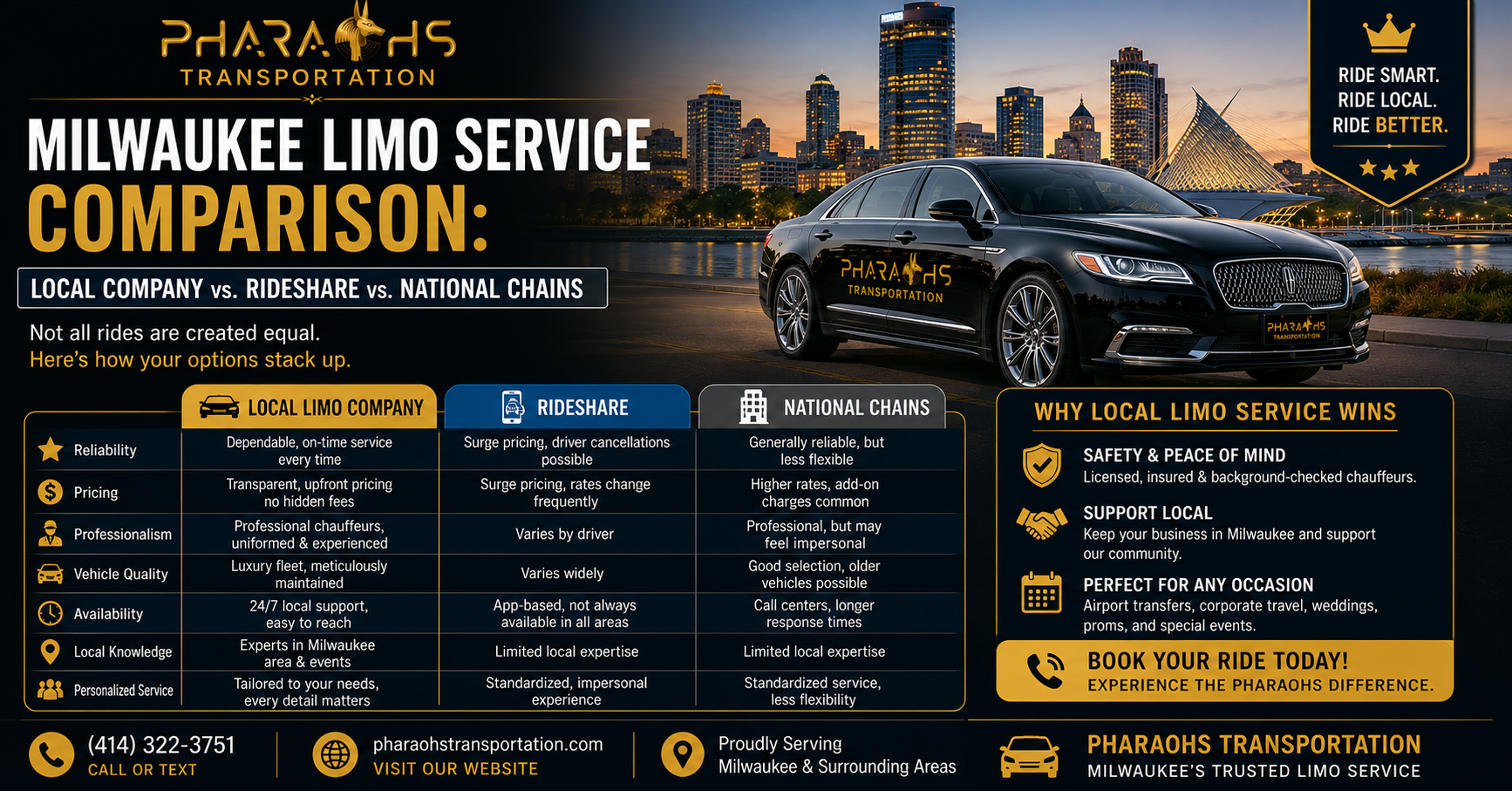
Milwaukee Limo Options at a Glance
| Local Fleet Company | Rideshare Black Car | National Limo Chain | |
|---|---|---|---|
| Vehicle ownership | Owns and maintains its own fleet | Independent contractor’s personal vehicle | Books a local subcontractor, not their own car |
| Pricing | Flat-rate, quoted upfront | Surge pricing during peak demand | Often quoted by a national call center, then re-priced by the local operator |
| Driver accountability | Background-checked employee, known to dispatch | App-vetted contractor, variable experience | Whoever the local affiliate assigns that day |
| Insurance/liability | Company-level commercial coverage tied to a physical Milwaukee address | Coverage varies by trip status and app terms | Depends on which subcontractor actually shows up |
| Same-day booking | Local dispatch, often confirmed in minutes | Instant, but subject to driver availability/surge | Routed through a national system, can take longer to confirm locally |
| Best for | Airport transfers, corporate accounts, weddings, events | One-off short rides when speed matters more than consistency | Rarely the best option in a market with strong local operators |
Below, we go through each of these factors in more detail.
Who Owns the Vehicle You’re Riding In?
This is the single biggest difference between the three options, and it’s the one most people don’t think to ask about.
Locally-owned fleet companies: buy, maintain, and insure their own vehicles. When you book a ride with a company like Pharaoh’s Transportation, the Cadillac Escalade or Mercedes-Benz Sprinter that shows up is the company’s own vehicle, serviced at their own Milwaukee facility, not leased from a driver or borrowed from a subcontractor. That matters because the company has a direct financial incentive to keep every vehicle in the fleet clean, mechanically sound, and presentable — their name and their reviews are attached to it.
Rideshare black car services: work differently. The “black car” tier of a rideshare app is still built on independent contractors using their own personal vehicles. The vehicle might meet a minimum age or model requirement, but there’s no fleet standard behind it — no shared maintenance schedule, no company detailing every car before every trip, and no guarantee the driver has done this kind of work full-time.
National limo chains: add a third layer. Many of the well-known national limo brands don’t operate vehicles in most of the cities they advertise in — including Milwaukee. Instead, they take your booking through a national call center or website, then hand it off to a local, independently-owned limo company to actually fulfill the ride. You may be charged a national company’s rate, but the vehicle, driver, and service standard are entirely determined by whichever local affiliate picks up the job. You often don’t find out who that is until the day of your ride.
Why this matters in practice: if a vehicle breaks down, gets in an accident, or simply doesn’t show up, a locally-owned fleet company can pull a backup vehicle from its own lot within minutes. A subcontracted national chain has to go back through its dispatch chain to find a replacement — and that chain runs through a call center that may not even be in Wisconsin.
Pricing Transparency — Flat-Rate vs. Surge vs. Hidden Booking Fees
Pricing is where the three models diverge the most, and it’s usually where people get surprised.
Flat-rate local pricing: means the fare is set before you ride and doesn’t move based on demand, weather, or time of day. As an example, local Milwaukee transfers with a locally-owned operator typically start around $60, with routes like Milwaukee to O’Hare priced as a flat rate regardless of when you book or how busy the roads are. You know the number when you book — not when you’re dropped off.
Rideshare surge pricing: is dynamic by design. The fare you see when you open the app can be 2x, 3x, or more during high-demand periods — bad weather, a Brewers or Bucks game letting out, a holiday travel weekend, or simply rush hour. There’s no way to lock in a rate ahead of time the way you can with a flat-rate limo booking, which makes rideshare a risky choice for something time-sensitive like an early-morning flight.
National chain pricing: introduces a different kind of unpredictability. Because the quote often comes from a national booking system that isn’t fully in sync with what the local affiliate actually charges, travelers sometimes get a quote from the national brand’s website, only to have it adjusted — or have extra fees like fuel surcharges, gratuity minimums, or “administrative” fees added — once the local operator takes over the booking.
The practical takeaway: if predictable, all-in pricing matters to you — especially for a flight you can’t afford to be late for — a flat-rate local operator with no surge pricing and no hidden booking fees removes the guesswork that comes with both rideshare and national-chain bookings.
Insurance & Accountability When Something Goes Wrong
Nobody plans for something to go wrong on a ride, but it’s worth knowing who’s actually responsible if it does.
Locally-owned companies: carry commercial insurance tied directly to their business and their fleet — for reference, a company operating its own vehicles typically carries commercial coverage in the range of $1 million, tied to a real business address you can visit. If there’s a dispute or an incident, there’s a specific company, at a specific location, with a name attached to the vehicle.
Rideshare drivers: are covered under the app’s insurance policy, but the coverage tier depends on the driver’s status at the moment of the incident — whether they’re en route to pick you up, actively transporting you, or simply logged into the app waiting for a request. This tiered structure has been the subject of ongoing insurance and legal disputes nationally, precisely because liability isn’t always straightforward.
National chains operating through subcontractors: create a layer of ambiguity: is the national brand liable, or is it the local affiliate that actually provided the car and driver? Because the contractual relationship between the national brand and the local operator isn’t something the average customer can see, this question can be genuinely difficult to answer after the fact — and that ambiguity works against the customer, not for them.
Accountability isn’t just about worst-case scenarios, either. It also covers everyday issues: a driver running late, a vehicle that doesn’t match what was booked, or a billing error. A company with local dispatch, a real office, and a name to defend tends to resolve these faster than a national call center routing your complaint to a third party.
Response Time for Same-Day & Last-Minute Bookings
Milwaukee travelers know this scenario: a flight gets moved up, a meeting runs late, or a red-eye lands at 2 a.m. and you need a ride now, not in three hours.
Locally-owned companies with on-site dispatch — particularly ones based near Milwaukee Mitchell International Airport — can typically confirm a same-day quote quickly and get a chauffeur curbside without routing the request through multiple layers. A company physically located minutes from the airport with real-time flight tracking can adjust a pickup instantly if a flight is delayed or a connection gets rebooked, without charging extra for the wait.
Rideshare is genuinely fast for on-demand requests, but “fast” doesn’t mean “reliable” during high-demand windows. Availability can thin out considerably during bad weather, major events, or overnight hours — exactly the situations where you need a ride the most.
National chains are usually the slowest of the three for last-minute bookings, because the request has to pass through a centralized system before it’s handed to a local affiliate, who then has to check their own separate availability. For a same-day or emergency booking, that extra step can cost you real time.
Which Option Fits Which Trip
Not every trip calls for the same kind of service. Here’s a practical breakdown:
Airport transfers (MKE, O’Hare, Midway):
A locally-owned company with real-time flight tracking and a base near the airport is generally the strongest fit — your driver already knows if your flight is delayed before you land, and there’s no surge pricing to worry about on an early-morning or red-eye run. See our airport limo service page for route-specific pricing.
Corporate travel and executive transport:
Businesses that need consistency — the same standard of vehicle, the same professionalism, and predictable billing across dozens of trips a month — are usually better served by a locally-owned operator that can set up a corporate account, rather than a rideshare app or a national chain with rotating subcontractors.
Weddings, proms, and special events:
These trips depend heavily on the vehicle actually showing up on time, in the condition it was described, with a driver who’s done this specific kind of event before. A company that owns and details its own fleet — rather than depending on whichever car a rideshare driver happens to have that day — carries much less risk for an event you can’t reschedule.
Long-distance and interstate trips:
For longer routes — Milwaukee to Chicago, Madison, or beyond — flat-rate pricing becomes even more valuable, since surge-based rideshare pricing over a long distance can get expensive fast, and national chains introduce more handoff points over a longer trip.
A quick, single, low-stakes ride:
If you just need a short ride and speed matters more than consistency, rideshare can be a reasonable choice — it’s simply not built for the trips above.
Frequently Asked Questions
Is a local limo company cheaper than Uber Black in Milwaukee?
It depends on timing. Rideshare can be cheaper during low-demand periods, but a flat-rate local limo service is often more cost-effective — and always more predictable — during surge periods like bad weather, event nights, or peak travel times, since the price doesn’t change based on demand.
Do national limo chains actually own their vehicles?
In most markets, including Milwaukee, national limo chains typically don’t operate their own local fleet. They generally book a local, independently-owned limo company to fulfill the ride, which means the vehicle, driver, and service standard depend on whichever local affiliate is assigned.
What insurance should a Milwaukee limo company carry?
Reputable locally-owned limo operators typically carry commercial auto insurance in the range of $1 million, in addition to state licensing. It’s reasonable to ask any provider — local, rideshare, or national chain — for proof of commercial coverage before booking.
Is rideshare or a limo service better for an early-morning flight?
For a flight you can’t afford to miss, a locally-owned limo service with real-time flight tracking and flat-rate pricing generally carries less risk than rideshare, since surge pricing and driver availability can both work against you during early-morning peak hours.
How far in advance should I book a Milwaukee limo service?
For weddings, proms, or corporate events, booking at least a few weeks ahead is recommended. For airport transfers, many locally-owned companies can confirm a booking same-day, though reserving 24–48 hours ahead guarantees vehicle availability.
Can I get a flat rate for Milwaukee to O’Hare or Midway?
Yes — most locally-owned Milwaukee limo companies quote long-distance airport routes like Milwaukee to O’Hare or Midway as a flat rate, so the price is set before you ride regardless of traffic or timing.
What happens if my flight is delayed and I booked a limo?
With a locally-owned company that tracks flights in real time, a delayed flight typically doesn’t cost you anything extra — the pickup simply adjusts to your new arrival time. This is worth confirming directly with any provider, since policies vary.
Do I need to tip a limo chauffeur separately, or is it included?
This varies by company. Some locally-owned operators build gratuity into the flat rate, while others list it separately. Always confirm what’s included in your quote before booking, especially with national chains where fees can be added at the local level.
The Bottom Line
The label “limo service” covers three genuinely different business models — and the differences show up in your wallet, your schedule, and who’s accountable if something doesn’t go as planned. A locally-owned, fleet-operated company gives you the clearest picture of what you’re actually booking: a specific vehicle, a specific driver, flat-rate pricing, and a real business behind the ride.
Ready to book, or want to see the fleet and pricing for yourself? Explore our vehicle fleet, learn more about our company, check airport limo service details, or reserve your ride online in under five minutes.