Avada Car Dealer News

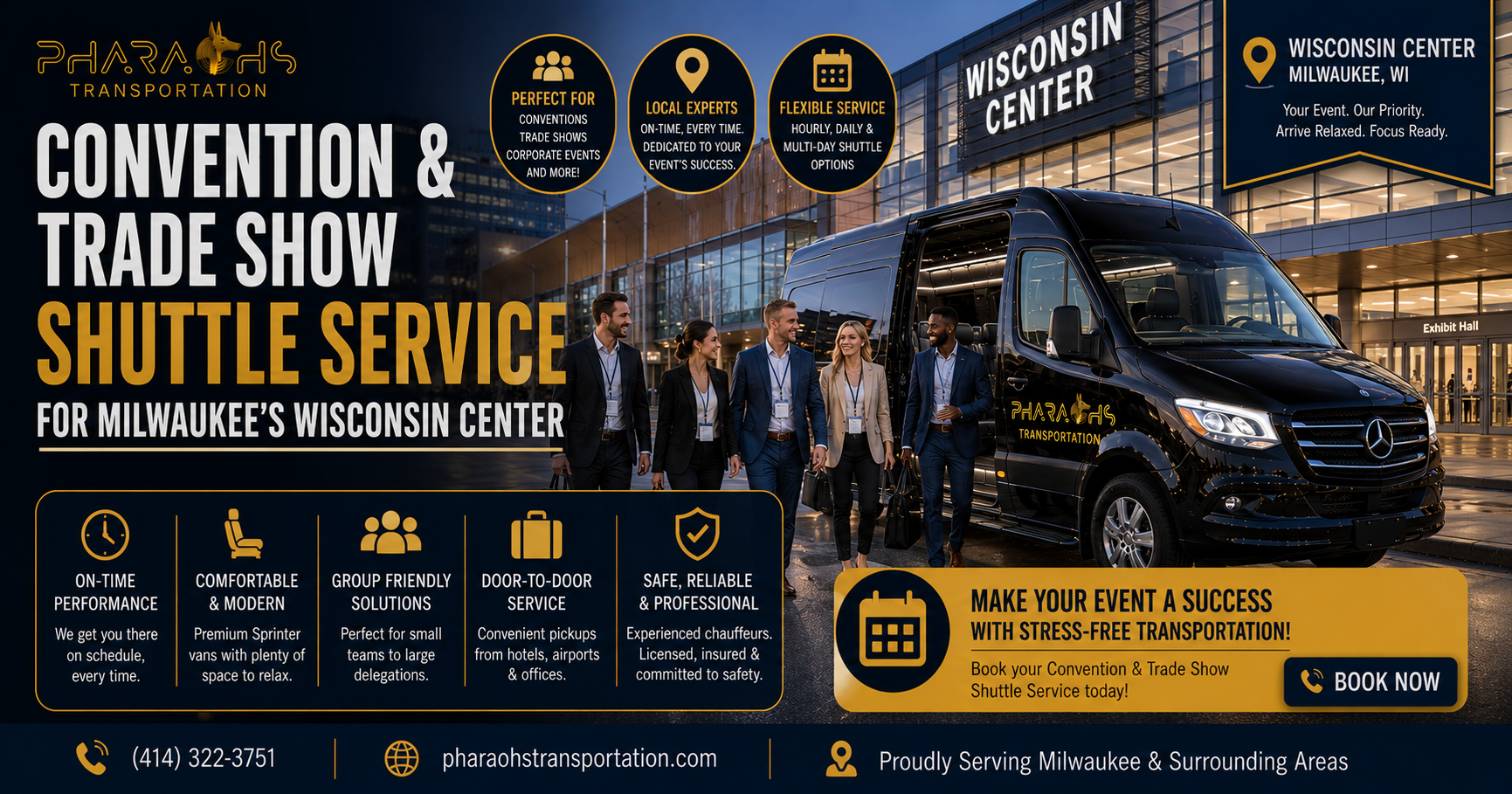
A typical Wisconsin Center shuttle loop runs a 15-passenger Mercedes-Benz Sprinter between two or three downtown convention hotels — usually the Hyatt Regency Milwaukee, Hilton Milwaukee City Center, or The Pfister Hotel — and the Wisconsin Center’s West Wisconsin Avenue entrance, on a 20–30 minute rotation timed to session breaks. For groups under 14, one Sprinter covers the loop; for general sessions with 200+ attendees checking out at once, planners typically add a second van or stagger checkout times across a 45-minute morning window. Multi-day bookings are quoted as a flat daily rate rather than per-ride, and the same vehicle and chauffeur stay assigned for the full event so drivers already know your badge-pickup routine, your exhibitor’s crate schedule, and which loading dock door to use by day two.

If you’re the person responsible for getting 40, 150, or 800 people from a hotel block to a keynote on time — without a rideshare app in the mix — this guide walks through how a dedicated Sprinter shuttle actually works for a Wisconsin Center event, from the first planning call to the last exhibitor pickup.

Wisconsin Center itself is a 189,000-square-foot convention facility in the heart of downtown Milwaukee, connected by skywalk to several nearby hotels and within a short drive of the rest of the downtown hotel corridor. That layout is exactly why shuttle planning for this venue looks different from shuttle planning for a suburban conference center surrounded by a single hotel campus: your attendees are spread across a real downtown grid, dealing with real downtown traffic patterns, parking restrictions, and — depending on the season — genuine Wisconsin weather. A shuttle plan that ignores any of those three factors tends to fall apart by day two of a multi-day event.

Why Event Planners Book a Dedicated Sprinter Over Rideshare Codes

Rideshare codes look simple on a budget spreadsheet — hand out a promo code, let attendees expense their own rides, done. In practice, they create three problems that show up during the event itself, not during planning.

Surge pricing during peak load-out:

Wisconsin Center sessions tend to break in clusters — everyone leaves the general session hall within the same eight-minute window. That’s exactly when rideshare apps in downtown Milwaukee spike pricing, and it’s the moment your attendees are standing on West Wisconsin Avenue in January watching their phone screen instead of getting to the next session or back to their hotel.

No accountability for no-shows or driver behavior:

With a rideshare code, if a driver cancels, takes a wrong route, or simply doesn’t show, there’s no one on your event team to call. A Sprinter charter comes with a dispatch line and a chauffeur who is contracted for your event dates specifically — if something goes sideways, you have a phone number that answers.

Splintered groups:

Rideshare sends attendees off in ones and twos, in different cars, at different times. A dedicated shuttle keeps your group moving together — useful when you’re trying to get a delegation, a speaker panel, or an exhibitor team to the same place at the same time without a headcount problem at the door.

The trade-off planners weigh here isn’t really cost — a shared Sprinter loop is often cheaper per head than a fleet of individual rideshare trips once you account for surge pricing and no-show gaps. It’s control: a Sprinter loop is a scheduled, contracted service that runs on your event’s clock, not an app’s supply-and-demand algorithm. For groups running a corporate account across multiple events per year, that predictability is also what makes budgeting easier — see the corporate account section below.

There’s also a weather factor that’s easy to underestimate until you’ve run a January conference in Milwaukee. Wisconsin Center’s downtown location means attendees walking between hotel and venue are exposed to lake-effect wind funneling through the Wisconsin Avenue corridor, and rideshare demand — and pricing — spikes hardest exactly when conditions are worst, because that’s when everyone who might otherwise walk decides not to. A contracted shuttle doesn’t care what the weather is doing; the van runs on the schedule regardless of whether it’s 15 degrees or humid and 90.

Finally, there’s the badge and registration angle. Many convention organizers coordinate shuttle pickup with their registration desk — announcing loop times at check-in, posting them in the mobile event app, or having concierge staff at each hotel confirm pickup windows. That kind of coordination is only possible with a scheduled shuttle service; a rideshare code can’t be built into a printed agenda the same way, because there’s no fixed departure time to print.

Related Guides: Per-Person Cost of Group Rides in Milwaukee

Hotel-to-Venue Shuttle Loop Logistics (Downtown Convention Hotels)

Wisconsin Center sits at 400 W Wisconsin Avenue, right in the middle of downtown Milwaukee‘s convention hotel cluster. Most of the properties event blocks land in are a five- to ten-minute drive — sometimes closer to a 10-minute walk in decent weather, but not in a January trade show or a July heat wave with a rolling exhibitor case in tow.

The hotels planners most often loop include:

  • Hyatt Regency Milwaukee (333 W Kilbourn Ave) — about six blocks northwest of the Wisconsin Center, a common headquarters hotel for larger conventions given its skywalk-adjacent downtown position.
  • Hilton Milwaukee City Center (509 W Wisconsin Ave) — directly across from the venue’s west entrance, sometimes close enough to skip a shuttle loop entirely, though groups still book a van for luggage-heavy move-in and move-out days.
  • The Pfister Hotel (424 E Wisconsin Ave) — on the opposite side of downtown, closer to the lakefront, which makes it one of the longer loop legs at roughly 12–15 minutes depending on traffic through the Wisconsin Avenue corridor.
  • InterContinental Milwaukee and Saint Kate — The Arts Hotel — both mid-distance options that frequently show up in secondary hotel blocks for overflow attendees and staff.

A standard loop setup looks like this: the Sprinter picks up at the headquarters hotel’s main entrance, makes one or two additional hotel stops if the block is split across properties, then drops at the Wisconsin Center’s designated shuttle zone — typically the West Wisconsin Avenue entrance rather than the Kilbourn side, since that’s where event staff usually stage badge check-in for shuttle arrivals. The return loop runs the same stops in reverse, timed to session end.

For a single hotel block under 15 people, one Sprinter running a continuous 20-minute loop from 7:00 AM through the first morning session, then again at lunch and end-of-day, usually covers it without gaps. Once you’re running multiple hotels or an attendee count that exceeds one van’s capacity per pickup wave, planners generally move to one of two models:

  1. Two vans on staggered loops — one covers the two nearest hotels, the second covers the farther property, both converging on the venue drop point around the same arrival window.
  2. One larger loop with tighter frequency — a single Sprinter running every 15 minutes instead of 20, accepting a slightly longer wait for guests at the last pickup stop.

Which model fits depends on your registration data — specifically, how attendees are actually distributed across the hotel block, not just how rooms were originally allotted. This is worth pulling from your hotel rooming list before locking a shuttle plan, since blocks often skew heavier toward one property than the contract suggests.

A quick reference for planners mapping out the downtown convention hotel zone:

HotelApprox. distance to Wisconsin CenterTypical loop role
Hilton Milwaukee City CenterAcross the streetOften walkable; still shuttled during move-in/out or bad weather
Hyatt Regency Milwaukee~6 blocks / 5–7 min driveCommon headquarters hotel, first loop stop
InterContinental Milwaukee~5–8 min driveMid-distance secondary stop
Saint Kate — The Arts Hotel~5–8 min driveCommon for overflow attendee blocks
The Pfister Hotel~10–15 min driveLongest standard loop leg, lakefront side of downtown

Traffic through the Wisconsin Avenue corridor is the variable that most affects loop timing — rush-hour flow between 7:30–8:30 AM and evening events letting out downstream can add several minutes to a leg that runs quickly midday. Chauffeurs familiar with downtown Milwaukee route around known congestion points (construction on Wisconsin Avenue itself is worth flagging to your provider ahead of the event if it’s active during your dates), but it’s still worth building a small time buffer into the first-session pickup rather than cutting it exactly to the printed agenda start time.

Weather is the other planning variable specific to a downtown Milwaukee venue. Winter conventions should assume slower loop times due to snow-affected surface streets even when the interstate is clear, and summer festival season (Bastille Days, Mexican Fiesta, and similar downtown events) can add road closures near the lakefront hotels that don’t show up on a map until the week of your event. A provider that runs Milwaukee routes daily will typically already know about closures like these; it’s a fair question to ask on your planning call regardless of the season.

Related Guides: Sprinter Limo Cost Milwaukee Pricing Guide

Multi-Day Recurring Booking for Exhibitors & Speakers

Trade shows and conferences at Wisconsin Center rarely run a single day. Move-in for exhibitors often starts a full day before doors open to attendees, general sessions run two or three days, and teardown adds another day on the back end. That’s a different transportation problem than a one-day meeting shuttle, because you’re coordinating around three separate schedules that don’t overlap:

  • Exhibitor move-in/move-out — early morning and late evening runs, often carrying equipment, not just people.
  • Speaker and VIP transport — smaller group, tighter timing, usually needs to arrive ahead of general attendees for green room or tech check.
  • General attendee loop — the highest-volume, most schedule-sensitive segment, running on session breaks.

A recurring multi-day booking means the same Sprinter and the same chauffeur are assigned across the full event window rather than a fresh vehicle dispatched each day. That continuity matters more than it sounds like it would on paper. By day two, a chauffeur who’s run the same loop already knows which hotel doorman to coordinate with, which Wisconsin Center entrance has the shortest curb wait, and roughly what time your keynote actually lets out versus what the printed agenda says. Planners who’ve run the same event in prior years often specifically request the same driver again for that reason.

Pricing for multi-day bookings is typically structured as a flat daily or event-block rate rather than per-trip billing, which makes budget approval simpler — one line item covers the full event window instead of a running tally of individual rides. If your event straddles a weekend or has an unusually long move-in window, it’s worth flagging that upfront so the quote reflects the actual number of active shuttle days rather than a default three- or four-day assumption.

For speakers and VIP guests specifically, some planners choose to separate that transportation from the general attendee loop entirely — a smaller vehicle or a point-to-point arrangement rather than a shared shuttle, so a keynote speaker isn’t waiting in a loop with 12 other passengers ten minutes before they’re due backstage. This can run alongside the main Sprinter loop as a parallel booking; it’s a conversation worth having during the initial planning call rather than an add-on decided the week of the event.

A sample four-day event structure, based on how most Wisconsin Center conventions actually run, illustrates how the schedule typically breaks down:

  • Day 0 (move-in): Exhibitor and staff transport only, early morning through evening, timed to the venue’s posted move-in window rather than any session schedule.
  • Day 1 (opening day): Speaker/VIP transport starts ahead of the general loop; general attendee loop begins roughly 45–60 minutes before the first keynote and continues on session breaks through the evening reception.
  • Day 2–3 (general sessions): Standard loop frequency, typically every 20–30 minutes during breaks, with the vehicle otherwise available for ad hoc requests — a speaker needing to get to a media interview, a staff member running supplies between hotel and venue.
  • Day 4 (teardown): Reverse of move-in — exhibitor and staff transport only, often running later into the evening than the general loop ever did, since teardown regularly runs past the official show-close time.

Booking across this full window as one recurring reservation, rather than four separate single-day bookings, is what lets a provider hold the same vehicle and driver for you rather than reassigning day to day based on whoever happens to be free.
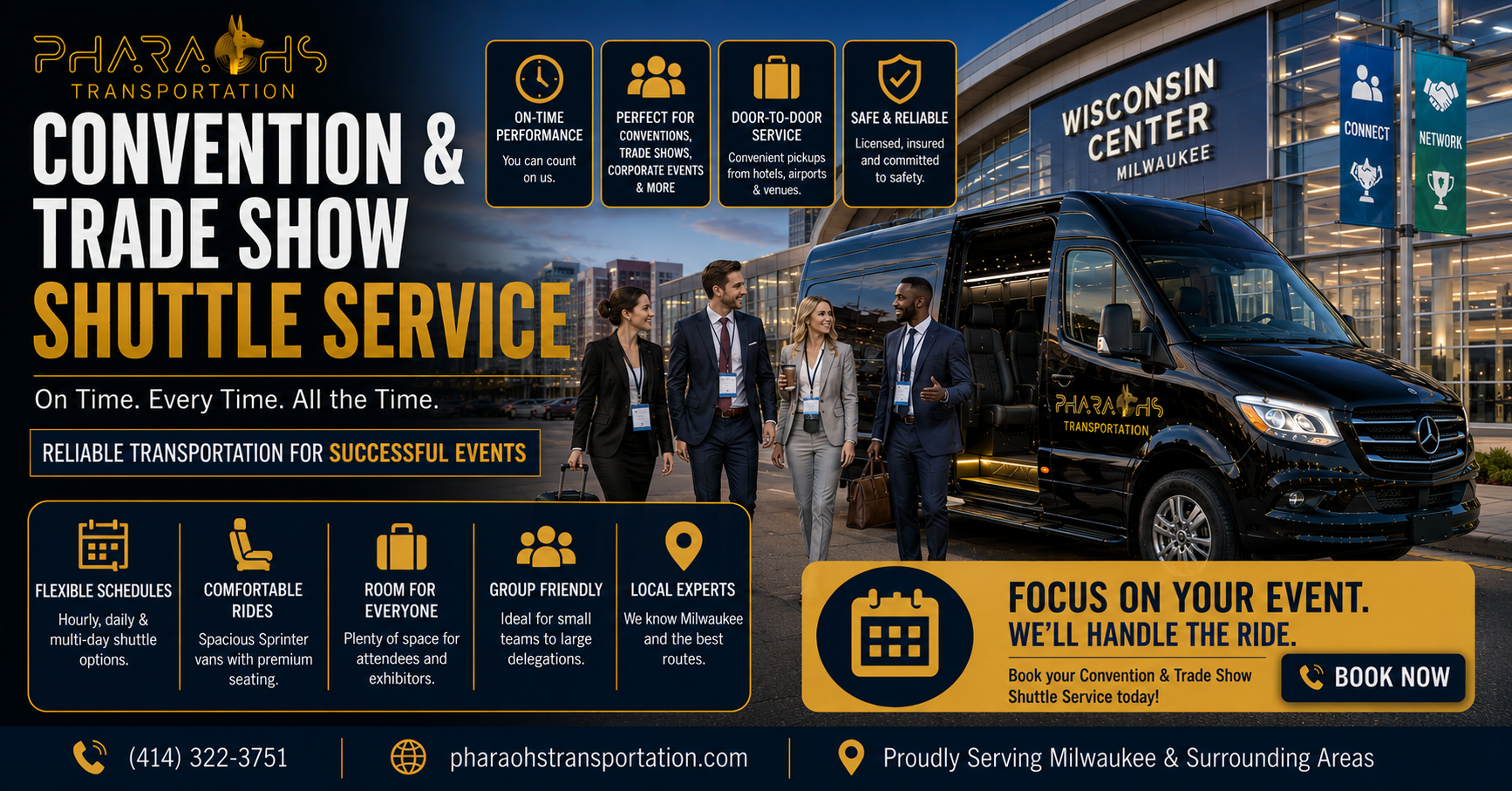
Wisconsin Center Convention Shuttle Sprinter


Exhibit Material & Equipment Transport Considerations

This is the part of shuttle planning that general meeting transportation guides tend to skip, and it’s usually where exhibitor logistics actually go wrong: exhibit booths come with freight, and freight doesn’t fit in a sedan.

A 15-passenger Sprinter has real cargo capacity when seats are folded or reduced — enough for pop-up booth frames, banner stands, product sample cases, and the rolling crates most exhibitors travel with. But there’s a practical limit, and it’s worth planners knowing where that limit sits before assuming a shuttle can double as a freight run:

  • What fits comfortably: pop-up displays, rollable banner stands, sample cases, laptop bags, small marketing collateral boxes, personal luggage for move-in/move-out days.
  • What typically doesn’t: pallet-loaded freight, large custom booth structures, anything requiring a dolly or two people to lift — this is what Wisconsin Center’s official freight/drayage contractor and loading dock process are built to handle, and it’s usually more efficient (and often contractually required by the venue) to route it through that system rather than a passenger shuttle.

The practical split most experienced exhibitors use: freight and heavy booth materials go through the venue’s dock and drayage process on the official move-in schedule, while the exhibit staff themselves — along with their carry-on-sized equipment — ride the Sprinter loop. Trying to combine both on the same trip usually just slows down a passenger loop that other attendees are also relying on.

If your event includes a significant number of exhibitors with equipment needs, it’s worth a short conversation with your transportation provider about a dedicated early-morning or late-evening run specifically for exhibit staff carrying gear, separate from the general attendee loop — timed around the Wisconsin Center’s posted move-in/move-out windows rather than the conference session schedule.

A short planning checklist for exhibitor transport specifically:

  • Confirm your official freight/drayage contractor and loading dock process directly with Wisconsin Center’s event services team — this is separate from any passenger shuttle arrangement and should be locked in first.
  • Ask your exhibitors to flag, during registration, whether they’re bringing equipment beyond what fits in a single rolling case — this helps you size the right number of vans for move-in day rather than guessing.
  • Build a slightly wider time buffer into move-in and teardown loops than you would for the general attendee schedule; equipment loading takes longer per stop than passengers simply boarding.
  • If your exhibit hall has multiple entrances, confirm with the venue which one is appropriate for shuttle drop-off versus which is reserved for freight vehicles — these are usually different doors, and mixing them up on move-in morning creates a bottleneck fast.

Booking a Corporate Account for Annual Conventions

If your organization runs the same convention, trade show, or annual meeting at Wisconsin Center year after year — or runs multiple different events there across a year — a standing corporate account generally makes more sense than re-quoting transportation from scratch each time.

A corporate account for recurring event transportation typically includes:

  • A standing quote template based on your typical hotel block and attendee count, so planning starts from a known baseline instead of a blank estimate every year.
  • Priority scheduling during Milwaukee’s busier convention calendar windows, when Sprinter availability across the city tightens up.
  • Consolidated invoicing — one bill per event or per quarter instead of piecing together individual ride receipts, which is usually what finance teams actually want when reconciling event spend.
  • A single point of contact who already has your event’s shuttle history on file, rather than re-explaining hotel stops and loading procedures to a new coordinator each time.

This setup tends to make the most sense for event planning firms managing multiple client conventions, associations running an annual meeting at Wisconsin Center on a fixed calendar, and companies that treat trade show attendance as a recurring line item rather than a one-off. If your organization also books transportation for other Milwaukee events — airport transfers for out-of-town speakers, an hourly charter for a client dinner the night before, or a ride to a game or show for attendees staying an extra night — a corporate account folds those into the same relationship instead of separate one-off bookings.

For event planning agencies, venues, and hotel concierge teams that regularly refer transportation needs, it’s also worth looking at partnering directly rather than booking per-event — a referral or affiliate arrangement can be a better fit than a standard corporate account depending on how often you’re placing bookings on behalf of clients.

Related Guides: MKE Mitchell Airport Terminal Pickup Guide

What to bring to your first corporate account planning call:

  • Your typical hotel block size and property list, or last year’s rooming list if this is a repeat event.
  • Your general session schedule template — even a rough draft helps size loop frequency correctly.
  • An estimate of exhibitor headcount separate from general attendees, since that affects move-in/teardown planning.
  • Whether speaker or VIP transport needs to be handled separately from the general loop.
  • Any other Milwaukee transportation your event or organization regularly books — airport pickups for out-of-town presenters, an evening hourly charter for a sponsor dinner, or transportation to a Milwaukee event or game for attendees staying the extra night — so it can be folded into one account rather than booked separately each time.

Having these details ready turns the first call into an actual quote rather than a round of follow-up questions, which matters if your event is on a tight planning timeline.

Frequently Asked Questions

How far in advance should I book a Wisconsin Center shuttle service?

For events under 20 attendees, two to three weeks’ notice is usually enough to lock a Sprinter and confirm the loop schedule. For larger conventions or events falling during Milwaukee’s peak convention season, four to six weeks ahead gives more room to secure multiple vehicles and avoid scheduling conflicts with other events booked the same week.

How many people fit in one Sprinter shuttle loop?

A single Mercedes-Benz Sprinter seats up to 15 passengers, including the driver. For attendee counts beyond that per pickup wave, planners typically add a second van running a parallel or staggered loop rather than trying to compress everyone into fewer, larger trips.

Can the shuttle handle both hotel pickups and airport transfers for out-of-town attendees?

Yes — these are usually booked as separate line items since airport transfers run on individual flight schedules rather than the fixed session-break timing of the convention loop, but both can run under the same event booking and corporate account.

Does the shuttle service coordinate directly with Wisconsin Center’s loading dock and drayage process?

The passenger shuttle handles people and carry-sized materials; large exhibit freight goes through Wisconsin Center’s own dock and drayage contractor, which is a separate process by design. Your driver can time exhibit staff drop-offs around your event’s move-in window, but freight itself should route through the venue’s official process.

What happens if a general session runs long and the shuttle pickup window shifts?

Because the vehicle and chauffeur are contracted for your event dates rather than dispatched per ride, the loop schedule can flex with the actual session timing rather than a fixed clock — this is one of the practical advantages over individually booked rideshare trips, which don’t adjust for a keynote that runs 20 minutes over.

Is a Sprinter shuttle more cost-effective than distributing rideshare codes to attendees?

For groups of 10 or more making regular trips between the same two or three points, a flat-rate Sprinter loop is generally more predictable and often less expensive per person than rideshare, especially once surge pricing during peak session breaks is factored in. For very small groups making occasional one-off trips, rideshare or a point-to-point booking can sometimes make more sense — it depends on your actual trip volume.

Can we book the same driver and vehicle for the entire multi-day event?

Yes, and it’s the standard setup for multi-day convention bookings — the same chauffeur stays assigned across move-in, general sessions, and teardown so they’re already familiar with your hotel stops, venue entrance, and daily rhythm by the second day.

Ready to Plan Your Wisconsin Center Shuttle

Whether you’re coordinating a 40-person delegation or an 800-attendee trade show with a multi-hotel block, a dedicated Sprinter loop keeps your group moving on your event’s actual schedule — not an app’s. Explore the full Sprinter Van & Limousine Service for vehicle specs and group options, set up a corporate account for recurring annual events, or partner with us if you’re a planning agency or venue team booking transportation on behalf of clients.

Call or text (414) 322-3751 to talk through your hotel block and session schedule, or reserve online to get your Wisconsin Center convention shuttle on the calendar.

Other Milwaukee Transportation Event Planners Book Alongside a Convention Shuttle

A Wisconsin Center shuttle loop rarely covers everything a multi-day event needs on its own. Planners running conventions and trade shows in downtown Milwaukee typically end up booking a few related services in the same window:

  • Airport transportation for keynote speakers, exhibitors, and out-of-town attendees flying into Milwaukee Mitchell International Airport (MKE), with flight tracking so a delayed inbound flight doesn’t leave a speaker stranded curbside.
  • Executive limo service for board members or VIP guests who need a private vehicle rather than the shared shuttle loop, particularly for a keynote arriving separately from the general attendee group.
  • Hourly limo rental for an evening sponsor dinner, an offsite networking event, or a driver held on standby for a busy day with unpredictable timing.
  • Point-to-point transportation for one-off trips that don’t fit the standing loop schedule — a last-minute supply run, a single attendee arriving off-cycle, or a media interview across town.
  • Concert and game transportation if your event includes an evening at Fiserv Forum, American Family Field, or another downtown venue as part of the program.

Booking these alongside your Wisconsin Center shuttle under a single corporate account means one point of contact, one consolidated invoice, and a dispatch team that already has your full event on file — rather than juggling separate vendors for each piece of ground transportation.


Avada Car Dealer News

A typical Wisconsin Center shuttle loop runs a 15-passenger Mercedes-Benz Sprinter between two or three downtown convention hotels — usually the Hyatt Regency Milwaukee, Hilton Milwaukee City Center, or The Pfister Hotel — and the Wisconsin Center’s West Wisconsin Avenue entrance, on a 20–30 minute rotation timed to session breaks. For groups under 14, one Sprinter covers the loop; for general sessions with 200+ attendees checking out at once, planners typically add a second van or stagger checkout times across a 45-minute morning window. Multi-day bookings are quoted as a flat daily rate rather than per-ride, and the same vehicle and chauffeur stay assigned for the full event so drivers already know your badge-pickup routine, your exhibitor’s crate schedule, and which loading dock door to use by day two.

If you’re the person responsible for getting 40, 150, or 800 people from a hotel block to a keynote on time — without a rideshare app in the mix — this guide walks through how a dedicated Sprinter shuttle actually works for a Wisconsin Center event, from the first planning call to the last exhibitor pickup.

Wisconsin Center itself is a 189,000-square-foot convention facility in the heart of downtown Milwaukee, connected by skywalk to several nearby hotels and within a short drive of the rest of the downtown hotel corridor. That layout is exactly why shuttle planning for this venue looks different from shuttle planning for a suburban conference center surrounded by a single hotel campus: your attendees are spread across a real downtown grid, dealing with real downtown traffic patterns, parking restrictions, and — depending on the season — genuine Wisconsin weather. A shuttle plan that ignores any of those three factors tends to fall apart by day two of a multi-day event.

Why Event Planners Book a Dedicated Sprinter Over Rideshare Codes

Rideshare codes look simple on a budget spreadsheet — hand out a promo code, let attendees expense their own rides, done. In practice, they create three problems that show up during the event itself, not during planning.

Surge pricing during peak load-out:

Wisconsin Center sessions tend to break in clusters — everyone leaves the general session hall within the same eight-minute window. That’s exactly when rideshare apps in downtown Milwaukee spike pricing, and it’s the moment your attendees are standing on West Wisconsin Avenue in January watching their phone screen instead of getting to the next session or back to their hotel.

No accountability for no-shows or driver behavior:

With a rideshare code, if a driver cancels, takes a wrong route, or simply doesn’t show, there’s no one on your event team to call. A Sprinter charter comes with a dispatch line and a chauffeur who is contracted for your event dates specifically — if something goes sideways, you have a phone number that answers.

Splintered groups:

Rideshare sends attendees off in ones and twos, in different cars, at different times. A dedicated shuttle keeps your group moving together — useful when you’re trying to get a delegation, a speaker panel, or an exhibitor team to the same place at the same time without a headcount problem at the door.

The trade-off planners weigh here isn’t really cost — a shared Sprinter loop is often cheaper per head than a fleet of individual rideshare trips once you account for surge pricing and no-show gaps. It’s control: a Sprinter loop is a scheduled, contracted service that runs on your event’s clock, not an app’s supply-and-demand algorithm. For groups running a corporate account across multiple events per year, that predictability is also what makes budgeting easier — see the corporate account section below.

There’s also a weather factor that’s easy to underestimate until you’ve run a January conference in Milwaukee. Wisconsin Center’s downtown location means attendees walking between hotel and venue are exposed to lake-effect wind funneling through the Wisconsin Avenue corridor, and rideshare demand — and pricing — spikes hardest exactly when conditions are worst, because that’s when everyone who might otherwise walk decides not to. A contracted shuttle doesn’t care what the weather is doing; the van runs on the schedule regardless of whether it’s 15 degrees or humid and 90.

Finally, there’s the badge and registration angle. Many convention organizers coordinate shuttle pickup with their registration desk — announcing loop times at check-in, posting them in the mobile event app, or having concierge staff at each hotel confirm pickup windows. That kind of coordination is only possible with a scheduled shuttle service; a rideshare code can’t be built into a printed agenda the same way, because there’s no fixed departure time to print.

Related Guides: Per-Person Cost of Group Rides in Milwaukee

Hotel-to-Venue Shuttle Loop Logistics (Downtown Convention Hotels)

Wisconsin Center sits at 400 W Wisconsin Avenue, right in the middle of downtown Milwaukee‘s convention hotel cluster. Most of the properties event blocks land in are a five- to ten-minute drive — sometimes closer to a 10-minute walk in decent weather, but not in a January trade show or a July heat wave with a rolling exhibitor case in tow.

The hotels planners most often loop include:

  • Hyatt Regency Milwaukee (333 W Kilbourn Ave) — about six blocks northwest of the Wisconsin Center, a common headquarters hotel for larger conventions given its skywalk-adjacent downtown position.
  • Hilton Milwaukee City Center (509 W Wisconsin Ave) — directly across from the venue’s west entrance, sometimes close enough to skip a shuttle loop entirely, though groups still book a van for luggage-heavy move-in and move-out days.
  • The Pfister Hotel (424 E Wisconsin Ave) — on the opposite side of downtown, closer to the lakefront, which makes it one of the longer loop legs at roughly 12–15 minutes depending on traffic through the Wisconsin Avenue corridor.
  • InterContinental Milwaukee and Saint Kate — The Arts Hotel — both mid-distance options that frequently show up in secondary hotel blocks for overflow attendees and staff.

A standard loop setup looks like this: the Sprinter picks up at the headquarters hotel’s main entrance, makes one or two additional hotel stops if the block is split across properties, then drops at the Wisconsin Center’s designated shuttle zone — typically the West Wisconsin Avenue entrance rather than the Kilbourn side, since that’s where event staff usually stage badge check-in for shuttle arrivals. The return loop runs the same stops in reverse, timed to session end.

For a single hotel block under 15 people, one Sprinter running a continuous 20-minute loop from 7:00 AM through the first morning session, then again at lunch and end-of-day, usually covers it without gaps. Once you’re running multiple hotels or an attendee count that exceeds one van’s capacity per pickup wave, planners generally move to one of two models:

  1. Two vans on staggered loops — one covers the two nearest hotels, the second covers the farther property, both converging on the venue drop point around the same arrival window.
  2. One larger loop with tighter frequency — a single Sprinter running every 15 minutes instead of 20, accepting a slightly longer wait for guests at the last pickup stop.

Which model fits depends on your registration data — specifically, how attendees are actually distributed across the hotel block, not just how rooms were originally allotted. This is worth pulling from your hotel rooming list before locking a shuttle plan, since blocks often skew heavier toward one property than the contract suggests.

A quick reference for planners mapping out the downtown convention hotel zone:

HotelApprox. distance to Wisconsin CenterTypical loop role
Hilton Milwaukee City CenterAcross the streetOften walkable; still shuttled during move-in/out or bad weather
Hyatt Regency Milwaukee~6 blocks / 5–7 min driveCommon headquarters hotel, first loop stop
InterContinental Milwaukee~5–8 min driveMid-distance secondary stop
Saint Kate — The Arts Hotel~5–8 min driveCommon for overflow attendee blocks
The Pfister Hotel~10–15 min driveLongest standard loop leg, lakefront side of downtown

Traffic through the Wisconsin Avenue corridor is the variable that most affects loop timing — rush-hour flow between 7:30–8:30 AM and evening events letting out downstream can add several minutes to a leg that runs quickly midday. Chauffeurs familiar with downtown Milwaukee route around known congestion points (construction on Wisconsin Avenue itself is worth flagging to your provider ahead of the event if it’s active during your dates), but it’s still worth building a small time buffer into the first-session pickup rather than cutting it exactly to the printed agenda start time.

Weather is the other planning variable specific to a downtown Milwaukee venue. Winter conventions should assume slower loop times due to snow-affected surface streets even when the interstate is clear, and summer festival season (Bastille Days, Mexican Fiesta, and similar downtown events) can add road closures near the lakefront hotels that don’t show up on a map until the week of your event. A provider that runs Milwaukee routes daily will typically already know about closures like these; it’s a fair question to ask on your planning call regardless of the season.

Related Guides: Sprinter Limo Cost Milwaukee Pricing Guide

Multi-Day Recurring Booking for Exhibitors & Speakers

Trade shows and conferences at Wisconsin Center rarely run a single day. Move-in for exhibitors often starts a full day before doors open to attendees, general sessions run two or three days, and teardown adds another day on the back end. That’s a different transportation problem than a one-day meeting shuttle, because you’re coordinating around three separate schedules that don’t overlap:

  • Exhibitor move-in/move-out — early morning and late evening runs, often carrying equipment, not just people.
  • Speaker and VIP transport — smaller group, tighter timing, usually needs to arrive ahead of general attendees for green room or tech check.
  • General attendee loop — the highest-volume, most schedule-sensitive segment, running on session breaks.

A recurring multi-day booking means the same Sprinter and the same chauffeur are assigned across the full event window rather than a fresh vehicle dispatched each day. That continuity matters more than it sounds like it would on paper. By day two, a chauffeur who’s run the same loop already knows which hotel doorman to coordinate with, which Wisconsin Center entrance has the shortest curb wait, and roughly what time your keynote actually lets out versus what the printed agenda says. Planners who’ve run the same event in prior years often specifically request the same driver again for that reason.

Pricing for multi-day bookings is typically structured as a flat daily or event-block rate rather than per-trip billing, which makes budget approval simpler — one line item covers the full event window instead of a running tally of individual rides. If your event straddles a weekend or has an unusually long move-in window, it’s worth flagging that upfront so the quote reflects the actual number of active shuttle days rather than a default three- or four-day assumption.

For speakers and VIP guests specifically, some planners choose to separate that transportation from the general attendee loop entirely — a smaller vehicle or a point-to-point arrangement rather than a shared shuttle, so a keynote speaker isn’t waiting in a loop with 12 other passengers ten minutes before they’re due backstage. This can run alongside the main Sprinter loop as a parallel booking; it’s a conversation worth having during the initial planning call rather than an add-on decided the week of the event.

A sample four-day event structure, based on how most Wisconsin Center conventions actually run, illustrates how the schedule typically breaks down:

  • Day 0 (move-in): Exhibitor and staff transport only, early morning through evening, timed to the venue’s posted move-in window rather than any session schedule.
  • Day 1 (opening day): Speaker/VIP transport starts ahead of the general loop; general attendee loop begins roughly 45–60 minutes before the first keynote and continues on session breaks through the evening reception.
  • Day 2–3 (general sessions): Standard loop frequency, typically every 20–30 minutes during breaks, with the vehicle otherwise available for ad hoc requests — a speaker needing to get to a media interview, a staff member running supplies between hotel and venue.
  • Day 4 (teardown): Reverse of move-in — exhibitor and staff transport only, often running later into the evening than the general loop ever did, since teardown regularly runs past the official show-close time.

Booking across this full window as one recurring reservation, rather than four separate single-day bookings, is what lets a provider hold the same vehicle and driver for you rather than reassigning day to day based on whoever happens to be free.

Wisconsin Center Convention Shuttle Sprinter


Exhibit Material & Equipment Transport Considerations

This is the part of shuttle planning that general meeting transportation guides tend to skip, and it’s usually where exhibitor logistics actually go wrong: exhibit booths come with freight, and freight doesn’t fit in a sedan.

A 15-passenger Sprinter has real cargo capacity when seats are folded or reduced — enough for pop-up booth frames, banner stands, product sample cases, and the rolling crates most exhibitors travel with. But there’s a practical limit, and it’s worth planners knowing where that limit sits before assuming a shuttle can double as a freight run:

  • What fits comfortably: pop-up displays, rollable banner stands, sample cases, laptop bags, small marketing collateral boxes, personal luggage for move-in/move-out days.
  • What typically doesn’t: pallet-loaded freight, large custom booth structures, anything requiring a dolly or two people to lift — this is what Wisconsin Center’s official freight/drayage contractor and loading dock process are built to handle, and it’s usually more efficient (and often contractually required by the venue) to route it through that system rather than a passenger shuttle.

The practical split most experienced exhibitors use: freight and heavy booth materials go through the venue’s dock and drayage process on the official move-in schedule, while the exhibit staff themselves — along with their carry-on-sized equipment — ride the Sprinter loop. Trying to combine both on the same trip usually just slows down a passenger loop that other attendees are also relying on.

If your event includes a significant number of exhibitors with equipment needs, it’s worth a short conversation with your transportation provider about a dedicated early-morning or late-evening run specifically for exhibit staff carrying gear, separate from the general attendee loop — timed around the Wisconsin Center’s posted move-in/move-out windows rather than the conference session schedule.

A short planning checklist for exhibitor transport specifically:

  • Confirm your official freight/drayage contractor and loading dock process directly with Wisconsin Center’s event services team — this is separate from any passenger shuttle arrangement and should be locked in first.
  • Ask your exhibitors to flag, during registration, whether they’re bringing equipment beyond what fits in a single rolling case — this helps you size the right number of vans for move-in day rather than guessing.
  • Build a slightly wider time buffer into move-in and teardown loops than you would for the general attendee schedule; equipment loading takes longer per stop than passengers simply boarding.
  • If your exhibit hall has multiple entrances, confirm with the venue which one is appropriate for shuttle drop-off versus which is reserved for freight vehicles — these are usually different doors, and mixing them up on move-in morning creates a bottleneck fast.

Booking a Corporate Account for Annual Conventions

If your organization runs the same convention, trade show, or annual meeting at Wisconsin Center year after year — or runs multiple different events there across a year — a standing corporate account generally makes more sense than re-quoting transportation from scratch each time.

A corporate account for recurring event transportation typically includes:

  • A standing quote template based on your typical hotel block and attendee count, so planning starts from a known baseline instead of a blank estimate every year.
  • Priority scheduling during Milwaukee’s busier convention calendar windows, when Sprinter availability across the city tightens up.
  • Consolidated invoicing — one bill per event or per quarter instead of piecing together individual ride receipts, which is usually what finance teams actually want when reconciling event spend.
  • A single point of contact who already has your event’s shuttle history on file, rather than re-explaining hotel stops and loading procedures to a new coordinator each time.

This setup tends to make the most sense for event planning firms managing multiple client conventions, associations running an annual meeting at Wisconsin Center on a fixed calendar, and companies that treat trade show attendance as a recurring line item rather than a one-off. If your organization also books transportation for other Milwaukee events — airport transfers for out-of-town speakers, an hourly charter for a client dinner the night before, or a ride to a game or show for attendees staying an extra night — a corporate account folds those into the same relationship instead of separate one-off bookings.

For event planning agencies, venues, and hotel concierge teams that regularly refer transportation needs, it’s also worth looking at partnering directly rather than booking per-event — a referral or affiliate arrangement can be a better fit than a standard corporate account depending on how often you’re placing bookings on behalf of clients.

Related Guides: MKE Mitchell Airport Terminal Pickup Guide

What to bring to your first corporate account planning call:

  • Your typical hotel block size and property list, or last year’s rooming list if this is a repeat event.
  • Your general session schedule template — even a rough draft helps size loop frequency correctly.
  • An estimate of exhibitor headcount separate from general attendees, since that affects move-in/teardown planning.
  • Whether speaker or VIP transport needs to be handled separately from the general loop.
  • Any other Milwaukee transportation your event or organization regularly books — airport pickups for out-of-town presenters, an evening hourly charter for a sponsor dinner, or transportation to a Milwaukee event or game for attendees staying the extra night — so it can be folded into one account rather than booked separately each time.

Having these details ready turns the first call into an actual quote rather than a round of follow-up questions, which matters if your event is on a tight planning timeline.

Frequently Asked Questions

How far in advance should I book a Wisconsin Center shuttle service?

For events under 20 attendees, two to three weeks’ notice is usually enough to lock a Sprinter and confirm the loop schedule. For larger conventions or events falling during Milwaukee’s peak convention season, four to six weeks ahead gives more room to secure multiple vehicles and avoid scheduling conflicts with other events booked the same week.

How many people fit in one Sprinter shuttle loop?

A single Mercedes-Benz Sprinter seats up to 15 passengers, including the driver. For attendee counts beyond that per pickup wave, planners typically add a second van running a parallel or staggered loop rather than trying to compress everyone into fewer, larger trips.

Can the shuttle handle both hotel pickups and airport transfers for out-of-town attendees?

Yes — these are usually booked as separate line items since airport transfers run on individual flight schedules rather than the fixed session-break timing of the convention loop, but both can run under the same event booking and corporate account.

Does the shuttle service coordinate directly with Wisconsin Center’s loading dock and drayage process?

The passenger shuttle handles people and carry-sized materials; large exhibit freight goes through Wisconsin Center’s own dock and drayage contractor, which is a separate process by design. Your driver can time exhibit staff drop-offs around your event’s move-in window, but freight itself should route through the venue’s official process.

What happens if a general session runs long and the shuttle pickup window shifts?

Because the vehicle and chauffeur are contracted for your event dates rather than dispatched per ride, the loop schedule can flex with the actual session timing rather than a fixed clock — this is one of the practical advantages over individually booked rideshare trips, which don’t adjust for a keynote that runs 20 minutes over.

Is a Sprinter shuttle more cost-effective than distributing rideshare codes to attendees?

For groups of 10 or more making regular trips between the same two or three points, a flat-rate Sprinter loop is generally more predictable and often less expensive per person than rideshare, especially once surge pricing during peak session breaks is factored in. For very small groups making occasional one-off trips, rideshare or a point-to-point booking can sometimes make more sense — it depends on your actual trip volume.

Can we book the same driver and vehicle for the entire multi-day event?

Yes, and it’s the standard setup for multi-day convention bookings — the same chauffeur stays assigned across move-in, general sessions, and teardown so they’re already familiar with your hotel stops, venue entrance, and daily rhythm by the second day.

Ready to Plan Your Wisconsin Center Shuttle

Whether you’re coordinating a 40-person delegation or an 800-attendee trade show with a multi-hotel block, a dedicated Sprinter loop keeps your group moving on your event’s actual schedule — not an app’s. Explore the full Sprinter Van & Limousine Service for vehicle specs and group options, set up a corporate account for recurring annual events, or partner with us if you’re a planning agency or venue team booking transportation on behalf of clients.

Call or text (414) 322-3751 to talk through your hotel block and session schedule, or reserve online to get your Wisconsin Center convention shuttle on the calendar.

Other Milwaukee Transportation Event Planners Book Alongside a Convention Shuttle

A Wisconsin Center shuttle loop rarely covers everything a multi-day event needs on its own. Planners running conventions and trade shows in downtown Milwaukee typically end up booking a few related services in the same window:

  • Airport transportation for keynote speakers, exhibitors, and out-of-town attendees flying into Milwaukee Mitchell International Airport (MKE), with flight tracking so a delayed inbound flight doesn’t leave a speaker stranded curbside.
  • Executive limo service for board members or VIP guests who need a private vehicle rather than the shared shuttle loop, particularly for a keynote arriving separately from the general attendee group.
  • Hourly limo rental for an evening sponsor dinner, an offsite networking event, or a driver held on standby for a busy day with unpredictable timing.
  • Point-to-point transportation for one-off trips that don’t fit the standing loop schedule — a last-minute supply run, a single attendee arriving off-cycle, or a media interview across town.
  • Concert and game transportation if your event includes an evening at Fiserv Forum, American Family Field, or another downtown venue as part of the program.

Booking these alongside your Wisconsin Center shuttle under a single corporate account means one point of contact, one consolidated invoice, and a dispatch team that already has your full event on file — rather than juggling separate vendors for each piece of ground transportation.