
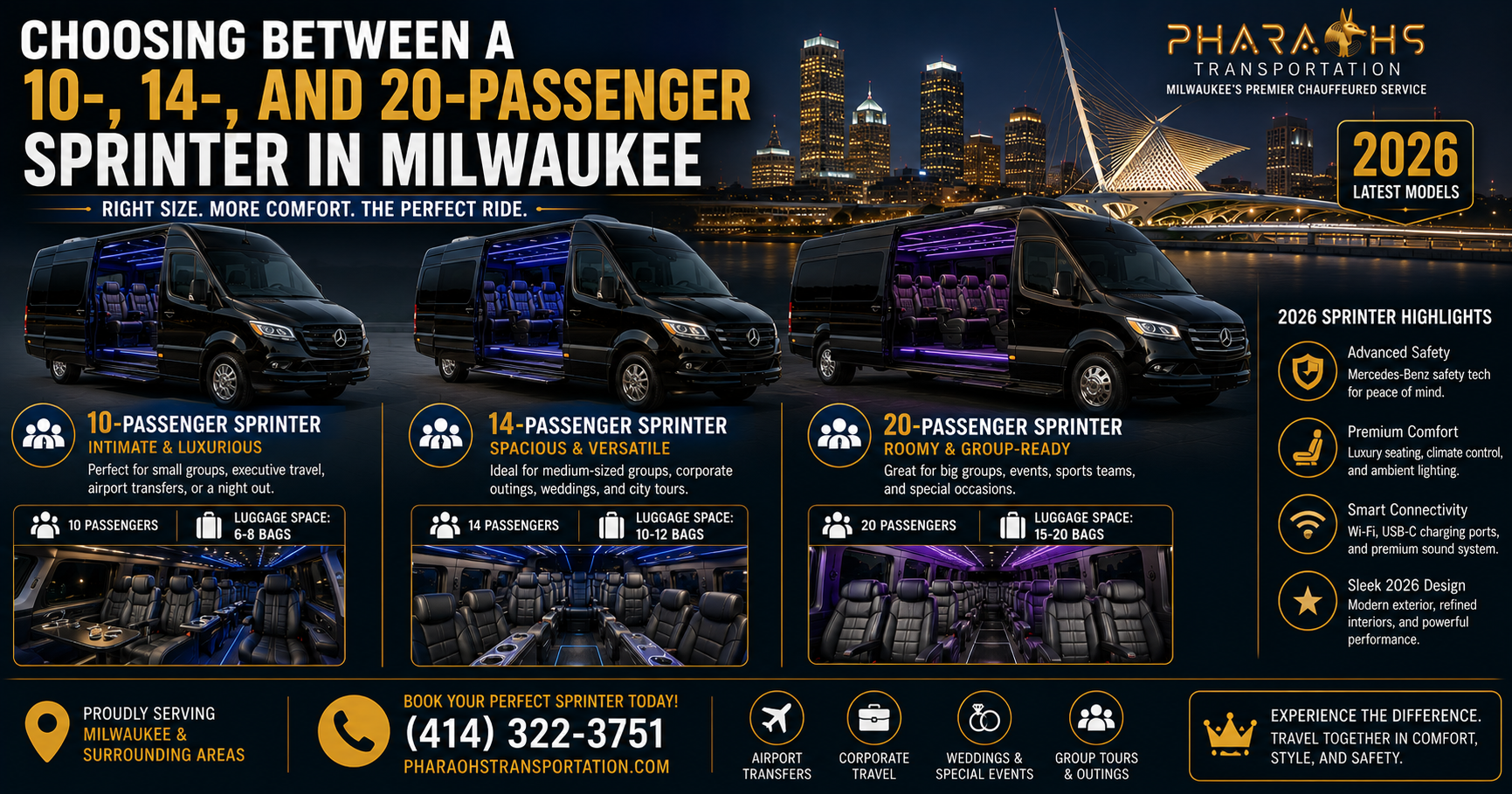
A 10-passenger Sprinter suits smaller groups working with a tighter budget. A 14- to 15-passenger Sprinter is the most commonly booked size for weddings, corporate transfers, and group events, offering the best balance of space and value. A 20+ passenger vehicle makes sense only for large groups, and in many fleets that capacity is handled by a stretch limo or party bus rather than a Sprinter chassis, so it’s worth confirming exact configuration and vehicle type with your provider before booking.
Booking a group vehicle sounds simple until you’re actually staring at a list of passenger counts and trying to figure out which one fits your group. Book too small, and you’re either leaving people behind or squeezing everyone in shoulder-to-shoulder. Book too large, and you’re paying for empty seats and wasted space. This guide walks through what actually changes between a 10-, 14-, and 20-passenger Sprinter — seating, legroom, luggage room, and price — plus which size tends to fit which kind of trip, so you can book with confidence instead of guessing.
Why Sprinter Size Actually Matters
Before getting into the comparison, it helps to understand why passenger count isn’t the only number that matters. Two vehicles both listed as “14-passenger” can feel completely different depending on the interior layout, seating configuration, and how much of that stated capacity is realistically comfortable versus technically possible.
Passenger ratings for group vehicles are often based on maximum seating — every seat filled, minimal legroom, bags stacked wherever they fit. That’s a fine number to know, but it’s not always the number that describes a comfortable ride for your specific group. A wedding party in formalwear, a corporate team bringing laptop bags, or a group headed to the airport with full luggage all need more real-world space than the passenger rating alone suggests. That’s why this guide breaks each size down by seating, legroom, and luggage — not just the headline passenger number — so you can match the vehicle to how your group will actually be using it.
It’s also worth noting that “10-passenger,” “14-passenger,” and “20-passenger” aren’t universal, standardized categories the way car classes are. Different operators build out their Sprinter and group vehicle fleets differently, so the same passenger count can mean a different actual interior from one company to the next. If you’re comparing sizes across a specific fleet — including Pharaoh’s Transportation’s own Sprinter limo lineup — the safest approach is always to confirm the exact seating and layout of the specific vehicle you’d be riding in, rather than assuming every “14-passenger” Sprinter is built the same way.
The Sprinter Chassis vs. Other Group Vehicles
It also helps to understand where the Sprinter category fits relative to other group vehicles you might be comparing it against. The Mercedes-Benz Sprinter (and similar vans from other manufacturers) is a commercial van chassis, which is exactly why it’s become the default choice for group limo conversions — it has more interior height and floor space than a stretched sedan, while staying easier to maneuver and park than a full-size motor coach or party bus. That combination is what makes the 10- to 14-passenger Sprinter range so popular: it comfortably covers the “too big for an SUV, too small to need a bus” gap that a huge share of group bookings actually fall into.
Once you move past roughly 15 passengers, most operators shift out of the Sprinter chassis entirely and into stretch limousines built on a larger vehicle platform, or dedicated party buses. Both of those categories can comfortably handle 20 or more passengers, but they come with a different ride experience — different seating style, different ceiling height, and often a different atmosphere geared more toward socializing than working or traveling with luggage. Knowing this distinction upfront helps set the right expectations when a fleet lists a “20-passenger” option: it’s worth asking exactly what vehicle type delivers that capacity.
Size Comparison Table (Seating, Legroom, Luggage)
Here’s a general breakdown of how these three size categories typically compare across the group transportation industry. Actual specs vary by operator and vehicle, so treat this as a starting framework rather than an exact match to any single fleet.
| Feature | 10-Passenger Sprinter | 14-Passenger Sprinter | 20+ Passenger Vehicle |
|---|---|---|---|
| Typical seating layout | Forward-facing bench and perimeter seating, sometimes with a small table | Extended perimeter/lounge seating, often with a full working table | Extended bench or stretch-style seating, may require a longer stretch limo or party bus rather than a Sprinter van |
| Legroom per passenger | Most generous of the three — fewer bodies in the same shell | Comfortable for most groups, tighter if everyone brings bags | Tightest per-passenger legroom; designed for shorter, more social rides |
| Luggage capacity | Best relative luggage room; rear cargo space isn’t competing with as many seats | Moderate — fine for personal bags, tighter for full luggage sets | Limited; usually best suited to occasions where passengers aren’t traveling with luggage |
| Best for | Small corporate teams, smaller bridal parties, close friend/family groups | Weddings, corporate groups, airport transfers, most group bookings | Large wedding parties, bachelor/bachelorette groups, big nights out, sports outings |
| Typical use case | Point-to-point trips, airport runs with luggage | Multi-stop event days, hourly charters, roadshows | Single-destination social events where the ride itself is part of the celebration |
A quick note on the 20-passenger category specifically: many operators, including fleets built around the Mercedes-Benz Sprinter chassis, top out their true Sprinter capacity around 14 to 15 passengers. For groups needing 20 or more seats, that capacity is frequently met with a different vehicle type altogether — a stretch limousine or party bus — rather than a larger Sprinter. If a 20-passenger option is important for your trip, it’s worth asking your provider directly whether that capacity comes from a Sprinter, a stretch limo, or a party bus, since the ride experience differs meaningfully between those vehicle types even at a similar headcount.
Legroom: Why the Difference Matters More Than It Sounds
Legroom differences between these sizes aren’t just about comfort for comfort’s sake — they affect how usable the ride actually is for longer trips. A 10-passenger configuration with generous legroom is far more forgiving on a 45-minute airport run than a tightly packed 20-passenger vehicle would be for the same distance. On the flip side, for a 15-minute hop between a hotel and a downtown venue, tighter seating in a larger vehicle matters a lot less, because the ride itself is short and the focus is on getting the whole group there together.
Luggage: The Factor Booking Groups Often Forget
Passenger count gets most of the attention when booking, but luggage capacity is just as important for airport transfers or multi-day trips. A 14-passenger Sprinter that comfortably seats 14 people with daypacks can feel very different once you add 14 sets of checked luggage for an airport run. If your group is traveling with full suitcases rather than just personal bags, it’s worth sizing up — or at minimum, telling your provider exactly how much luggage is coming, so they can confirm the vehicle actually has room for both people and bags. Our airport transportation team regularly fields this exact question for MKE, O’Hare, and Midway transfers.
Best Occasion Fit for Each Size
Passenger count and legroom only tell part of the story — the type of occasion often matters just as much when deciding which size actually fits.
10-Passenger: Best for Focused, Smaller Groups
A 10-passenger Sprinter tends to be the right call when the group is smaller but still too large for a standard SUV or sedan. This size shows up most often for:
- Small corporate teams heading to a single meeting, conference, or corporate event where the group doesn’t need a full 14-seat vehicle
- Intimate wedding parties, particularly for the bridal party alone rather than a combined group with extended family
- Close friend or family groups headed to a birthday celebration or milestone event
- Airport transfers with luggage, where the extra legroom and cargo space matter more than maximizing headcount
Because this size has the most breathing room per passenger of the three, it tends to be the better choice any time comfort and space matter more than fitting the maximum possible number of people.
14-Passenger: The Most Commonly Booked Size
The 14-passenger Sprinter is, for most operators, the workhorse of the fleet — the size that ends up booked most often because it fits the widest range of occasions without over- or under-shooting the group’s actual needs. This is the size most people picture when they think “Sprinter limo,” and it typically covers:
- Weddings, both for the full bridal party and for shuttling guests between the ceremony and reception
- Corporate groups and roadshows, where the vehicle needs enough table space and seating for a full team to work en route
- Airport group transfers, striking the right balance between passenger space and luggage room
- Hourly charters covering a full day of stops — conferences, multi-venue events, or city tours
- Special events like proms, concerts, and milestone celebrations, where a bigger group wants to travel together but doesn’t need the scale of a full party bus
If you’re not sure which size to book and don’t have a strong reason to size up or down, this middle option is almost always the safest default — enough room for most groups, without paying for capacity that will sit empty.
20+ Passenger: Built for Big, Social Occasions
Once a group crosses into the 20-passenger range, the occasion is usually social and celebratory rather than logistical. This size fits:
- Large bachelor and bachelorette parties moving between multiple venues for a night out
- Big wedding parties combining the bridal party with close family and friends in a single vehicle
- Concert and game-day groups headed to Fiserv Forum, American Family Field, or a downtown venue together
- Milestone birthdays and reunions where the priority is keeping the whole group together for the ride itself
Because per-passenger legroom and luggage space shrink at this size, it works best for shorter, single-destination trips where the ride is part of the fun rather than a long point-to-point transfer. If your event involves multiple stops or longer distances, it’s worth weighing whether two 10-passenger vehicles might actually serve the group better than one maxed-out large vehicle — more on that trade-off below.
One Large Vehicle vs. Two Smaller Ones
For groups sitting right at the edge between sizes — say, 18 to 22 people — it’s worth considering whether one large vehicle or two mid-sized vehicles is the better fit. A single large vehicle keeps everyone together and simplifies coordination, but it also means the whole group is tied to one schedule and one pickup point. Two 10-passenger vehicles cost more in total but offer more flexibility — different pickup locations, staggered timing, or splitting a group that’s naturally divided (like a wedding party versus extended family). There’s no universally right answer here; it depends on whether your priority is keeping everyone together or having more flexibility in how the group moves.
Mixed Groups and Multi-Vehicle Events
Some of the biggest bookings aren’t a single-size decision at all — they’re a combination. A wedding might book a 10-passenger Sprinter for the bridal party’s photos-and-ceremony leg, then switch to a larger vehicle or a second car for guest shuttling later in the evening. A corporate conference might use several 10-passenger vehicles running staggered airport pickups throughout the day rather than one large vehicle waiting on a single flight schedule.
If your event has multiple phases with different group sizes at each one, it’s worth mapping out the day stop by stop before deciding on a single vehicle size, since the right answer might be “more than one size, at different points in the day” rather than picking one and sticking with it start to finish. Our special events transportation team regularly builds out exactly this kind of multi-vehicle plan for weddings and large corporate functions.
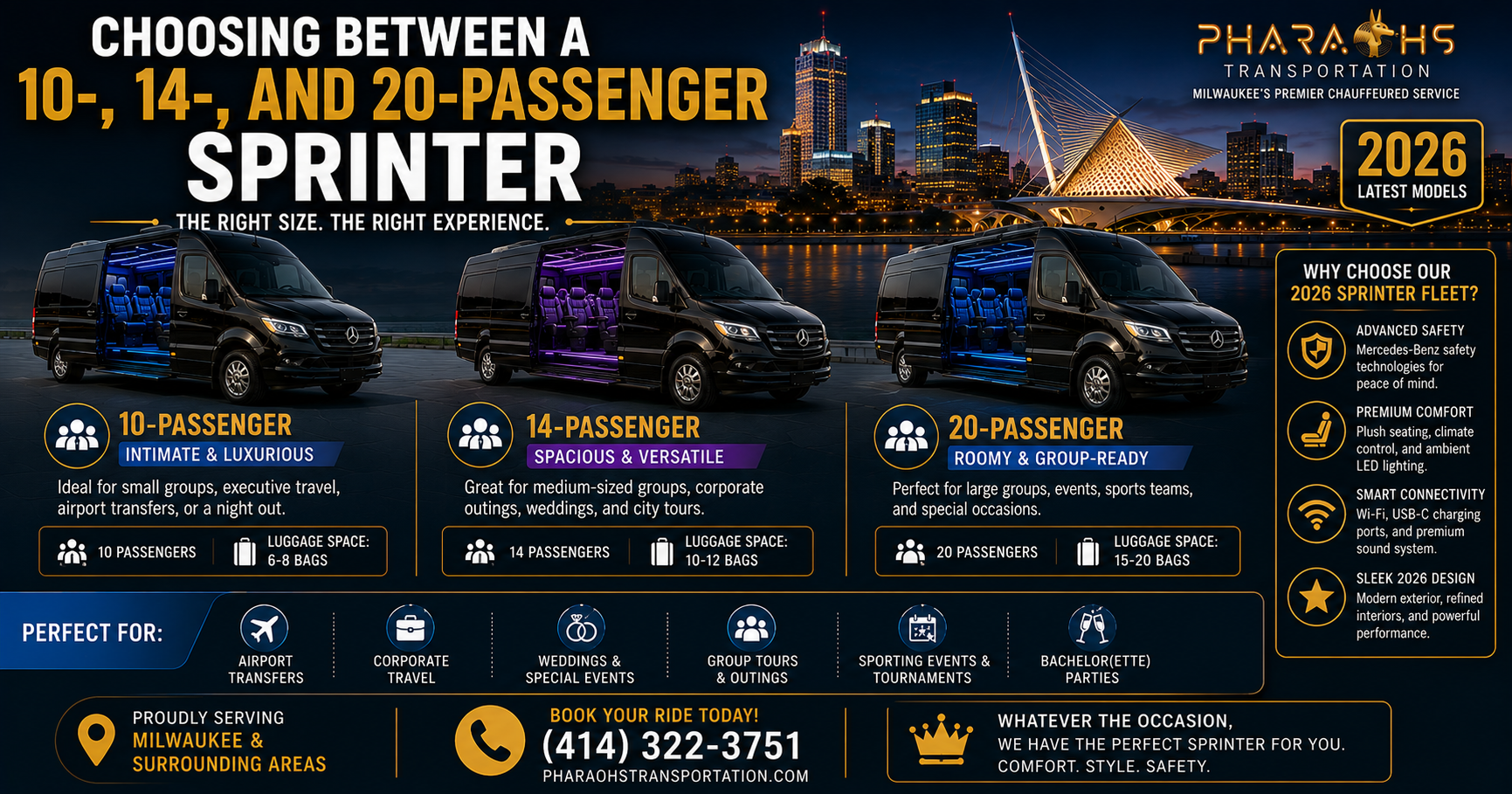
Pricing Differences Between Sizes
Pricing for group vehicles generally scales with size, but not always in a straight line, and a few other factors shift the final number more than passenger count alone.
What Drives the Price Difference
- Vehicle size and interior build-out. A 14-passenger Sprinter with a full lounge interior, table seating, and premium finishes costs more to build and maintain than a smaller 10-passenger configuration, and that cost is reflected in the rental rate.
- Duration of the booking. An hourly rental is priced differently than a flat-rate point-to-point transfer, and larger vehicles often carry higher hourly minimums regardless of size, since operators want to ensure the vehicle’s downtime is covered.
- Day and season. Weekend evenings, prom season, and wedding season tend to command higher rates across all sizes, simply due to demand, and larger vehicles in particular can book up early during peak periods.
- Distance and route. A long-distance trip to Chicago or Madison is priced differently than a short in-city transfer, and that distance factor applies on top of whatever base rate the vehicle size carries.
- Included amenities. Some sizes come standard with extras — a working table, upgraded lighting, or connectivity features — that affect price independent of passenger count.
Rough Relative Pricing
Without quoting specific dollar figures — since rates vary by operator, date, and route — the general pattern across the group transportation industry looks like this: a 10-passenger Sprinter typically sits at the lower end of group vehicle pricing, a 14-passenger Sprinter commands a moderate premium reflecting its larger interior and broader use case, and a 20+ passenger vehicle carries the highest rate of the three, particularly if that capacity is fulfilled by a stretch limo or party bus rather than a Sprinter.
The most useful way to think about this isn’t “which size is cheapest” but “which size gets my whole group there for the lowest total cost per person.” A 10-passenger vehicle booked for 8 people might look cheaper on paper than a 14-passenger vehicle, but if your group is actually 12 people and you’d need a second vehicle to cover the extra 4, the larger single vehicle is very likely the better value overall. For an exact quote based on your group size, date, and route, our limo pricing page and booking team can walk through the numbers for your specific trip.
Booking Early Affects Price and Availability at Every Size
Across all three sizes, but especially at the larger end, booking early matters. Larger vehicles are a smaller share of most fleets — there are simply more 10- and 14-passenger vehicles in circulation than 20+ passenger options — so availability tightens faster during busy weekends, wedding season, and major event dates. Locking in your size early, especially for a 20+ passenger vehicle, tends to protect both your date and your rate.
Deposits, Minimums, and What Else Affects the Final Number
A few other line items shape the final price beyond the base vehicle rate, and they’re worth asking about regardless of which size you book:
- Hourly minimums. Many operators require a minimum number of hours for larger vehicles, even if your actual event only runs a couple of hours. This is more common at the 14- and 20-passenger tiers than for smaller sedans.
- Gratuity and service fees. These are often calculated as a percentage of the base fare, so they scale with vehicle size and trip length.
- Overtime rates. If an event runs longer than booked — a wedding reception that goes late, a corporate day that adds a stop — ask what the per-hour overtime rate looks like before you’re in that situation, not after.
- Deposit and cancellation terms. Larger vehicles, being in shorter supply, sometimes carry stricter deposit or cancellation policies than smaller vehicles, since the operator is holding that vehicle exclusively for your date.
None of these are unique to any one size, but they tend to matter more as the vehicle and the booking get bigger, simply because there’s more dollar value riding on the details being right.
How to Decide Which Size Fits Your Group
If you’re still not sure which size is right, a few quick questions can usually settle it:
- How many people, realistically, will be riding? Count actual confirmed attendees, not an optimistic guest list. It’s easier to size down slightly than to scramble for a second vehicle at the last minute.
- Is everyone traveling with luggage, or just personal items? Full luggage sets push you toward sizing up, even if the headcount alone would fit a smaller vehicle.
- Is this a long ride or a short one? Longer trips reward the extra legroom of a smaller, more spacious vehicle. Shorter, single-destination social trips can tolerate a tighter fit in a larger vehicle.
- Does the group need to stay together, or could two vehicles work? For groups near a size threshold, splitting into two smaller vehicles sometimes serves the trip better than maxing out one large one.
- What’s the occasion? A working corporate group values table space and legroom; a bachelorette party headed to one destination values headcount and atmosphere more than personal space.
Answering these honestly before you book is the single best way to avoid the two most common sizing mistakes: paying for a vehicle that’s bigger than the group needs, or squeezing a group into something too small for the trip they’re actually taking.
Common Sizing Mistakes Worth Avoiding
A few patterns show up again and again when groups book the wrong size, and knowing them ahead of time is the easiest way to sidestep them.
Booking to the guest list instead of the confirmed headcount. It’s tempting to book a vehicle sized for everyone who was invited rather than everyone who actually confirmed. This almost always leads to oversizing — paying for a 20-passenger vehicle when 13 people show up. A better approach is to book close to your realistic confirmed number and build in a small buffer, rather than sizing for a best-case guest list.
Forgetting about luggage or gear. Sports equipment, instrument cases, oversized garment bags for formalwear, or a full set of checked luggage for an airport run all eat into passenger comfort even if the headcount technically fits. If your group is bringing more than personal bags, mention it when booking so the vehicle size accounts for it.
Assuming every “14-passenger” vehicle is identical. As covered above, passenger ratings vary by fleet and vehicle build. Two different 14-passenger Sprinters can have meaningfully different table space, legroom, and amenities. Ask about the specific vehicle rather than relying on the passenger number alone.
Not accounting for multi-stop itineraries. A vehicle that’s comfortable for a 20-minute single-destination ride can feel very different on a day with four or five stops. For multi-stop days, it’s worth prioritizing comfort and legroom over squeezing in the maximum headcount, since your group will be spending meaningfully more time in the vehicle overall.
Waiting too long to book larger sizes. As mentioned earlier, larger vehicles are a smaller slice of most fleets. Groups that wait until the last minute to book a 14- or 20-passenger vehicle for a popular date sometimes find their preferred size already booked, forcing a late pivot to a different size or a second vehicle.
Avoiding these five mistakes covers the vast majority of sizing regrets groups run into after the fact — and all five are easy to prevent with a short conversation with your provider before you lock in a booking.
Frequently Asked Questions
How many passengers actually fit comfortably in a 14-passenger Sprinter?
The stated capacity of 14 reflects every seat filled, which is comfortable for most groups on a typical event ride. For longer trips or groups traveling with significant luggage, some parties choose to book a 14-passenger vehicle for a slightly smaller group — 10 to 12 people — to leave extra room for bags and a more relaxed ride.
Is a 10-passenger Sprinter cheaper than a 14-passenger Sprinter?
Generally, yes — smaller vehicles tend to carry a lower base rate than larger ones, reflecting the smaller build and interior. That said, the better comparison isn’t the sticker price of each vehicle alone, but the total cost for your actual group size, since a smaller vehicle that can’t fit everyone may end up costing more once a second vehicle is added.
Do all operators offer a true 20-passenger Sprinter?
Not always. Many Sprinter fleets, including vehicles built on the Mercedes-Benz Sprinter chassis, max out around 14 to 15 passengers. Capacity beyond that is frequently handled by a stretch limousine or party bus instead. If a 20-passenger option matters for your trip, confirm directly with your provider whether that capacity comes from a Sprinter or a different vehicle type.
What size Sprinter is best for a wedding?
It depends on the wedding party size and whether you’re transporting just the bridal party or a larger combined group. Many wedding bookings land on a 14-passenger Sprinter as the size that comfortably fits a full bridal party with room to spare, while larger combined groups sometimes move up to a bigger vehicle. Our wedding limo service team can help match vehicle size to your specific wedding party count.
Can I book two smaller Sprinters instead of one large one?
Yes, and for some groups this actually works better than a single maxed-out vehicle, especially if the group has different pickup points or wants more flexibility in timing. It typically costs more in total than a single large vehicle, but it trades that cost for more scheduling flexibility.
How far in advance should I book a larger Sprinter or group vehicle?
Larger vehicles make up a smaller portion of most fleets, so they tend to book up faster — particularly during wedding season, prom season, and major event weekends. Booking several weeks to a few months ahead is a safer approach for 14- and 20-passenger vehicles than the shorter lead time that might work fine for a smaller sedan or SUV booking.
What if my group size changes after I book?
It’s common for headcounts to shift between booking and the actual event, especially for weddings and large corporate trips. Most operators can accommodate a modest change if you let them know as early as possible, but a significant jump — say, from 10 confirmed riders to 18 — may require moving up to a larger vehicle or adding a second one, which is easier to arrange with notice than at the last minute. If your guest list or attendee count is still firming up, it’s worth communicating a realistic range rather than a single fixed number when you first book.
Does a bigger Sprinter mean a longer boarding and unloading time?
Generally, yes, and it’s a factor worth planning around for tightly scheduled events. Getting 20 people in and out of a vehicle simply takes longer than getting 10 people in and out, particularly for events involving formalwear, heels, or luggage. For time-sensitive legs of an event — like a wedding party trying to hit a photography window — it’s worth building a few extra minutes into the schedule for boarding and unloading with a larger vehicle, rather than assuming it moves at the same pace as a smaller one.
Ready to Book the Right Size?
Choosing between a 10-, 14-, or 20-passenger Sprinter comes down to your group size, luggage, trip length, and occasion — not just the biggest number available. Our team can help match the right vehicle to your Milwaukee trip, whether that’s a corporate transfer, a wedding, an airport run, or a night out. Visit our Milwaukee Sprinter Limo page for current fleet specs and availability, check our full fleet for every size option, or book online to lock in your date.