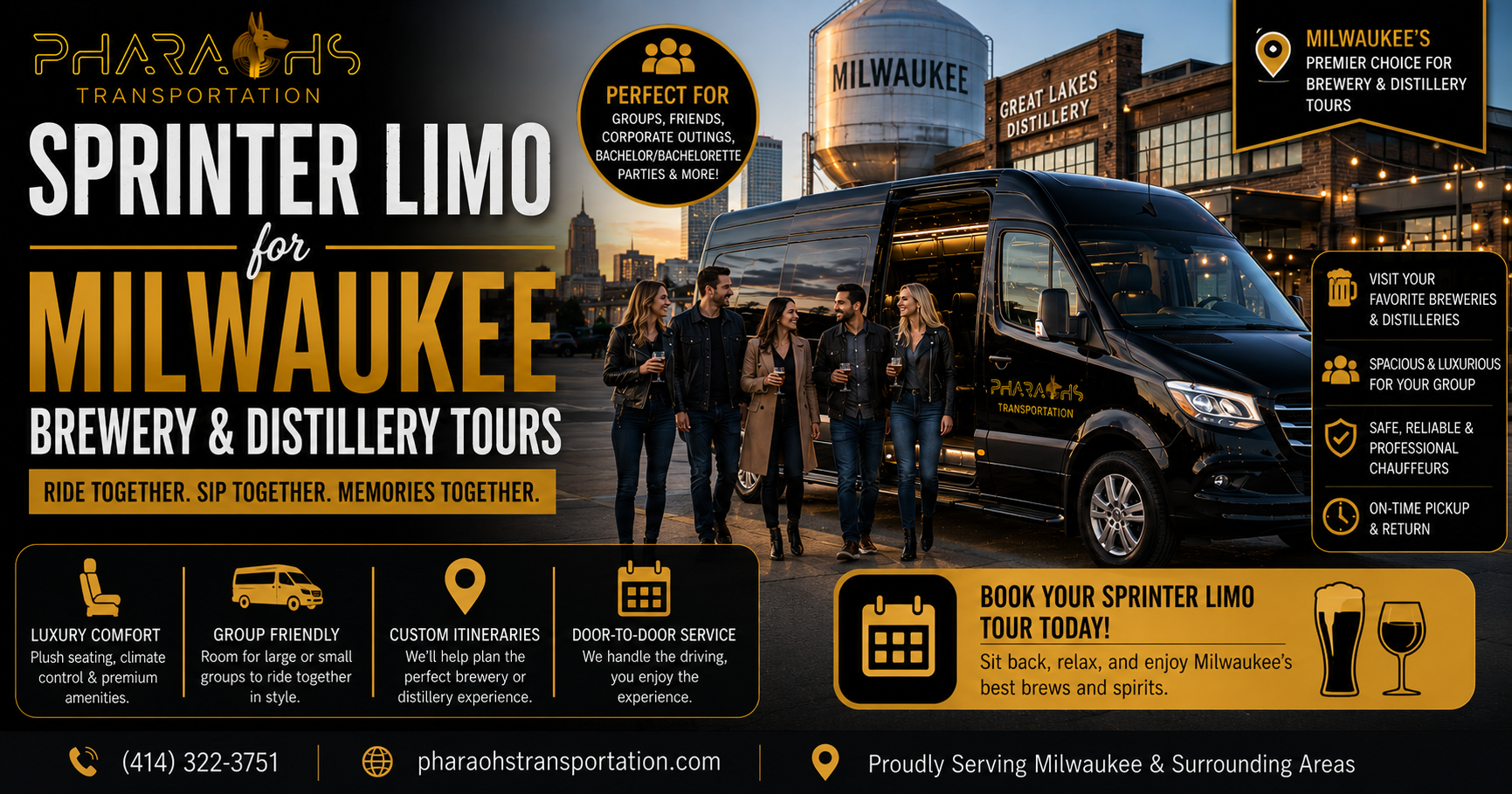
A Milwaukee brewery or distillery crawl in a chauffeured Sprinter typically runs 4–6 hours and covers 3–4 stops across neighborhoods like the Historic Third Ward, Walker’s Point, and Bay View — enough time for a real tasting or tour at each stop without rushing anyone. A 14–15 passenger Sprinter limo is the standard vehicle for a group this size, and pricing is quoted by the hour rather than per stop.
There’s a specific moment that separates a brewery crawl people talk about for years from one that quietly falls apart: it’s not the beer list, and it’s not who picked the itinerary. It’s what happens on the sidewalk between stop one and stop two. Is everyone standing together, or is half the group stuck refreshing a rideshare app while the other half already left? Is there one person who agreed to stay sober tonight, resentfully, or is nobody driving at all?
Milwaukee has more craft breweries and small-batch distilleries per capita than most cities its size, and “let’s do a brewery tour” has become the default answer for birthday weekends, bachelor and bachelorette parties, visiting friends, and corporate offsites that don’t want to feel like a corporate offsite. The part that actually determines whether the day works isn’t the guest list of breweries — it’s the transportation plan sitting underneath it.
This guide breaks down how a Sprinter-based brewery and distillery tour actually runs in Milwaukee: which neighborhoods make sense together, how the scheduling math works, what it costs to split across a group, and the planning details that keep a four-stop day from turning into a four-hour argument about parking.
Why a Sprinter Beats Rideshare, Personal Cars, or a Party Bus for This Specific Trip
Milwaukee’s brewery scene sits in pockets that are close enough to feel connected on a map but too far apart to walk comfortably as a group carrying tasting flights and growlers — the Historic Third Ward, Walker’s Point, the Menomonee River Valley, the Harbor District, and Bay View. That geography is exactly where the usual options start breaking down for a group of ten or more.
Splitting into rideshare cars means splitting into rideshare pickup times, too. A group of twelve moving between four stops isn’t booking four rides — it’s booking somewhere between twelve and sixteen, since a party that size rarely fits in fewer than three or four vehicles per move. Every one of those bookings is a separate chance for someone to end up at the wrong entrance, wait through a five-minute cancellation, or get stuck standing outside while the app searches for a driver on a Friday night when every other bar crawl in the Third Ward is requesting a ride at the same time.
Personal vehicles solve nothing either — someone has to stay sober and drive, which defeats the point of a brewery crawl, or nobody does, which is a real safety problem. And a large party bus built around one long, loud stop doesn’t handle a true multi-stop itinerary with a timed pickup outside four different tasting rooms.
A single chauffeured Sprinter removes all three problems at once. The group boards together, rides together, and gets dropped at the same door at the same time, every time. One chauffeur is responsible for the whole day’s timing instead of splitting that job across three or four drivers who’ve never seen the route. And because the vehicle seats up to 14–15 passengers with room to spare, there’s actual space for jackets, six-packs, and gift-shop purchases instead of everyone holding a growler on their lap for three hours.
There’s also a quieter benefit that doesn’t show up on a spec sheet: a group that arrives together spends its energy on the tasting room, not on logistics. That’s the entire reason to book transportation for a day like this in the first place.
What Splitting Into Rideshares Actually Costs a Group
On a spreadsheet, three or four separate rideshare accounts look cheaper than one dedicated vehicle. In practice, that math falls apart fast on a Friday or Saturday evening in Walker’s Point or the Third Ward, where every brewery crawl, wedding shuttle, and Fiserv Forum event in the city is competing for the same drivers. Surge pricing hits every car in the group, separately, every single time the group moves — and a four-stop day means arranging that four times over, for three or four vehicles each time.
That’s a dozen-plus individual bookings for one outing, and each one is an opportunity for someone to get left behind, land at the wrong door, or wait fifteen minutes for a cancelled ride. A single Sprinter charter collapses all of that into one booking. One hourly reservation covers the entire day, one driver runs the whole route, and the group never actually splits apart — so there’s nothing to reassemble.
What the Day Actually Looks Like, Start to Finish
A well-run Sprinter brewery tour follows a rhythm that stays predictable even when the stops don’t. The chauffeur typically arrives a few minutes early to the pickup point — a home, a hotel lobby, a hosting venue, or an office if it’s a corporate outing — and confirms the day’s stops and rough timing with whoever organized the booking before anyone boards. That five-minute conversation at the curb is usually what catches the small stuff: a guest running ten minutes late, a brewery that moved its tour time, a stop the group decided to swap that morning.
At each brewery or distillery, the vehicle pulls as close to the entrance as the neighborhood’s loading zones allow — which, in tight blocks like Walker’s Point or the Third Ward, is exactly where a chauffeur who knows the streets earns their keep. The group heads in for their tasting or tour, and the driver either waits nearby or circles back at an agreed time, depending on how that particular stop was planned. Between stops is where a surprising amount of the day’s actual fun happens — comparing notes on the last pour, arguing about what to order next, or just riding with the windows cracked and music on instead of hunting for a parking spot.
At the end of the day, the return trip mirrors the pickup — back to the original address, a restaurant for dinner, or a hotel, depending on how the group planned it. The goal of the whole structure is that nobody in the group ever has to think about the transportation piece. It’s just there, on schedule, at every door.
Comfort Matters More Than It Sounds Like It Should
A 14–15 passenger Sprinter isn’t just roomier than a sedan — it changes what a group can comfortably do between stops. There’s space to stash growlers, six-packs, and gift-shop bags without them sliding around the floor. There’s room to actually sit facing the people you’re talking to instead of staring at the back of a headrest. And there’s enough climate control and legroom that a stop running fifteen minutes long doesn’t turn into a cramped, restless wait in a parked van.
That matters more on a brewery day than it does on a typical point-to-point ride, because the vehicle isn’t just a way to get somewhere — it’s where the group spends a meaningful chunk of the afternoon between tastings.
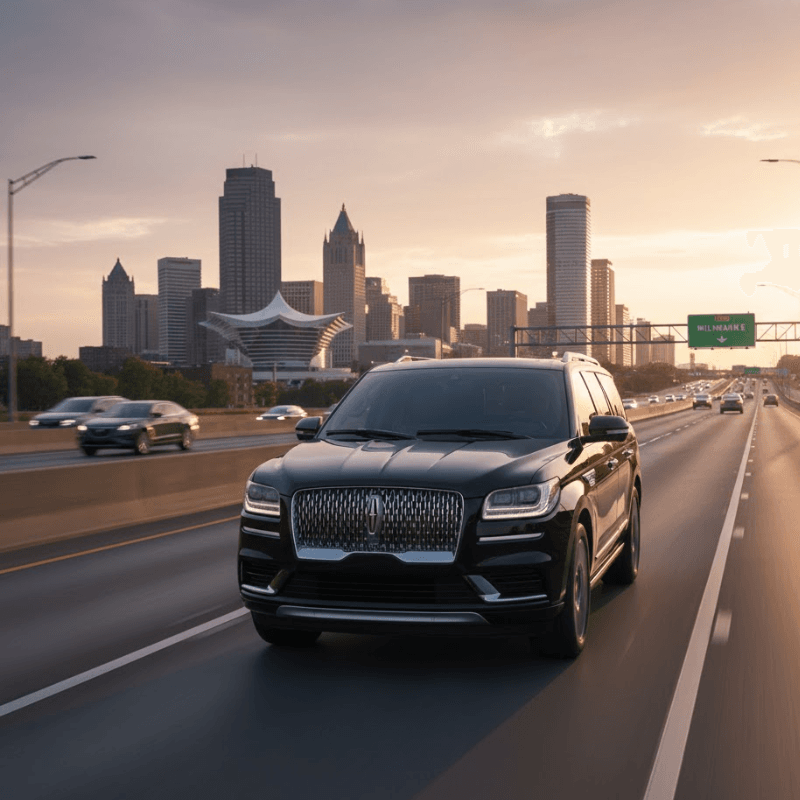
Milwaukee’s Brewery & Distillery Neighborhoods, and What’s Actually There
A good Sprinter itinerary threads through neighborhoods that are close enough for tight routing but distinct enough that the day doesn’t feel repetitive. Here’s what’s realistically in play in each one.
Historic Third Ward
Milwaukee’s old warehouse district mixes taprooms with dining, galleries, and shopping breaks, which makes it a natural anchor for a crawl that wants variety between pours. The Explorium Brewpub has a Third Ward location that works well as a mid-afternoon stop with food available alongside the flight, and the neighborhood sits close enough to the Milwaukee River that a route built around it can pick up a scenic riverside stretch without adding real drive time.
Walker’s Point
This is the densest taproom cluster in the city, and it’s built for a route with several short stops rather than one long visit. Component Brewing Company, Urban Harvest Brewing Company (1024 S. 5th St.), Indeed Brewing Company, and Broken Bat Brewing Co. all sit within a few blocks of each other, which means the Sprinter might only need to move a handful of blocks between doors instead of crossing the city. It’s also home to Central Standard Craft Distillery, if the group wants to swap a beer stop for a spirits tasting mid-route.
Menomonee River Valley
Just west of Walker’s Point, Third Space Brewing (1505 W. St. Paul Ave.) anchors this stretch with a large taproom and regular events — it pairs naturally with a Walker’s Point leg since the drive between them is short.
Harbor District
A newer addition to the map, the Harbor District is home to Twisted Path Distillery (2018 S. 1st St., inside the Lincoln Warehouse), an organic grain-to-glass distillery with a cocktail lounge, and Torzala Brewing Company in the same building — meaning one stop here can cover both a distillery tasting and a brewery pour without moving the vehicle at all.
Bay View
A short drive south, Bay View has a more neighborhood, less touristy feel that groups often use to close out a route. Because it sits further from downtown, it works best as the first or last stop rather than something the group detours to mid-afternoon — spots like The Sugar Maple (a 60-tap beer bar rather than a brewery, but a strong final stop) and The Vine Humboldt, a beer garden inside the park, both fit the neighborhood’s laid-back close-out feel.
Building the Route: One Direction, Not a Zigzag
The itineraries that run smoothly almost always move in one general direction — south from downtown through Walker’s Point and into Bay View, or north through the Third Ward toward the riverfront — rather than crossing back and forth across the city. Every extra mile between stops eats into tasting time and adds to the total hours booked.
A workable four-stop shape looks like: start in the Third Ward or Menomonee River Valley, work south through Walker’s Point or the Harbor District, and finish in Bay View — or run it in reverse depending on where the group starts and ends the night. If a riverfront stop near Brewers Hill is on the list, it usually belongs at the start of the day, since it sits north of downtown and would otherwise force the vehicle to double back.
This is also where a chauffeur’s local knowledge earns its keep. Third Ward and Walker’s Point both have tight one-way blocks, limited loading zones, and heavy weekend foot traffic — a driver who doesn’t know the neighborhood can get boxed into a spot that costs the group ten minutes it didn’t need to lose.
How the Scheduling Actually Works
The part that separates a smooth crawl from a stressful one isn’t the stops — it’s what happens between them. A well-built Sprinter itinerary is really three moving pieces stacked together:
- Drive time between locations, based on the real route and current traffic rather than straight-line distance.
- Dwell time at each stop, sized to match a guided tour, a tasting flight, or a casual walk-in visit.
- A wait-or-return decision at each stop — whether the chauffeur circles the block, parks nearby, or comes back at a scheduled window.
For a 4–6 hour outing, that usually breaks down to 45–60 minutes at each of 3–4 stops, with 10–15 minute drives between them, plus a buffer for the fact that almost every group is running a few minutes behind by the third stop. Booking brewery reservations in advance matters here — a route built around confirmed tour times avoids the group standing outside a 30-minute wait for a table that was never held.
A Sample 5-Hour Route
Pickup at 1:00 PM. First stop in the Third Ward from 1:20–2:15 for a guided tour and flight. A short drive into Walker’s Point, arriving 2:30–3:20 for a taproom visit. A second nearby stop — Walker’s Point or the Harbor District — from 3:35–4:20. A closing stop in Bay View from 4:35–5:35 before the vehicle heads home. That structure gives the group four real stops, a reasonable amount of time at each one, and absorbs the inevitable slippage into the drive segments instead of squeezing it out of the tastings.
When the Group Runs Behind
Almost every crawl does, by the second or third stop — someone’s mid-conversation with a bartender, someone’s finishing a flight, someone stepped outside for a photo. A route with real buffer time built in absorbs this without falling apart, which is one of the practical advantages of coordinating the schedule with a transportation provider ahead of time rather than managing it group-chat-style in the moment. A chauffeur who knows the plan can adjust in real time; a scattered group of rideshare drivers can’t.
Corporate Groups: A Different Kind of Crawl
A brewery or distillery tour has become a common stand-in for the standard corporate happy hour — team offsites, client entertainment, end-of-quarter celebrations. For a company organizing the day, the appeal is straightforward: a Sprinter keeps the whole team together for the outing, which matters more for a work event than it might for a casual friend group. Nobody splits off into a separate car, nobody’s expensing a rideshare receipt, and the company isn’t exposed to the liability of employees driving between venues — or home — after a few tastings.
Corporate bookings tend to run on tighter windows than a birthday or bachelor party crawl, often a half-day block bookended by work commitments, so a route with two or three stops rather than four is common, with more time budgeted at each location for conversation than for moving quickly between them. For teams that want the full corporate transportation treatment — airport pickups for out-of-town colleagues folded into the same day, for instance — the same vehicle and chauffeur can cover both legs.
Related Guides: Sprinter Limo vs Party Bus vs Stretch Limo Milwaukee
Birthdays, Bachelor Parties & Visiting Guests
A birthday group wants every guest, including the person the day is for, free to drink without thinking about the ride home — a birthday limo booking built around a brewery route does exactly that. A bachelor or bachelorette party wants the whole day handled so it feels planned instead of improvised, which is where a broader look at event transportation options is worth a look if the crawl is one piece of a longer weekend that also includes dinner or a night out. Out-of-town guests want a local driver who knows the neighborhoods well enough that the day feels curated instead of guessed at — which is really just local knowledge doing the work that an app can’t.
Different reasons for booking, same underlying requirement: one licensed vehicle, one professional chauffeur, for the whole day.
The Safety Case, Stated Plainly
A brewery or distillery crawl is, by definition, a day built around drinking — which makes the transportation decision a safety decision as much as a scheduling one. A licensed, commercially insured Sprinter service with a background-checked chauffeur removes the two riskiest points in a DIY brewery day: driving between stops, and driving home at the end of it.
That matters most for whoever organized the day, since that’s usually the person who’d otherwise feel responsible for making sure everyone gets home safely. A dedicated vehicle takes that weight off any one guest and puts it on a professional instead — and it means nobody in the group has to volunteer to skip the tastings, count drinks against a drive home, or split off early.
A legitimate operator runs under commercial insurance and DOT compliance that a personal vehicle or an informal group carpool simply doesn’t carry. That distinction is exactly what matters on a day that involves a passenger group being moved between venues that serve alcohol — it’s the difference between a covered, professional ride and an informal arrangement with no real protection if something goes wrong.
Group Size and What It Costs Per Person
A Sprinter comfortably seats up to 14–15 passengers, which covers most brewery-crawl groups — birthday parties, bachelor and bachelorette groups, corporate outings, and visiting-guest itineraries typically land somewhere between 8 and 15 people.
Splitting the cost of a multi-hour charter across a full group generally lands the per-person cost in line with, or below, what several rounds of rideshare fares would run for the same day once surge pricing, multiple cars, and the return trip home are all added up. The bigger the group, the more that math favors one dedicated vehicle over splitting into rideshares, since the per-person number holds roughly steady across the vehicle’s full capacity — a 15-person group and a 10-person group are splitting the same flat rate, just more ways.
Pricing generally scales with total hours booked and distance between neighborhoods rather than a flat per-stop fee, so a tighter route through one or two adjacent areas — Walker’s Point and the Harbor District, say — typically costs less than a route that spans downtown, Walker’s Point, and Bay View in one afternoon. For a detailed breakdown of how Sprinter rates are actually structured in Milwaukee, the Sprinter limo cost guide walks through what changes the number and what doesn’t. Total hours, the day of the week, and how far apart the requested stops sit all factor into the final rate — keeping the route to one or two adjacent neighborhoods, booking a weekday or early evening, or trimming the day to 3–4 hours are all ways to manage cost without giving up the core benefit of one vehicle for the whole group.
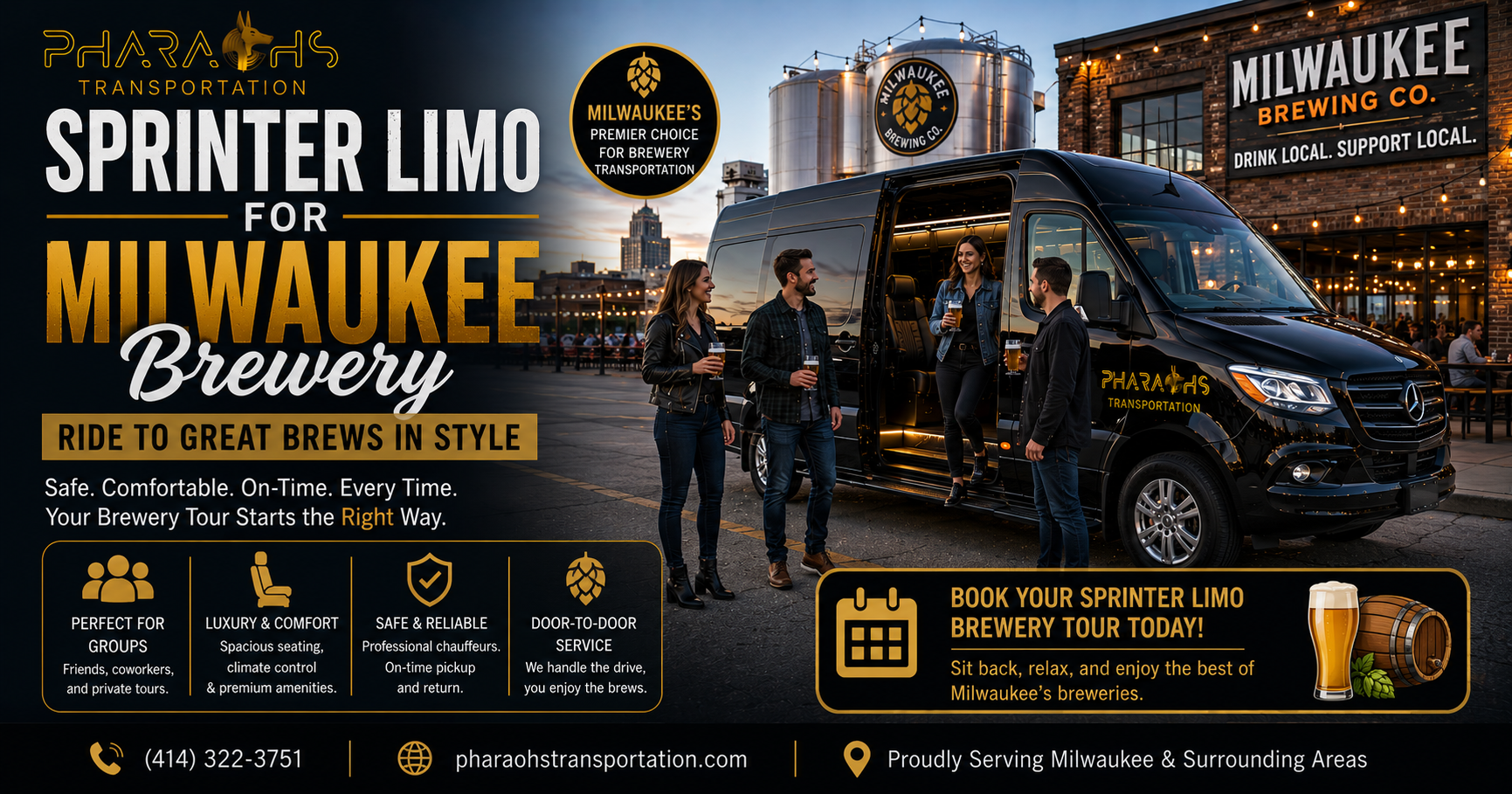
Best Times of Year for a Milwaukee Brewery Tour
Milwaukee’s brewery scene runs year-round, but the season changes how the day feels. Late spring through early fall brings beer gardens and patios into play — several Third Ward and riverfront spots open outdoor seating during these months, adding a walkable, open-air feel to stops that are strictly indoor taprooms in January.
Summer weekends are peak demand for group transportation generally, since brewery tours are competing with weddings, festivals, and Brewers or Bucks game days for the same vehicles and chauffeurs. Booking a few weeks out is worth doing for any Friday or Saturday from June through September.
Fall brings its own pull — Oktoberfest-style events and seasonal releases make late September and October a popular window for a themed crawl. Winter tours shift almost entirely indoors, which actually simplifies routing in one sense: less concern about outdoor waits between stops, and taprooms tend to run less crowded on weekday afternoons, making it easier to walk in without a reservation.
The stretch around Thanksgiving and the December office-party season sees a real spike in corporate bookings specifically, since a brewery or distillery tour has become a common alternative to the traditional sit-down holiday party.
Related Guides: Milwaukee Sprinter Limo Cost 2026: Real Pricing Breakdown
A Planning Checklist Before You Book
A handful of decisions made ahead of time make the actual day run noticeably smoother:
- Confirm the group’s final headcount, since vehicle size and per-person cost both depend on it.
- Decide tour-heavy versus taproom-heavy before calling breweries for reservations — guided tours need more lead time than casual taproom visits.
- Pick a route direction (north, south, or a Third Ward-and-Walker’s-Point loop) rather than leaving it open-ended.
- Flag any guest who may need to leave early or arrive late, so the route can build in a convenient stop for that.
- Decide whether the day extends into dinner or a nightlife stop afterward, since that changes the total hours booked.
- Book the vehicle and chauffeur a few weeks ahead for weekend dates, especially in summer and fall.
Working through this list with the transportation provider directly — instead of locking in every brewery reservation first and fitting transportation around it last — tends to produce a tighter, more realistic itinerary, since the provider can flag drive times and routing conflicts before the schedule is set in stone.
Frequently Asked Questions
How many breweries or distilleries can we visit in one Sprinter tour?
Most groups comfortably fit 3–4 stops into a 4–6 hour outing. A fifth or sixth stop is possible, but it starts compressing the time spent actually tasting at each location, so groups that want more stops usually extend the booking to 7–8 hours rather than shortening every visit.
How many people fit in a Sprinter limo for a brewery tour?
Up to 14–15 passengers, which covers most birthday groups, bachelor and bachelorette parties, and corporate outings that book this kind of day. Larger groups can be split across two vehicles running the same route together.
Do we need reservations at the breweries or distilleries ahead of time?
For guided tours or tasting flights, usually yes — Milwaukee breweries frequently book tour slots in advance, especially on weekends. Casual taproom stops typically don’t require a reservation, though it’s worth confirming for larger groups, since some taprooms cap how many guests they’ll seat together without notice.
Can the driver wait at each stop, or do we need scheduled pickup windows?
Both work. For shorter taproom stops, the chauffeur can wait nearby or circle the block. For longer guided tours, a scheduled pickup window keeps the day on track and avoids the vehicle sitting idle in a loading zone longer than necessary.
Is a Sprinter tour actually better than booking separate rideshares?
For groups of eight or more, yes in most cases — a single Sprinter keeps everyone together, avoids surge pricing hitting every car separately, and removes the risk of vehicles arriving at different times, usually for a comparable or lower per-person cost once the full day’s rides are totaled up.
What neighborhoods does a typical Milwaukee brewery tour cover?
The Historic Third Ward, Walker’s Point, the Menomonee River Valley, the Harbor District, and Bay View are the most common combination, sometimes paired with a riverfront stop near Brewers Hill. Most itineraries stick to one general direction across the city rather than crossing back and forth.
How far in advance should we book a brewery tour Sprinter?
A few weeks ahead is a safe target, especially for weekend dates or a day that includes guided brewery tours, since both the vehicle and the tour slots can fill up during peak season.
Can the same vehicle handle dinner or a nightlife stop afterward?
Yes — many groups extend the same booking to include a dinner reservation or a downtown stop after the last brewery, using the same Sprinter and driver for the full evening instead of arranging separate transportation later.
What happens if someone in the group needs to leave early?
Worth flagging at booking, since it changes the routing. Some groups plan a stop near a hotel or a rideshare-friendly pickup point partway through the day so one or two guests can peel off without disrupting the rest of the itinerary.
Does the Sprinter have anything onboard between stops?
Most Sprinter limos in this class come with group-facing seating, climate control, and space for coolers, growlers, and anything picked up along the way — the ride between stops tends to be part of the experience rather than just a transfer.
Ready to Book Your Milwaukee Brewery Crawl
A chauffeured Sprinter keeps the group together, keeps the day on schedule, and keeps everyone off the road after the last pour. Pharaoh’s Transportation operates its Sprinter fleet out of Milwaukee, two minutes from Mitchell Airport, with real-time coordination on every multi-stop route.
Browse the full Sprinter limo lineup, check the fleet for other vehicle options if your group is smaller, or look at hourly rental if you’d rather keep the schedule flexible instead of locking in a fixed stop list. Planning something bigger than a brewery day — a full weekend that also needs an airport pickup or a wedding folded in — one call can cover the whole itinerary.
Call or text (414) 322-3751, book online, or reach out through the contact page to reserve your brewery crawl vehicle.
Related Guides: How Far in Advance Should You Book a Sprinter Limo in Milwaukee?