
Avada Car Dealer News

Plan on 1 Sprinter limo per 15 passengers as your baseline — but that number shrinks fast once you factor in luggage, formalwear, gift bags, or a wedding party that wants room to breathe. For most Milwaukee groups, the safer planning number is 12–13 riders per Sprinter rather than the maximum 15, especially for weddings, proms, and any event where guests are carrying bags, dresses, or equipment.

If you’re planning transportation for a wedding party, a corporate retreat, a Bucks or Brewers suite night, a milestone birthday, or a 100-person conference shuttle, the real question isn’t “how many people are coming.” It’s how those people — plus their luggage, formalwear, gifts, and event timeline — actually fit into a vehicle plan that holds up on the day itself. A lot of Milwaukee event planners get the headcount right and still end up with a transportation plan that falls apart at pickup, because seat math and event math aren’t the same thing.

Below is the exact math our dispatch team at Pharaoh’s Transportation uses every week to plan Milwaukee group rides — from single-Sprinter bachelorette parties to eight-vehicle conference shuttles — so you can work out your number before you ever pick up the phone.

Why “Seats 15” Doesn’t Mean “Book for 15”

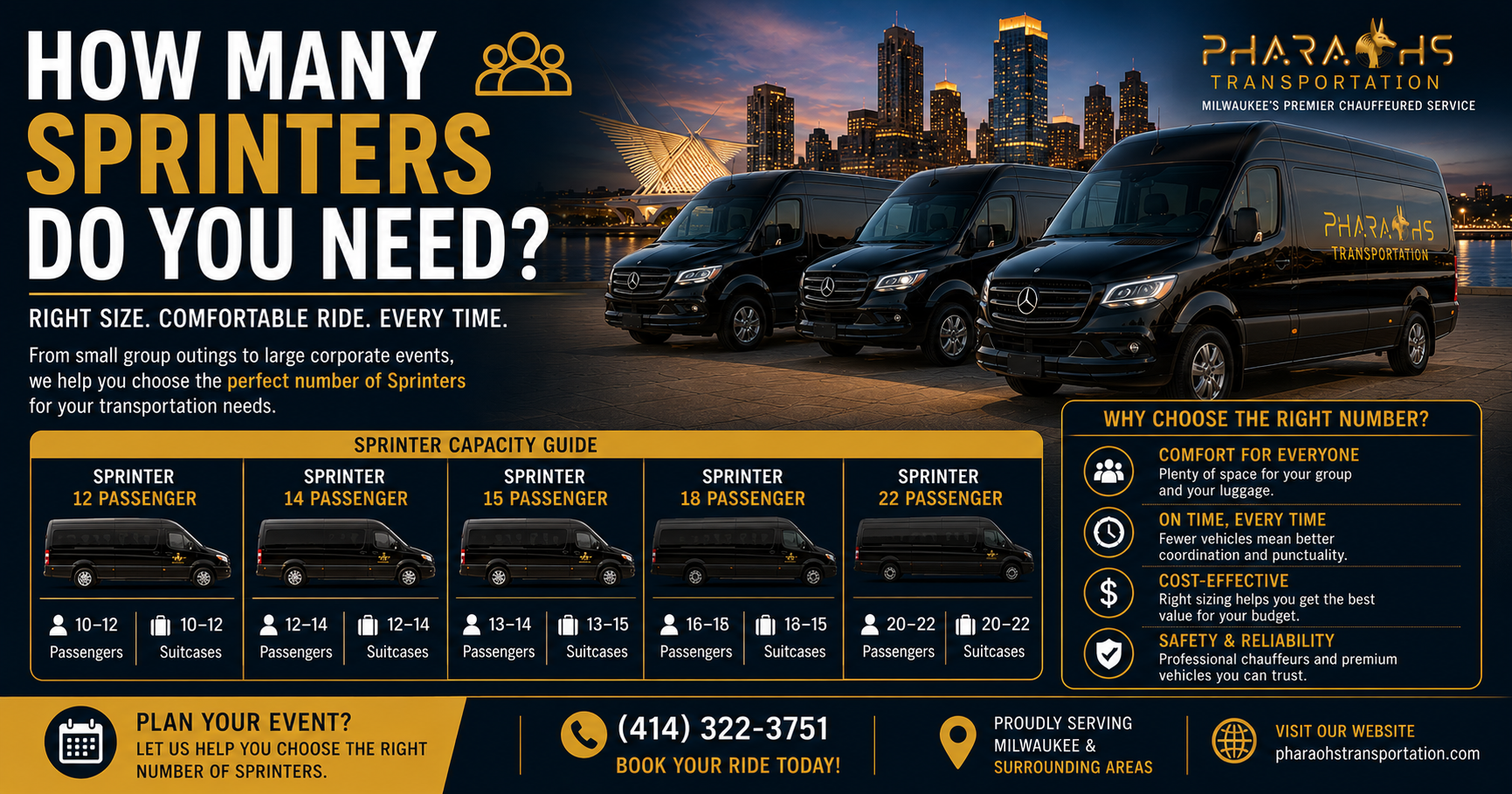
Every Sprinter limo in a typical Milwaukee fleet is rated for up to 15 passengers, including our own. That number comes from the manufacturer’s seating configuration — it’s a legal and structural capacity, not a comfort recommendation. Think of it the way you’d think about a dinner table rated to “seat 12”: it’s technically possible, but nobody wants their elbow in a stranger’s soup for a two-hour ride.

Three things eat into that rated capacity before you even get to comfort:

Luggage and bags:

A group of 15 flying out of Milwaukee Mitchell International Airport with rolling suitcases needs meaningfully less passenger space than 15 people going to a hockey game with just their phones and wallets. Sprinters have rear and under-seat storage, but a full set of checked luggage for 15 travelers will typically max that out well before the last passenger boards.

Formalwear:

Wedding parties, prom groups, and gala attendees take up more physical space than their headcount suggests. A ball gown or a rented tux with a garment bag effectively claims part of the seat next to it. Ask any Milwaukee wedding planner, and they’ll tell you a bridal party of 14 in gowns rides very differently than 14 people in jeans.

Event gear:

Golf outings, corporate offsites with presentation materials, sports team transportation, and DJ or photography equipment for a private event all reduce usable passenger space. If your group is hauling anything beyond a purse or small backpack, that has to factor into your vehicle count.

The practical rule we give Milwaukee clients: take the rated capacity (15), subtract 2–3 seats for real-world comfort, and use that adjusted number when you calculate how many vehicles you need. For most groups, that means planning around 12–13 comfortable seats per Sprinter rather than the full 15.

Passenger Math by Group Size

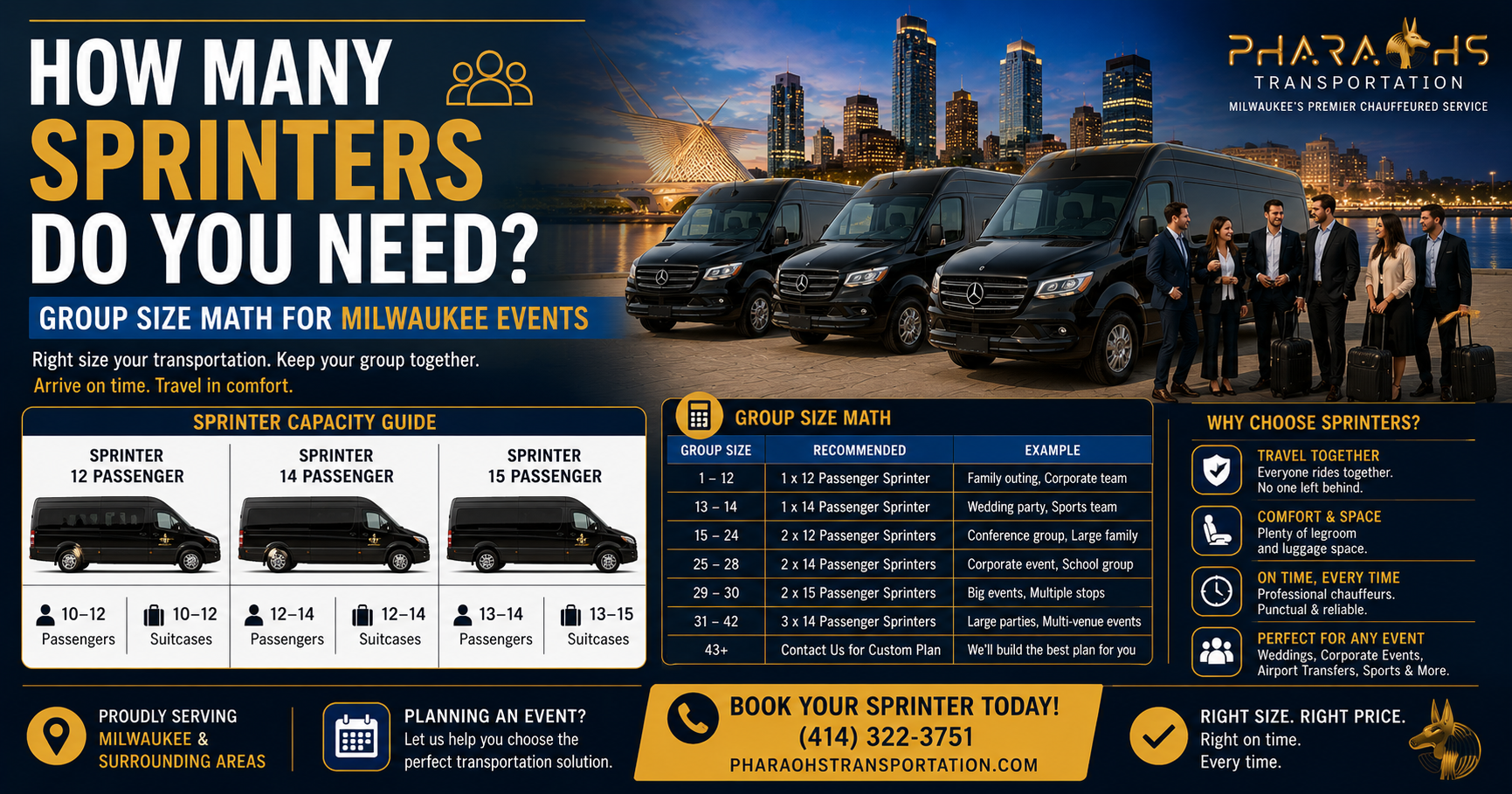
The table below is the same reference our reservations team uses internally when a Milwaukee client calls in with a headcount and asks, “how many vans do I actually need?” It shows both the bare-minimum vehicle count (max legal capacity) and the recommended count (comfortable capacity) side by side.

Group SizeSprinters at Max Capacity (15/vehicle)Sprinters Recommended (Comfortable, ~12–13/vehicle)Planning Notes
1–1511Fine for airport runs, short hops, or casual groups. Tight for weddings with dresses/suits or golf outings with bags.
16–3022–3Two Sprinters at max capacity works for short trips (under 30 minutes). For weddings or longer rides, three vehicles gives real breathing room.
31–503–44This is where most Milwaukee wedding and corporate groups land. Plan for 4 vehicles even if the math says 3.3 — you can’t book a third of a van.
51–754–55–6Coordination, not seat count, becomes the real challenge. This is the range where a single point of contact per vehicle becomes essential.
76–1006–77–8Consider mixing Sprinters with a stretch limo or SUVs for VIPs, plus staggered arrival windows to avoid a curbside traffic jam.
100+8+Custom fleet planNeeds a dedicated logistics plan with a named dispatch contact — this is a phone-call booking, not an online form.

A quick formula you can do in your head:

Take your total headcount, divide by 15, and round up — that’s your legal minimum vehicle count. Then divide the same headcount by 12 or 13 instead, and round up again — that’s your comfortable, recommended count. Book somewhere between the two, leaning toward the comfortable number if the trip is longer than 30 minutes, involves formalwear, or is time-sensitive (like a ceremony start time you can’t move).

For example: a 42-person corporate holiday party. At max capacity (15/vehicle), that’s 2.8 vehicles — rounds up to 3. At comfortable capacity (13/vehicle), that’s 3.2 — also rounds up to 4. In this case, we’d recommend booking 4 Sprinters, because 3 vehicles at max capacity leaves almost zero room for coats, bags, or last-minute guests, and a holiday party is exactly the kind of event where someone brings a gift bag or two.

When to Split Into Multiple Sprinters vs Booking One Larger Vehicle

This is the single most common question Milwaukee event planners ask our dispatch team, and the honest answer is: it depends on more than headcount. Three factors decide it — group size, trip type, and how much everyone genuinely needs to arrive together at the same moment.

When one Sprinter is the right call

  • Your group is under 20 people, and everyone is departing from and arriving at the same two points — for example, a hotel-to-venue transfer or a single group airport run.
  • You want a shared, social ride experience. A Sprinter’s lounge-style interior with face-to-face seating is built for a group that wants to stay together — a bachelorette party riding downtown, a birthday group heading to a concert, a small corporate team going to dinner.
  • Budget favors fewer vehicles and drivers over splitting the group, and the trip is short enough (under 30–40 minutes) that comfort trade-offs are manageable.

When splitting into multiple Sprinters is the smarter call

  • Your group exceeds roughly 20–25 people. Beyond that range, even two Sprinters at max capacity start feeling cramped, and you lose the “everyone rides together” advantage anyway once people are spread across two vans.
  • You have staggered pickup locations — a classic example is a bridal party getting ready at one hotel while the groomsmen are getting dressed across town. Trying to force both groups into one pickup route usually blows the timeline.
  • You’re running a corporate event with different departure times for executives versus staff, or a conference where attendees are flying in on different schedules and need to be shuttled from the airport in waves.
  • You want built-in redundancy. If something happens to one vehicle — a mechanical issue, a routing problem, a last-minute change — the rest of your group isn’t stranded waiting on a single van.

A closer look by event type

Weddings: For Milwaukee wedding transportation, we typically recommend splitting the bridal party and the groomsmen into separate Sprinters even when a single vehicle could technically hold everyone. The reasoning isn’t just about seat count — it’s about the morning-of experience. Brides want room for a photographer to move around, room for a dress to breathe, and room for the nerves and excitement of the day without feeling like everyone’s stacked on top of each other. Splitting the two parties into their own vehicles also solves the staggered-pickup problem automatically, since they’re almost always getting ready in different locations anyway.

Proms: Milwaukee-area prom groups typically run 10–16 students per booking, which lands almost exactly at one Sprinter’s comfortable capacity. For a group of 16–18, we’ll usually suggest either bumping to two vehicles or trimming slightly, since prom groups also tend to carry more than they think — corsage boxes, overnight bags for after-parties, and phones/cameras that need room to actually use.

Corporate events and conferences: These are the trickiest to plan because the group often isn’t moving as a single unit. A 60-person offsite might need airport pickups spread across four flight arrival windows, a shuttle loop between hotel and venue running every 30 minutes, and a separate VIP vehicle for executives. This is where “how many Sprinters do I need” stops being a single number and becomes a schedule — see the coordination section below.

Milestone birthdays and nights out: These groups tend to run smaller — 8 to 15 people — so a single Sprinter usually covers the whole trip comfortably, especially for shorter downtown routes between dinner, a bar, and a final venue.

Sports and game-day groups: Groups heading to Fiserv Forum, American Family Field, or Lambeau Field trips often carry coolers, tailgate gear, or team merchandise. Even a group of 12 with gear might need the same vehicle allowance as a group of 15 without it.

Coordinating Multiple Sprinters for One Event

Booking enough vehicles solves half the problem. The other half — the part that actually determines whether your event transportation runs smoothly — is making sure multiple Sprinters arrive, load, and depart in sync. This is where most self-organized, DIY group transportation plans start to fall apart, usually somewhere between “everyone please be ready by 4pm” and the actual moment four separate vans show up at slightly different times with no coordination between them.

Here’s the coordination framework we use for multi-vehicle Milwaukee bookings:

1. Assign one point of contact per vehicle:

For any group above roughly 30 people, we strongly recommend designating one person per Sprinter — a maid of honor, a groomsman, an office manager, a team captain — who knows the timeline and can talk directly to that vehicle’s chauffeur. Without this, you get the classic pickup-line confusion: “wait, who’s supposed to be in this van?” repeated four times in a row while a schedule slips.

2. Stagger pickups by 10–15 minutes instead of scheduling everyone simultaneously:

If every Sprinter in your fleet tries to load at the exact same curb at the exact same minute, you create a bottleneck that costs you more time than staggering ever would. This matters most at venues with limited pull-up space — downtown Milwaukee hotels, tight residential streets, or event venues like Fiserv Forum on a concert night where curb space is already competitive.

3. Build in a buffer between vehicle departures and the event start time:

In a real multi-vehicle convoy, vehicles almost never arrive at the exact same second, even when they leave close together — traffic lights, loading time, and small stops all introduce a few minutes of drift. Plan your event’s actual start time (a ceremony, a dinner reservation, a check-in window) around the last vehicle’s realistic arrival time, not the first one to pull up.

4. Centralize dispatch under one provider:

When you book multiple Sprinters through a single company, all vehicles are coordinated from one dispatch point with one shared timeline — rather than you personally juggling separate confirmations, separate driver phone numbers, and separate companies who’ve never spoken to each other. This is the practical advantage of booking a full multi-vehicle package through one Sprinter limo provider instead of piecing together bookings across different services to save a few dollars per vehicle.

5. Confirm luggage and equipment needs per vehicle, not just per group total:

A Sprinter carrying 14 passengers and golf bags needs a very different passenger allowance than one carrying 14 passengers and nothing else. When you call in a multi-vehicle booking, tell dispatch what each specific vehicle will be carrying, not just your overall group size — this is often the detail that gets missed when people only think in total headcount.

6. Share a single master timeline with every point of contact:

For anything above three vehicles, we recommend a one-page schedule (even a simple text message thread works) listing pickup times, addresses, and vehicle assignments for every group. This sounds like overkill for a wedding or birthday, but it’s the single biggest factor in whether a multi-vehicle event feels smooth or chaotic.

7. Plan the return trip with the same care as the pickup:

Groups spend most of their planning energy on the initial pickup and forget that the end of the night needs the same coordination — especially for events where people may want to leave at different times (a wedding reception, a concert, a late corporate dinner). Confirm whether you need vehicles to wait on standby, do a return loop, or handle staggered departures before the event, not during it.

Common Miscalculations to Avoid

Even experienced event planners make these mistakes when calculating Sprinter counts for the first time. Here’s what we see most often from Milwaukee clients, and how to avoid each one.

Booking to max capacity with zero buffer:

A Sprinter “seats 15” the same way an economy flight “fits” a carry-on in the overhead bin — technically accurate, uncomfortable in practice, and the first thing that breaks down when reality doesn’t match the spreadsheet. If your headcount lands exactly at 15, either book for 13–14 real riders with room to spare, or upgrade to a second vehicle.

Forgetting the luggage or gear factor entirely:

Airport groups, ski trips, and sports teams are the most common groups to undercount, because organizers are only thinking about people, not the bags, coolers, hockey equipment, or golf clubs riding along with them. Every duffel bag, garment bag, or equipment case effectively removes usable seat space — plan accordingly rather than discovering the problem at curbside.

Assuming one Sprinter can make two trips:

Some groups try to save money by having a single van drop off half the group, then loop back for the rest. This sounds efficient on paper and almost always causes real delays in practice — traffic, loading time, and drop-off logistics rarely go exactly as planned, and it puts your entire event timeline at the mercy of one vehicle’s round trip. If your group is anywhere close to the 15-passenger line, book the second vehicle instead of relying on a shuttle-and-return plan.

Not accounting for late RSVP additions:

Guest counts creep up between the time you book and the day of the event — that’s just how events work. If you’re planning near a capacity threshold (15, 30, 45, 60), build in 1–2 extra seats of headroom so that a few last-minute additions don’t force an emergency second booking days before your event, when availability may already be tight.

Treating all group vehicles as interchangeable:

A Sprinter’s lounge-style, face-to-face seating is a fundamentally different experience from a stretch limo’s bench seating or an SUV’s standard rows. If your group includes guests with mobility needs, older family members who need easier in-and-out access, or a strong preference for a more traditional limo feel, it’s worth comparing a Sprinter limo against SUV or stretch limo options before assuming a Sprinter is automatically the right fit.

Ignoring pickup logistics for large, spread-out groups:

Splitting a large group into multiple vehicles solves the seat-count problem, but if your guests are coming from several different starting points, you also need a routing plan — not just a vehicle count. This shows up most often with corporate teams flying into Milwaukee Mitchell International Airport on different flights throughout the day, or wedding guests staying at multiple hotels across the city. A good group transportation provider will help sequence pickups so nobody ends up waiting 40 minutes for a van that’s still finishing its first loop.

Underestimating trip length when deciding on comfort buffer:

A 10-minute hop from a hotel to a nearby venue can tolerate a fuller vehicle better than a 90-minute drive to Lake Geneva or Wisconsin Dells. The longer the ride, the more the “12–13 comfortable riders” rule matters — nobody wants to spend an hour and a half at true max capacity with a garment bag on their lap.

Forgetting to plan for the day-of coordinator’s own transportation:

If you’ve assigned someone as the point of contact for each vehicle, make sure that person is actually accounted for in the headcount and seating plan. It sounds obvious, but it’s a surprisingly common oversight when a wedding planner or office manager is so focused on organizing everyone else’s ride that they forget to book their own seat.

Real-World Example: Sizing a 45-Person Wedding

To make this concrete, here’s how the math plays out for a mid-sized Milwaukee wedding — a common scenario for our team.

The couple has a wedding party of 10 (5 bridesmaids, 5 groomsmen), immediate family of 12, and out-of-town guests who need a hotel-to-venue shuttle totaling 23 more people, for a total of 45.

Using the max-capacity formula: 45 ÷ 15 = 3 vehicles exactly. On paper, that looks clean. But applying the real-world adjustments:

  • The wedding party (10 people) is in formalwear and needs its own vehicle, split further into bride’s party and groom’s party departing from different locations — that’s 2 vehicles right there, even though 10 people alone wouldn’t normally need two.
  • Immediate family (12 people) fits comfortably in one Sprinter with room for a few bags and cameras.
  • The 23 out-of-town guests, running a shuttle loop between hotel and venue, need at least 2 vehicles to keep the loop moving without long waits, especially if the shuttle is running multiple times before the ceremony.

Total: 5 vehicles recommended, not the 3 the raw math suggested — because trip type, formalwear, and staggered pickup points all pushed the real number up. This is exactly why we recommend calling dispatch with your actual event details rather than booking strictly off a headcount-divided-by-15 calculation.
How Many Sprinters Do I Need Milwaukee

Seasonal and Timing Considerations for Milwaukee Groups

Milwaukee’s event calendar has real peak windows, and vehicle availability tightens accordingly — which affects how far in advance you should lock in your Sprinter count.

Wedding season (May through October): is the busiest stretch for multi-vehicle bookings. If your headcount calculation lands you at 4 or more Sprinters, book at least 6–8 weeks out during peak wedding months, since fleets fill up fastest for Saturday events in this window.

Prom season (April–May): compresses into just a few weekends across Milwaukee-area high schools, meaning demand for single-Sprinter bookings spikes hard on specific dates. If your group’s date falls on a popular prom weekend, book as early as possible rather than assuming a single Sprinter will be available on short notice.

Game days and concert season: at Fiserv Forum, American Family Field, and Summerfest grounds create short bursts of high demand for smaller groups (1–2 vehicles), where the challenge isn’t fleet size but curb space and drop-off timing around the venue itself.

Corporate event season (Q4, particularly November–December): brings a wave of holiday party bookings, often in the 30–75 person range — exactly the size where the “3 vehicles on paper, 4 recommended in practice” gap tends to show up, and where availability for 4+ vehicle bookings should be locked in well before the first snow.

Thinking in Cost-Per-Seat, Not Just Cost-Per-Vehicle

One mistake we see often: planners compare vehicle quotes side by side without adjusting for how many people will actually be comfortable in each one. A single Sprinter booked at max capacity might look like the “cheaper” option on a quote sheet, but if it means guests are uncomfortable, luggage doesn’t fit, or the group has to leave gifts and gear behind, the real cost shows up in a worse event experience, not the invoice.

Instead, calculate your cost per comfortable seat rather than cost per vehicle. Take the quoted price for a Sprinter, divide it by your planned comfortable capacity (12–13, not 15), and compare that number across vehicle options. This tends to make the case for booking one additional vehicle clearer, especially for weddings and corporate events where the transportation experience is part of the overall impression you’re creating for guests or clients.

It’s also worth asking your provider whether pricing is flat-rate or scales with passenger count, since flat-rate group vehicles (like most Milwaukee Sprinter bookings) mean the cost difference between running a van at 13 passengers versus 15 is often smaller than people assume — which makes the comfort trade-off an easy call in most cases.

FAQ: Sprinter Limo Group Size Questions

How many people fit comfortably in one Sprinter limo?

Sprinter limos are typically rated for up to 15 passengers, but for events involving formalwear, luggage, or longer rides, plan for 12–13 riders per vehicle for genuine comfort rather than booking to the maximum.

Is it cheaper to book one large Sprinter or split into two smaller vehicles?

It depends on your group size and pickup points. For groups near 15, one Sprinter is usually the more cost-effective option. Once you’re consistently over 20–25 people, or you have multiple pickup locations, splitting into two coordinated Sprinters is often more efficient overall — even if the combined base cost is higher than a single vehicle — because it avoids delays and comfort trade-offs that end up costing more in a stressful event-day experience.

Can I mix a Sprinter with other vehicle types for one event?

Yes. Many Milwaukee weddings and corporate events pair a Sprinter for the main group with an SUV or sedan for VIPs, officiants, or executives who need to arrive separately or on a different schedule. A mixed-fleet plan is common for events over 50 people, especially when a few guests need a more private or flexible ride.

How far in advance should I book multiple Sprinters?

For groups needing 3 or more vehicles, book at least 4–6 weeks out as a general rule — and 6–8 weeks out during Milwaukee’s peak wedding season (May–October) or major event weekends, when fleet availability tightens considerably.

Does luggage really change how many Sprinters I need?

Yes, meaningfully. A Sprinter carrying 15 passengers with only small bags rides very differently than one carrying 15 passengers along with suitcases, golf bags, or wedding décor. For airport transfers or travel-heavy groups, mention your luggage load when you book so dispatch can recommend the right vehicle count instead of assuming bags-free capacity.

Who do I talk to about coordinating a large, multi-vehicle group?

Call dispatch directly rather than booking a large multi-vehicle order purely online. For groups over 30, a phone conversation lets your provider walk through pickup timing, staggered departure points, and vehicle mix with you in real time — details that are hard to capture accurately through a standard online booking form.

What happens if my headcount changes after I’ve already booked my Sprinter count?

Let your provider know as soon as your numbers shift. Small changes (a few guests) can often be absorbed within the buffer of your existing booking if you planned with the comfortable-capacity number rather than the max-capacity number. Larger changes may require adding or adjusting a vehicle, which is easier to accommodate the earlier you flag it — another reason to avoid booking exactly to the max-capacity line in the first place.

Do I need a bigger vehicle plan for a longer trip, like Milwaukee to Lake Geneva or Wisconsin Dells?

Generally yes. The comfortable-capacity guideline (12–13 riders per Sprinter) matters more on longer drives, where an hour or more at true max capacity becomes noticeably less comfortable than a short in-town transfer. For long-distance group trips, lean toward the lower end of the recommended range in the passenger math table above.

Ready to Lock In Your Group’s Sprinter Count?

Whether you need one Sprinter or a coordinated fleet of eight, Pharaoh’s Transportation runs every group booking from a single Milwaukee dispatch point — so multi-vehicle events stay on schedule and on the same page from pickup to drop-off. Explore our full Milwaukee Sprinter Limo Service page for pricing, interior details, and booking, or call (414) 322-3751 to walk through your group’s specific numbers with dispatch directly.

For event-specific planning, see our dedicated pages for wedding limo service, prom limo rental, corporate limo service, and birthday limo packages. If your group is closer to a private setting than a full Sprinter, compare our SUV limo service and stretch limousine rental options as well.


Reserve Your Sprinter Limo →

Avada Car Dealer News

Plan on 1 Sprinter limo per 15 passengers as your baseline — but that number shrinks fast once you factor in luggage, formalwear, gift bags, or a wedding party that wants room to breathe. For most Milwaukee groups, the safer planning number is 12–13 riders per Sprinter rather than the maximum 15, especially for weddings, proms, and any event where guests are carrying bags, dresses, or equipment.

If you’re planning transportation for a wedding party, a corporate retreat, a Bucks or Brewers suite night, a milestone birthday, or a 100-person conference shuttle, the real question isn’t “how many people are coming.” It’s how those people — plus their luggage, formalwear, gifts, and event timeline — actually fit into a vehicle plan that holds up on the day itself. A lot of Milwaukee event planners get the headcount right and still end up with a transportation plan that falls apart at pickup, because seat math and event math aren’t the same thing.

Below is the exact math our dispatch team at Pharaoh’s Transportation uses every week to plan Milwaukee group rides — from single-Sprinter bachelorette parties to eight-vehicle conference shuttles — so you can work out your number before you ever pick up the phone.

Why “Seats 15” Doesn’t Mean “Book for 15”

Every Sprinter limo in a typical Milwaukee fleet is rated for up to 15 passengers, including our own. That number comes from the manufacturer’s seating configuration — it’s a legal and structural capacity, not a comfort recommendation. Think of it the way you’d think about a dinner table rated to “seat 12”: it’s technically possible, but nobody wants their elbow in a stranger’s soup for a two-hour ride.

Three things eat into that rated capacity before you even get to comfort:

Luggage and bags:

A group of 15 flying out of Milwaukee Mitchell International Airport with rolling suitcases needs meaningfully less passenger space than 15 people going to a hockey game with just their phones and wallets. Sprinters have rear and under-seat storage, but a full set of checked luggage for 15 travelers will typically max that out well before the last passenger boards.

Formalwear:

Wedding parties, prom groups, and gala attendees take up more physical space than their headcount suggests. A ball gown or a rented tux with a garment bag effectively claims part of the seat next to it. Ask any Milwaukee wedding planner, and they’ll tell you a bridal party of 14 in gowns rides very differently than 14 people in jeans.

Event gear:

Golf outings, corporate offsites with presentation materials, sports team transportation, and DJ or photography equipment for a private event all reduce usable passenger space. If your group is hauling anything beyond a purse or small backpack, that has to factor into your vehicle count.

The practical rule we give Milwaukee clients: take the rated capacity (15), subtract 2–3 seats for real-world comfort, and use that adjusted number when you calculate how many vehicles you need. For most groups, that means planning around 12–13 comfortable seats per Sprinter rather than the full 15.

Passenger Math by Group Size

The table below is the same reference our reservations team uses internally when a Milwaukee client calls in with a headcount and asks, “how many vans do I actually need?” It shows both the bare-minimum vehicle count (max legal capacity) and the recommended count (comfortable capacity) side by side.

Group SizeSprinters at Max Capacity (15/vehicle)Sprinters Recommended (Comfortable, ~12–13/vehicle)Planning Notes
1–1511Fine for airport runs, short hops, or casual groups. Tight for weddings with dresses/suits or golf outings with bags.
16–3022–3Two Sprinters at max capacity works for short trips (under 30 minutes). For weddings or longer rides, three vehicles gives real breathing room.
31–503–44This is where most Milwaukee wedding and corporate groups land. Plan for 4 vehicles even if the math says 3.3 — you can’t book a third of a van.
51–754–55–6Coordination, not seat count, becomes the real challenge. This is the range where a single point of contact per vehicle becomes essential.
76–1006–77–8Consider mixing Sprinters with a stretch limo or SUVs for VIPs, plus staggered arrival windows to avoid a curbside traffic jam.
100+8+Custom fleet planNeeds a dedicated logistics plan with a named dispatch contact — this is a phone-call booking, not an online form.

A quick formula you can do in your head:

Take your total headcount, divide by 15, and round up — that’s your legal minimum vehicle count. Then divide the same headcount by 12 or 13 instead, and round up again — that’s your comfortable, recommended count. Book somewhere between the two, leaning toward the comfortable number if the trip is longer than 30 minutes, involves formalwear, or is time-sensitive (like a ceremony start time you can’t move).

For example: a 42-person corporate holiday party. At max capacity (15/vehicle), that’s 2.8 vehicles — rounds up to 3. At comfortable capacity (13/vehicle), that’s 3.2 — also rounds up to 4. In this case, we’d recommend booking 4 Sprinters, because 3 vehicles at max capacity leaves almost zero room for coats, bags, or last-minute guests, and a holiday party is exactly the kind of event where someone brings a gift bag or two.

When to Split Into Multiple Sprinters vs Booking One Larger Vehicle

This is the single most common question Milwaukee event planners ask our dispatch team, and the honest answer is: it depends on more than headcount. Three factors decide it — group size, trip type, and how much everyone genuinely needs to arrive together at the same moment.

When one Sprinter is the right call

  • Your group is under 20 people, and everyone is departing from and arriving at the same two points — for example, a hotel-to-venue transfer or a single group airport run.
  • You want a shared, social ride experience. A Sprinter’s lounge-style interior with face-to-face seating is built for a group that wants to stay together — a bachelorette party riding downtown, a birthday group heading to a concert, a small corporate team going to dinner.
  • Budget favors fewer vehicles and drivers over splitting the group, and the trip is short enough (under 30–40 minutes) that comfort trade-offs are manageable.

When splitting into multiple Sprinters is the smarter call

  • Your group exceeds roughly 20–25 people. Beyond that range, even two Sprinters at max capacity start feeling cramped, and you lose the “everyone rides together” advantage anyway once people are spread across two vans.
  • You have staggered pickup locations — a classic example is a bridal party getting ready at one hotel while the groomsmen are getting dressed across town. Trying to force both groups into one pickup route usually blows the timeline.
  • You’re running a corporate event with different departure times for executives versus staff, or a conference where attendees are flying in on different schedules and need to be shuttled from the airport in waves.
  • You want built-in redundancy. If something happens to one vehicle — a mechanical issue, a routing problem, a last-minute change — the rest of your group isn’t stranded waiting on a single van.

A closer look by event type

Weddings: For Milwaukee wedding transportation, we typically recommend splitting the bridal party and the groomsmen into separate Sprinters even when a single vehicle could technically hold everyone. The reasoning isn’t just about seat count — it’s about the morning-of experience. Brides want room for a photographer to move around, room for a dress to breathe, and room for the nerves and excitement of the day without feeling like everyone’s stacked on top of each other. Splitting the two parties into their own vehicles also solves the staggered-pickup problem automatically, since they’re almost always getting ready in different locations anyway.

Proms: Milwaukee-area prom groups typically run 10–16 students per booking, which lands almost exactly at one Sprinter’s comfortable capacity. For a group of 16–18, we’ll usually suggest either bumping to two vehicles or trimming slightly, since prom groups also tend to carry more than they think — corsage boxes, overnight bags for after-parties, and phones/cameras that need room to actually use.

Corporate events and conferences: These are the trickiest to plan because the group often isn’t moving as a single unit. A 60-person offsite might need airport pickups spread across four flight arrival windows, a shuttle loop between hotel and venue running every 30 minutes, and a separate VIP vehicle for executives. This is where “how many Sprinters do I need” stops being a single number and becomes a schedule — see the coordination section below.

Milestone birthdays and nights out: These groups tend to run smaller — 8 to 15 people — so a single Sprinter usually covers the whole trip comfortably, especially for shorter downtown routes between dinner, a bar, and a final venue.

Sports and game-day groups: Groups heading to Fiserv Forum, American Family Field, or Lambeau Field trips often carry coolers, tailgate gear, or team merchandise. Even a group of 12 with gear might need the same vehicle allowance as a group of 15 without it.

Coordinating Multiple Sprinters for One Event

Booking enough vehicles solves half the problem. The other half — the part that actually determines whether your event transportation runs smoothly — is making sure multiple Sprinters arrive, load, and depart in sync. This is where most self-organized, DIY group transportation plans start to fall apart, usually somewhere between “everyone please be ready by 4pm” and the actual moment four separate vans show up at slightly different times with no coordination between them.

Here’s the coordination framework we use for multi-vehicle Milwaukee bookings:

1. Assign one point of contact per vehicle:

For any group above roughly 30 people, we strongly recommend designating one person per Sprinter — a maid of honor, a groomsman, an office manager, a team captain — who knows the timeline and can talk directly to that vehicle’s chauffeur. Without this, you get the classic pickup-line confusion: “wait, who’s supposed to be in this van?” repeated four times in a row while a schedule slips.

2. Stagger pickups by 10–15 minutes instead of scheduling everyone simultaneously:

If every Sprinter in your fleet tries to load at the exact same curb at the exact same minute, you create a bottleneck that costs you more time than staggering ever would. This matters most at venues with limited pull-up space — downtown Milwaukee hotels, tight residential streets, or event venues like Fiserv Forum on a concert night where curb space is already competitive.

3. Build in a buffer between vehicle departures and the event start time:

In a real multi-vehicle convoy, vehicles almost never arrive at the exact same second, even when they leave close together — traffic lights, loading time, and small stops all introduce a few minutes of drift. Plan your event’s actual start time (a ceremony, a dinner reservation, a check-in window) around the last vehicle’s realistic arrival time, not the first one to pull up.

4. Centralize dispatch under one provider:

When you book multiple Sprinters through a single company, all vehicles are coordinated from one dispatch point with one shared timeline — rather than you personally juggling separate confirmations, separate driver phone numbers, and separate companies who’ve never spoken to each other. This is the practical advantage of booking a full multi-vehicle package through one Sprinter limo provider instead of piecing together bookings across different services to save a few dollars per vehicle.

5. Confirm luggage and equipment needs per vehicle, not just per group total:

A Sprinter carrying 14 passengers and golf bags needs a very different passenger allowance than one carrying 14 passengers and nothing else. When you call in a multi-vehicle booking, tell dispatch what each specific vehicle will be carrying, not just your overall group size — this is often the detail that gets missed when people only think in total headcount.

6. Share a single master timeline with every point of contact:

For anything above three vehicles, we recommend a one-page schedule (even a simple text message thread works) listing pickup times, addresses, and vehicle assignments for every group. This sounds like overkill for a wedding or birthday, but it’s the single biggest factor in whether a multi-vehicle event feels smooth or chaotic.

7. Plan the return trip with the same care as the pickup:

Groups spend most of their planning energy on the initial pickup and forget that the end of the night needs the same coordination — especially for events where people may want to leave at different times (a wedding reception, a concert, a late corporate dinner). Confirm whether you need vehicles to wait on standby, do a return loop, or handle staggered departures before the event, not during it.

Common Miscalculations to Avoid

Even experienced event planners make these mistakes when calculating Sprinter counts for the first time. Here’s what we see most often from Milwaukee clients, and how to avoid each one.

Booking to max capacity with zero buffer:

A Sprinter “seats 15” the same way an economy flight “fits” a carry-on in the overhead bin — technically accurate, uncomfortable in practice, and the first thing that breaks down when reality doesn’t match the spreadsheet. If your headcount lands exactly at 15, either book for 13–14 real riders with room to spare, or upgrade to a second vehicle.

Forgetting the luggage or gear factor entirely:

Airport groups, ski trips, and sports teams are the most common groups to undercount, because organizers are only thinking about people, not the bags, coolers, hockey equipment, or golf clubs riding along with them. Every duffel bag, garment bag, or equipment case effectively removes usable seat space — plan accordingly rather than discovering the problem at curbside.

Assuming one Sprinter can make two trips:

Some groups try to save money by having a single van drop off half the group, then loop back for the rest. This sounds efficient on paper and almost always causes real delays in practice — traffic, loading time, and drop-off logistics rarely go exactly as planned, and it puts your entire event timeline at the mercy of one vehicle’s round trip. If your group is anywhere close to the 15-passenger line, book the second vehicle instead of relying on a shuttle-and-return plan.

Not accounting for late RSVP additions:

Guest counts creep up between the time you book and the day of the event — that’s just how events work. If you’re planning near a capacity threshold (15, 30, 45, 60), build in 1–2 extra seats of headroom so that a few last-minute additions don’t force an emergency second booking days before your event, when availability may already be tight.

Treating all group vehicles as interchangeable:

A Sprinter’s lounge-style, face-to-face seating is a fundamentally different experience from a stretch limo’s bench seating or an SUV’s standard rows. If your group includes guests with mobility needs, older family members who need easier in-and-out access, or a strong preference for a more traditional limo feel, it’s worth comparing a Sprinter limo against SUV or stretch limo options before assuming a Sprinter is automatically the right fit.

Ignoring pickup logistics for large, spread-out groups:

Splitting a large group into multiple vehicles solves the seat-count problem, but if your guests are coming from several different starting points, you also need a routing plan — not just a vehicle count. This shows up most often with corporate teams flying into Milwaukee Mitchell International Airport on different flights throughout the day, or wedding guests staying at multiple hotels across the city. A good group transportation provider will help sequence pickups so nobody ends up waiting 40 minutes for a van that’s still finishing its first loop.

Underestimating trip length when deciding on comfort buffer:

A 10-minute hop from a hotel to a nearby venue can tolerate a fuller vehicle better than a 90-minute drive to Lake Geneva or Wisconsin Dells. The longer the ride, the more the “12–13 comfortable riders” rule matters — nobody wants to spend an hour and a half at true max capacity with a garment bag on their lap.

Forgetting to plan for the day-of coordinator’s own transportation:

If you’ve assigned someone as the point of contact for each vehicle, make sure that person is actually accounted for in the headcount and seating plan. It sounds obvious, but it’s a surprisingly common oversight when a wedding planner or office manager is so focused on organizing everyone else’s ride that they forget to book their own seat.

Real-World Example: Sizing a 45-Person Wedding

To make this concrete, here’s how the math plays out for a mid-sized Milwaukee wedding — a common scenario for our team.

The couple has a wedding party of 10 (5 bridesmaids, 5 groomsmen), immediate family of 12, and out-of-town guests who need a hotel-to-venue shuttle totaling 23 more people, for a total of 45.

Using the max-capacity formula: 45 ÷ 15 = 3 vehicles exactly. On paper, that looks clean. But applying the real-world adjustments:

  • The wedding party (10 people) is in formalwear and needs its own vehicle, split further into bride’s party and groom’s party departing from different locations — that’s 2 vehicles right there, even though 10 people alone wouldn’t normally need two.
  • Immediate family (12 people) fits comfortably in one Sprinter with room for a few bags and cameras.
  • The 23 out-of-town guests, running a shuttle loop between hotel and venue, need at least 2 vehicles to keep the loop moving without long waits, especially if the shuttle is running multiple times before the ceremony.

Total: 5 vehicles recommended, not the 3 the raw math suggested — because trip type, formalwear, and staggered pickup points all pushed the real number up. This is exactly why we recommend calling dispatch with your actual event details rather than booking strictly off a headcount-divided-by-15 calculation.

How Many Sprinters Do I Need Milwaukee

Seasonal and Timing Considerations for Milwaukee Groups

Milwaukee’s event calendar has real peak windows, and vehicle availability tightens accordingly — which affects how far in advance you should lock in your Sprinter count.

Wedding season (May through October): is the busiest stretch for multi-vehicle bookings. If your headcount calculation lands you at 4 or more Sprinters, book at least 6–8 weeks out during peak wedding months, since fleets fill up fastest for Saturday events in this window.

Prom season (April–May): compresses into just a few weekends across Milwaukee-area high schools, meaning demand for single-Sprinter bookings spikes hard on specific dates. If your group’s date falls on a popular prom weekend, book as early as possible rather than assuming a single Sprinter will be available on short notice.

Game days and concert season: at Fiserv Forum, American Family Field, and Summerfest grounds create short bursts of high demand for smaller groups (1–2 vehicles), where the challenge isn’t fleet size but curb space and drop-off timing around the venue itself.

Corporate event season (Q4, particularly November–December): brings a wave of holiday party bookings, often in the 30–75 person range — exactly the size where the “3 vehicles on paper, 4 recommended in practice” gap tends to show up, and where availability for 4+ vehicle bookings should be locked in well before the first snow.

Thinking in Cost-Per-Seat, Not Just Cost-Per-Vehicle

One mistake we see often: planners compare vehicle quotes side by side without adjusting for how many people will actually be comfortable in each one. A single Sprinter booked at max capacity might look like the “cheaper” option on a quote sheet, but if it means guests are uncomfortable, luggage doesn’t fit, or the group has to leave gifts and gear behind, the real cost shows up in a worse event experience, not the invoice.

Instead, calculate your cost per comfortable seat rather than cost per vehicle. Take the quoted price for a Sprinter, divide it by your planned comfortable capacity (12–13, not 15), and compare that number across vehicle options. This tends to make the case for booking one additional vehicle clearer, especially for weddings and corporate events where the transportation experience is part of the overall impression you’re creating for guests or clients.

It’s also worth asking your provider whether pricing is flat-rate or scales with passenger count, since flat-rate group vehicles (like most Milwaukee Sprinter bookings) mean the cost difference between running a van at 13 passengers versus 15 is often smaller than people assume — which makes the comfort trade-off an easy call in most cases.

FAQ: Sprinter Limo Group Size Questions

How many people fit comfortably in one Sprinter limo?

Sprinter limos are typically rated for up to 15 passengers, but for events involving formalwear, luggage, or longer rides, plan for 12–13 riders per vehicle for genuine comfort rather than booking to the maximum.

Is it cheaper to book one large Sprinter or split into two smaller vehicles?

It depends on your group size and pickup points. For groups near 15, one Sprinter is usually the more cost-effective option. Once you’re consistently over 20–25 people, or you have multiple pickup locations, splitting into two coordinated Sprinters is often more efficient overall — even if the combined base cost is higher than a single vehicle — because it avoids delays and comfort trade-offs that end up costing more in a stressful event-day experience.

Can I mix a Sprinter with other vehicle types for one event?

Yes. Many Milwaukee weddings and corporate events pair a Sprinter for the main group with an SUV or sedan for VIPs, officiants, or executives who need to arrive separately or on a different schedule. A mixed-fleet plan is common for events over 50 people, especially when a few guests need a more private or flexible ride.

How far in advance should I book multiple Sprinters?

For groups needing 3 or more vehicles, book at least 4–6 weeks out as a general rule — and 6–8 weeks out during Milwaukee’s peak wedding season (May–October) or major event weekends, when fleet availability tightens considerably.

Does luggage really change how many Sprinters I need?

Yes, meaningfully. A Sprinter carrying 15 passengers with only small bags rides very differently than one carrying 15 passengers along with suitcases, golf bags, or wedding décor. For airport transfers or travel-heavy groups, mention your luggage load when you book so dispatch can recommend the right vehicle count instead of assuming bags-free capacity.

Who do I talk to about coordinating a large, multi-vehicle group?

Call dispatch directly rather than booking a large multi-vehicle order purely online. For groups over 30, a phone conversation lets your provider walk through pickup timing, staggered departure points, and vehicle mix with you in real time — details that are hard to capture accurately through a standard online booking form.

What happens if my headcount changes after I’ve already booked my Sprinter count?

Let your provider know as soon as your numbers shift. Small changes (a few guests) can often be absorbed within the buffer of your existing booking if you planned with the comfortable-capacity number rather than the max-capacity number. Larger changes may require adding or adjusting a vehicle, which is easier to accommodate the earlier you flag it — another reason to avoid booking exactly to the max-capacity line in the first place.

Do I need a bigger vehicle plan for a longer trip, like Milwaukee to Lake Geneva or Wisconsin Dells?

Generally yes. The comfortable-capacity guideline (12–13 riders per Sprinter) matters more on longer drives, where an hour or more at true max capacity becomes noticeably less comfortable than a short in-town transfer. For long-distance group trips, lean toward the lower end of the recommended range in the passenger math table above.

Ready to Lock In Your Group’s Sprinter Count?

Whether you need one Sprinter or a coordinated fleet of eight, Pharaoh’s Transportation runs every group booking from a single Milwaukee dispatch point — so multi-vehicle events stay on schedule and on the same page from pickup to drop-off. Explore our full Milwaukee Sprinter Limo Service page for pricing, interior details, and booking, or call (414) 322-3751 to walk through your group’s specific numbers with dispatch directly.

For event-specific planning, see our dedicated pages for wedding limo service, prom limo rental, corporate limo service, and birthday limo packages. If your group is closer to a private setting than a full Sprinter, compare our SUV limo service and stretch limousine rental options as well.

Reserve Your Sprinter Limo →