

Not all Sprinter rentals are equal. Before you hand over a deposit for a wedding party, corporate shuttle, or airport transfer, it’s worth knowing exactly what separates a professional Sprinter limo service from an operator who bought a van, slapped on some LED lights, and started taking bookings on Craigslist. This guide walks through the licensing, insurance, vehicle features, and chauffeur standards that actually matter — so you can ask the right questions before you book, not after something goes wrong.
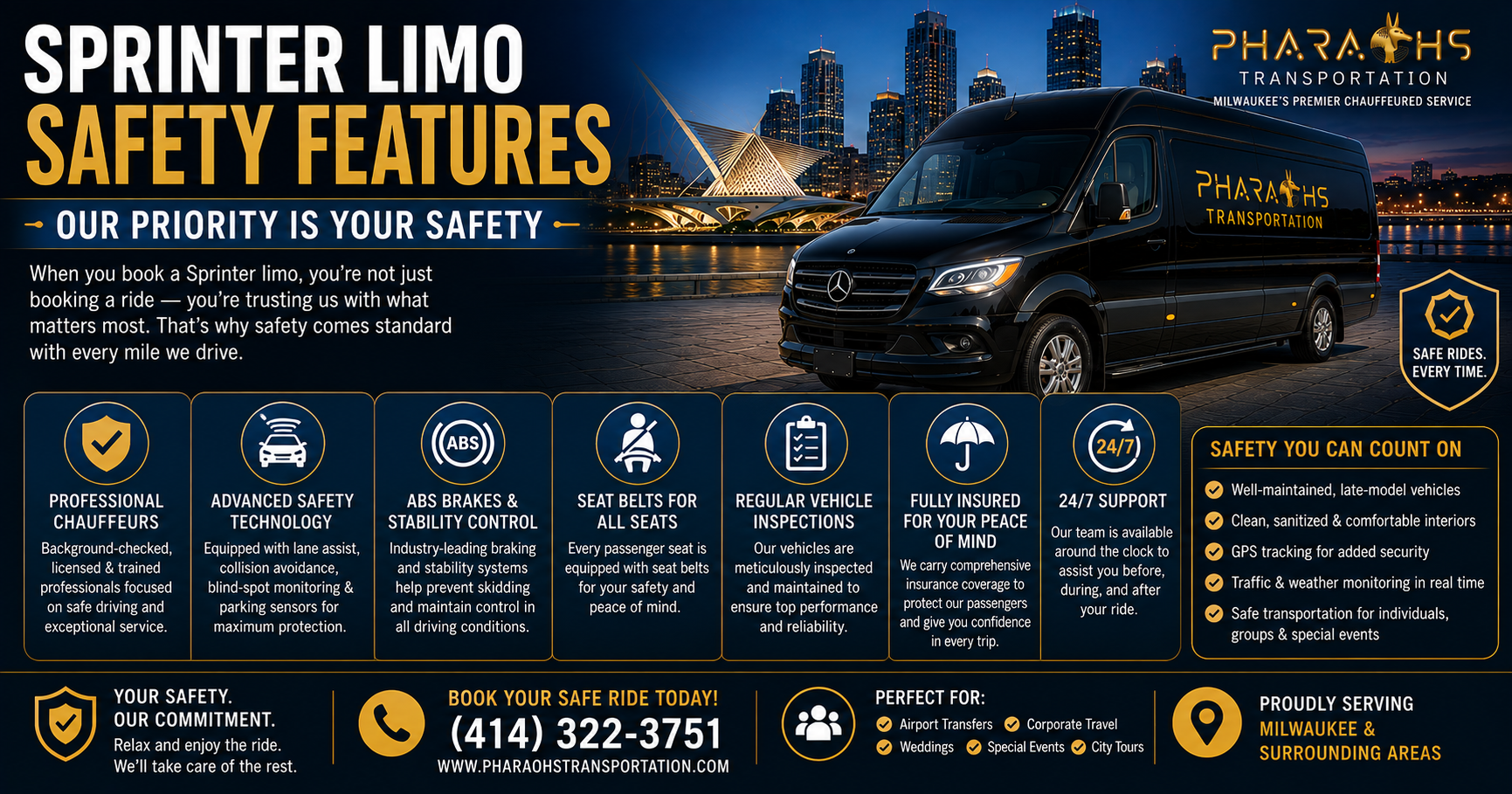
A safe Sprinter limo service carries active commercial livery insurance (not personal auto coverage), holds the correct state and municipal operating licenses, seats every passenger with a functioning seatbelt (bench-style lounge seating included), and only puts chauffeurs behind the wheel after a federal background check, a motor vehicle record review, and documented driving experience. If a company can’t produce proof of any of these on request, keep looking.
Why Sprinter Limo Safety Is a Different Conversation Than Sedan or SUV Safety
A Mercedes-Benz or Ford Sprinter conversion isn’t just a bigger vehicle — it’s a different category of risk. You’re putting 10 to 15 passengers into a single vehicle for a wedding, prom night, bachelorette party, or airport run, often after dark, sometimes on unfamiliar roads, and frequently with alcohol involved. The stakes of a poorly maintained van, an underinsured operator, or an unlicensed driver are simply higher than they are for a two-passenger sedan trip to the airport.
Sprinter conversions also introduce safety variables that don’t exist in a stock van. The rear cabin has been gutted and rebuilt — lounge seating installed, sometimes facing sideways or backward, a bar area added, mood lighting wired in, sound systems retrofitted. Every one of those modifications is a place where a shortcut can be taken. A reputable Milwaukee Sprinter limo company treats the conversion as seriously as the drivetrain, because a beautiful interior means nothing if the seatbelts weren’t reinstalled correctly after the bench seating went in.
This is also why “is a Sprinter limo safe” doesn’t have a single yes-or-no answer. A well-maintained Sprinter from a licensed, insured operator with trained chauffeurs is one of the safer ways to move a large group — safer, in many respects, than a group splitting into multiple rideshare vehicles or one person driving a 15-passenger van they rented for the weekend. But a Sprinter from an operator cutting corners on any of the items below can be genuinely dangerous. The vehicle type isn’t the variable. The operator is.
Questions to Ask a Sprinter Company Before Booking
Before you get into pricing or availability, there are a handful of questions that tell you almost everything you need to know about whether a company takes safety seriously. Most legitimate operators will answer these without hesitation — often before you even ask, because they know booking a large group vehicle is a bigger decision than booking a sedan.
1. “Are you licensed to operate commercially in this state?”
Commercial passenger transportation — limos, Sprinter conversions, party buses — requires state-level authorization in Wisconsin, along with any applicable municipal permits for the cities the company operates in. A legitimate operator will have this information ready, often as a certificate number they can reference on the spot. If you get a vague answer, or the person you’re talking to changes the subject to pricing, that’s worth noting.
2. “What insurance do you carry, and can I see proof?”
This is arguably the single most important question you can ask. Personal auto insurance does not cover a vehicle being used commercially to transport paying passengers — if a company is running Sprinter limo trips on a personal policy, that policy is void the moment there’s a claim, meaning you and every other passenger in the vehicle would have no coverage in an accident. Ask specifically for commercial auto liability coverage, and don’t be shy about asking for the coverage amount. Reputable operators are generally carrying seven figures in liability protection, not the state minimum.
3. “How old is the vehicle, and when was it last inspected?”
Sprinter vans see heavy mileage and heavy passenger loads. Ask about the model year of the specific vehicle you’d be riding in (not just “our fleet”), and ask when it was last serviced and inspected. A company confident in its fleet maintenance will usually volunteer this before you even ask.
4. “Who will be driving, and what’s their background?”
You’re trusting this person with your group for hours. Ask whether the chauffeur has undergone a background check, how long they’ve been driving commercially, and whether they’re a W-2 employee of the company or a subcontracted gig driver. This matters more than it sounds — subcontracted or app-based drivers often haven’t gone through the same vetting as an in-house chauffeur service.
5. “Does every seat have a functioning seatbelt?”
Lounge-style bench seating in a converted Sprinter can visually obscure whether seatbelts are present and working. Ask directly, and if you’re able to see the vehicle beforehand, check for yourself.
6. “What happens if the vehicle breaks down mid-trip?”
A company with a real backup plan — a second vehicle on standby, a dispatch team that can reroute — is a company that has thought through worst-case scenarios. “We’d figure something out” is not a plan.
7. “Can I see reviews or references that specifically mention safety, punctuality, or driving?”
Reviews about decor and lighting tell you about the party experience. Reviews that mention a driver being careful, professional, or handling a tricky situation well tell you about the thing that actually matters most.
Vehicle Safety Features to Look For
Once you’ve asked the right questions, it helps to know what to look for if you get a chance to see the vehicle — either in photos, at a showroom, or on the day of pickup.
Seatbelts at Every Seating Position
This is non-negotiable and it’s the first item in federal guidance on vehicle occupant protection for good reason. In a converted Sprinter, seating is often reconfigured into forward-facing benches, side-facing lounge seats, or U-shaped booths around a table. Each of those positions needs its own properly anchored seatbelt — not a single lap belt shared across a bench, and not a “decorative” belt that isn’t actually connected to the vehicle’s structural anchor points. If you can see the vehicle ahead of time, physically check that each position has a belt and that it retracts and locks properly.
Structural Integrity of the Conversion
When a Sprinter is converted into a limo, the rear cabin is typically stripped and rebuilt with new flooring, wall paneling, seating frames, and sometimes a raised roof. Every one of those modifications needs to be done by a shop that understands automotive safety standards — improperly secured seating frames or flooring can shift or fail under hard braking or in a collision. Ask whether the conversion was done by a certified coachbuilder, and whether the finished vehicle has been inspected and certified as roadworthy after the conversion (not just at the factory, before the modifications were made).
Emergency Exits and Clear Signage
A converted Sprinter should have clearly marked emergency exits in addition to the main door — this matters a lot in a vehicle where 10-plus passengers are seated in an unfamiliar layout, sometimes in low light. Ask whether the vehicle has a rear or side emergency exit and whether it’s clearly labeled.
Fire Extinguisher and First Aid Kit
Basic, but easy to overlook. A properly equipped Sprinter limo should have a mounted, current fire extinguisher and an accessible first aid kit — standard equipment for any commercial passenger vehicle, and a quick way to gauge whether a company sweats the details.
Climate Control and Ventilation
Beyond comfort, proper climate control and ventilation matter for safety in a fully enclosed cabin, especially on longer trips or in vehicles where windows don’t open. Confirm the air conditioning and heating systems are functional — a stuffy, poorly ventilated cabin isn’t just uncomfortable, it can contribute to passenger discomfort or illness on longer rides.
GPS Tracking and Real-Time Monitoring
A company that GPS-tracks its own fleet in real time can respond immediately if a vehicle is delayed, off-route, or involved in an incident. This is standard in professional dispatch operations and worth asking about directly — it’s a meaningful difference between a company running a real operation and one person answering a phone from their kitchen.
Tire Condition and Maintenance Records
Sprinter vans carry significant weight when fully loaded with passengers, and tire condition affects braking distance and handling more in a heavy, top-loaded vehicle than in a sedan. Ask when the tires were last replaced or inspected, particularly if you’re booking during winter months in Wisconsin.
Interior Lighting That Doesn’t Compromise the Driver’s View
Mood lighting is part of the appeal of a Sprinter limo, but it should be designed so it doesn’t spill into the driver’s mirrors or windshield. A well-built conversion isolates the cabin lighting from the driver’s compartment.
Chauffeur Licensing & Background Checks
The vehicle is half the equation. The person driving it is the other half — and arguably the more important one, since even the safest vehicle is only as safe as the person operating it.
Commercial Driver’s License Requirements
Depending on the vehicle’s passenger capacity and gross weight, a Sprinter limo chauffeur may be required to hold a commercial driver’s license (CDL) or a specific passenger endorsement, in addition to meeting state chauffeur licensing requirements. Ask whether the driver assigned to your trip holds the appropriate license class for the specific vehicle you’re riding in — a chauffeur licensed for a sedan isn’t automatically qualified to operate a 14-passenger Sprinter conversion.
Federal and State Background Checks
Legitimate operators run criminal background checks on every chauffeur before they’re ever put behind the wheel with paying passengers — not just at hiring, but on an ongoing basis. This should include a check against national criminal databases, not just a local records search, and it should be a condition of continued employment, not a one-time hiring formality.
Motor Vehicle Record (MVR) Reviews
A clean criminal background doesn’t tell you anything about someone’s driving history. Professional operators pull and review motor vehicle records regularly, checking for moving violations, at-fault accidents, and license suspensions. A driver with a pattern of speeding tickets or accidents shouldn’t be driving your group, regardless of how clean their criminal record is.
Drug and Alcohol Testing
Pre-employment and random drug and alcohol testing is standard practice for professional chauffeur services, particularly for drivers operating passenger vehicles. Ask whether this is part of the company’s driver policy — it’s a reasonable and increasingly expected question.
Defensive Driving and Vehicle-Specific Training
Driving a Sprinter conversion is different from driving a sedan or even a standard cargo van — the vehicle is taller, heavier, has a different center of gravity, and handles differently in turns and under braking, especially when fully loaded with passengers. Chauffeurs should receive vehicle-specific training on the Sprinter platform, not just a general driving orientation. Ask how long a new chauffeur trains before they’re assigned Sprinter routes solo.
Experience Behind the Wheel
There’s no substitute for road experience, particularly experience with the specific routes, venues, and traffic patterns your trip will involve. A chauffeur who already knows the pickup and drop-off patterns at Fiserv Forum, American Family Field, or Milwaukee Mitchell International Airport is bringing more to your trip than someone unfamiliar with the area, even if both are technically licensed. This is part of why working with an established local chauffeur service with drivers who work Milwaukee routes daily tends to produce a smoother, safer experience than a driver commuting in from out of town for the booking.
Employment Status: In-House vs. Subcontracted
This is worth asking about directly. Some Sprinter “limo companies” are actually booking brokers — they take your reservation and money, then subcontract the actual trip to a third-party operator you’ve never vetted, sometimes one you never even find out the name of. When a company owns and operates its own fleet with employed, trained chauffeurs, there’s a direct line of accountability. When your trip gets farmed out to an unknown subcontractor, that accountability disappears, and so does your ability to verify any of the licensing, insurance, or background-check standards above — because you’re no longer dealing with the company you actually vetted.
Red Flags That Signal an Unlicensed Operator
Some warning signs are obvious once you know to look for them. Others are subtler — pricing or communication patterns that suggest a company isn’t running a fully compliant operation.
Pricing that’s dramatically lower than every other quote. Insurance, licensing, maintenance, and background checks all cost money. A quote that’s 40–50% below every competing quote for the same date, vehicle, and hours is often a sign that one or more of those costs isn’t being paid — which usually means the coverage or vetting behind the trip isn’t there either.
No business address, or an address that doesn’t match a real operating facility. A legitimate Sprinter operator has a physical base of operations — a garage, a lot, an office — where vehicles are maintained and dispatched from. A company that operates entirely through a cell phone number and a booking app with no verifiable address is harder to hold accountable if something goes wrong.
Reluctance to provide proof of insurance or licensing. This is the single clearest red flag. A company confident in its compliance will produce documentation without pushback. A company that stalls, changes the subject, or gets defensive when asked is telling you something important.
Vehicles that look inconsistent with the photos in the listing. Bait-and-switch is a real problem in the group transportation industry — the photos show a late-model Sprinter with a pristine interior, and the vehicle that shows up is older, worn, or a completely different model. Ask whether the photos represent the specific vehicle you’ll be riding in.
No written contract or confirmation. A verbal agreement over text message with no formal booking confirmation, no cancellation policy, and no documented pricing is a sign of an informal operation, not a licensed commercial service.
Payment only accepted via cash, Venmo, or other untraceable methods. Legitimate operators accept traceable payment methods and typically provide a receipt or invoice. A cash-only requirement is a common pattern among unlicensed operators avoiding a paper trail.
Drivers who seem unfamiliar with basic vehicle operation or local routes. If a driver seems uncertain about how to operate cabin features, doesn’t know standard pickup procedures at the airport or a major venue, or seems generally unfamiliar with the vehicle, that’s a sign of inadequate training — regardless of what the company told you beforehand.
No online presence beyond a single marketplace listing. A company with no reviews history, no verifiable business registration, and no consistent web presence outside of a single classifieds-style listing is much harder to vet — and much harder to hold accountable after the fact if something does go wrong.
Winter Driving and Seasonal Safety Considerations in Wisconsin
Booking a Sprinter limo in Milwaukee comes with a variable that operators in warmer climates simply don’t have to plan for: five-plus months of potential snow, ice, and sub-freezing temperatures. A vehicle and driver that perform fine in June conditions can be a genuinely different experience in a January whiteout, and this is an area worth asking about directly if your trip falls between November and March.
Winter Tires and Tread Depth
Sprinter vans are tall and heavy relative to their wheelbase, which affects handling on snow and ice differently than it does in a sedan. Ask whether the company switches to winter or all-season tires rated for cold-weather traction, and whether tread depth is checked before the season starts, not just when a problem becomes visible.
Chauffeur Experience in Winter Conditions
Driving a loaded Sprinter on I-94 during a lake-effect snow event requires a different skill set than driving it on a dry summer evening. Ask whether chauffeurs receive any winter-specific training or whether route and dispatch decisions change during severe weather — for example, whether the company has a policy for delaying or rerouting trips during a winter storm warning rather than pushing through regardless of conditions.
Cabin Heating and Windshield Defrost
A cabin that heats effectively and a windshield/defrost system that clears quickly aren’t just comfort items in a Wisconsin winter — a driver with a frosted or fogged windshield is a driver with reduced visibility. Confirm this is part of the pre-trip vehicle check during colder months.
Emergency Preparedness for Weather Delays
Ask what the plan is if a trip is delayed by weather — whether that’s a flight delay affecting an airport pickup, or a highway closure affecting a long-distance transfer to Chicago or Madison. A company with real dispatch infrastructure can track conditions and adjust in real time; a one-person operation generally can’t.
What Happens During a Pre-Trip Vehicle Inspection
Professional operators don’t just maintain vehicles on a general schedule — they inspect the specific vehicle assigned to your trip before it leaves the lot. Understanding what that inspection typically covers can help you gauge whether a company you’re considering is doing this consistently, or only when something has visibly gone wrong.
A thorough pre-trip check generally covers:
- Brakes and braking system — pad wear, fluid levels, and responsiveness, particularly important given the added weight of a full passenger load
- Tires — tread depth, proper inflation, and visible damage or wear patterns
- Lights and signals — headlights, taillights, brake lights, turn signals, and hazard lights, all confirmed functional before departure
- Fluid levels — oil, coolant, transmission fluid, and windshield washer fluid
- Seatbelts and seating hardware — confirming every belt retracts, latches, and locks properly, and that seating frames show no signs of loosening
- Interior safety equipment — fire extinguisher charge and expiration, first aid kit contents, emergency exit accessibility
- Cleanliness and cabin condition — not a safety item on its own, but a useful proxy for how carefully a company treats the vehicle overall
Ask whether this kind of inspection happens before every single trip or only periodically. A company that inspects before every departure — and can describe the process specifically, rather than in vague terms — is generally the more disciplined operation.
How Sprinter Limo Safety Compares to Other Group Transportation Options
If you’re weighing a Sprinter limo against alternatives — renting a 15-passenger van and self-driving, splitting into multiple rideshare vehicles, or booking a traditional stretch limousine — it helps to know how the safety considerations actually differ.
Self-driven rental vans:
put the driving responsibility on someone in your group, often someone without commercial vehicle experience, sometimes after a full day of travel or celebration. There’s no professional licensing requirement, no background check, and no commercial insurance layer protecting passengers if something goes wrong. This is generally the highest-risk option for a large group, even though it’s often the cheapest.
Splitting into multiple rideshare vehicles:
solves the “who’s driving” problem, but introduces a different one: your group is now spread across several vehicles driven by drivers you haven’t vetted beyond an app rating, with no coordination between vehicles and no guarantee everyone arrives together or on the same timeline.
A licensed Sprinter limo service:
keeps your group together in one vehicle, under one background-checked, commercially insured, professionally trained chauffeur — which is the core safety advantage of this option over the alternatives, assuming the operator actually meets the standards outlined throughout this guide.
A traditional stretch limousine:
carries similar licensing and insurance requirements to a Sprinter, but typically seats fewer passengers and offers less interior space per person — a consideration for comfort more than safety, but relevant if you’re comparing options for a larger group.
What a Fully Compliant Sprinter Limo Service Looks Like
Putting it all together, here’s the baseline a professional operator should meet:
- State and municipal operating licenses, verifiable on request
- Commercial auto liability insurance at meaningful coverage levels — not personal auto insurance
- A fleet that’s owned and directly maintained by the company, not subcontracted out
- Properly installed and functioning seatbelts at every seating position, including lounge-style bench seating
- A conversion built and certified by a qualified coachbuilder, not a garage retrofit
- Chauffeurs who are background-checked, MVR-reviewed, and specifically trained on the Sprinter platform
- Real-time GPS tracking and dispatch oversight during every trip
- Transparent, traceable payment and a written booking confirmation
This is the standard behind services like our Milwaukee Sprinter limo service, where every vehicle in the fleet is owned and maintained directly — no subcontractors, no unverified third-party drivers — and every chauffeur goes through background screening before ever taking the wheel with passengers on board. If you’re comparing group vehicle options for an upcoming trip, our guide on choosing between an SUV limo and a Sprinter limo can help you match the right vehicle size to your group.
Frequently Asked Questions
Is a Sprinter limo safe for a large wedding party or bachelorette group?
Yes — if the operator is licensed, carries commercial insurance, and maintains the vehicle to commercial standards. A compliant Sprinter service is generally safer for large groups than splitting up across multiple rideshare vehicles, since one trained chauffeur handles the whole group instead of several unvetted drivers.
What’s the difference between a licensed and unlicensed Sprinter limo service?
A licensed operator has state/municipal transportation authorization, commercial auto liability insurance, and background-checked chauffeurs. An unlicensed one often runs on personal insurance with unvetted or subcontracted drivers — shifting the risk onto passengers if something goes wrong.
Do all seats in a Sprinter limo have seatbelts?
Yes, they should. Every seating position — including lounge-style bench seating — needs a functioning, properly anchored seatbelt. Confirm this directly with the operator before booking.
How can I verify a Sprinter limo company‘s insurance?
Ask for proof of commercial auto liability insurance and the coverage amount. Reputable companies provide this immediately; hesitation is a red flag.
What background checks should a Sprinter limo chauffeur have?
A national criminal background check and a motor vehicle record (MVR) review at minimum. Many operators also require drug/alcohol testing and Sprinter-specific driver training.
Are subcontracted Sprinter limo drivers as safe as employed chauffeurs?
Not necessarily. Subcontracted trips make it harder to verify the actual driver’s licensing, insurance, and background checks. Companies that own their fleet and employ their chauffeurs offer clearer accountability.
Book With Confidence
Choosing a Sprinter limo service is ultimately a safety decision as much as a comfort or style decision. Ask the direct questions above, verify licensing and insurance before you pay a deposit, and don’t be talked out of wanting to see the vehicle or confirm who’s actually driving.
If you’re planning an event in Milwaukee or across Wisconsin, our team can walk you through our fleet, licensing, and chauffeur standards directly — no subcontractors, no unverified drivers. Explore our Milwaukee Sprinter limo service, check out group and hourly limo options for events, weddings, and airport transfers, or reserve online — most quotes are confirmed in under 15 minutes. You can also call or text dispatch directly at (414) 322-3751.