

If you’re coordinating airport transportation for a group of 8 to 14 travelers, a single Mercedes-Benz Sprinter van typically replaces 3 to 4 separate sedans. A Sprinter configured for corporate travel comfortably seats 10 to 14 passengers with additional rear cargo space for luggage, while a standard executive sedan seats 3 passengers and 2 to 3 standard suitcases at most.
| Single Sprinter | 3–4 Sedans | |
|---|---|---|
| Passengers | 10–14 in one vehicle | 3 per sedan; 3–4 vehicles needed |
| Luggage | 14–18 suitcases + carry-ons, plus room for trade show/AV gear | 2–3 suitcases per sedan; overflow common |
| Drivers to coordinate | 1 | 3–4 |
| Flight tracking | One dispatch tracking all flights in the group | Each driver working off a single static pickup time |
| Invoicing | One quote, one confirmation, one invoice | 3–4 separate line items and gratuities |
| Best for | Groups of 6–14 traveling together | Groups of 2–4, or VIPs traveling separately |
The short version: for any group of 6 or more flying in or out of Milwaukee together, a Sprinter removes the coordination burden of managing multiple vehicles, multiple drivers, and multiple pickup times. For groups under 6, a sedan or SUV is often the better fit. For delegations, conference teams, and trade show groups of 8–14, the Sprinter is almost always the more efficient and more cost-predictable choice.
Why Delegations & Conference Groups Choose One Sprinter Over Multiple Cars
When a corporate travel coordinator is arranging transportation for a visiting delegation, a sales team flying in for a trade show, or a group of conference attendees landing in Milwaukee, the instinct is often to book individual black car sedans or SUVs — one per traveler or one per two travelers. On paper it looks simple. In practice, it creates a coordination problem that grows with every additional vehicle.
The Math of Coordination Complexity
Every additional vehicle in a group booking adds a new point of failure: a new driver to brief, a new pickup zone to communicate, a new arrival time to track, and a new possibility that one car arrives late while the rest of the group is already waiting. For a group of 10 people split across 4 sedans, that’s 4 separate confirmations, 4 separate driver check-ins, and 4 separate opportunities for miscommunication about exactly where to meet at the terminal.
A single Sprinter collapses that into one relationship: one driver, one confirmed pickup point, one line of communication. If plans shift — a flight delay, a change in meeting location, an update on which hotel the group is now staying at — that information only needs to reach one driver instead of four.
Delegations Move as a Unit, Not as Individuals
Corporate delegations and visiting teams typically want to arrive together, ideally in the same vehicle, so the group can begin coordinating logistics, reviewing the day’s agenda, or simply decompressing after a flight as a unit rather than as scattered individuals trickling in over 20–30 minutes in separate cars. This matters especially for:
- International delegations visiting Milwaukee manufacturers, where the group wants a shared first impression of the visit and time together to align on the day’s schedule
- Conference speaker teams or panel groups who need to review materials together on the ride from the airport to the venue
- Sales or account teams flying in for a client visit who want to walk in together, not staggered
- University or government delegations where protocol calls for a unified group arrival rather than a scattered one
A Sprinter with configurable seating — including forward-facing, conference-style arrangements in some configurations — lets the group begin working, reviewing notes, or simply talking through the day’s plan during the ride itself, turning transit time into productive time.
Cost Predictability Over Per-Vehicle Billing
Booking 3–4 individual sedans generally means 3–4 separate line items, 3–4 separate gratuities, and 3–4 separate chances for a rate to shift between quote and pickup. A single Sprinter booking is one quote, one confirmation, and one invoice — which matters when a coordinator is reconciling travel expenses against a single budget line for the delegation’s visit, or submitting one clean receipt to accounting rather than four.
Fewer Points of Vehicle-Tracking Anxiety
Anyone who has coordinated group travel knows the particular stress of watching several separate ride confirmations to make sure none of them fall through, none get delayed independently, and none show up at the wrong terminal door. Consolidating into one Sprinter with one dispatch contact removes most of that monitoring burden — and it means one briefing instead of several.
Briefing a single driver on the group’s itinerary, VIP names, hotel destination, and any special instructions takes one conversation; briefing four separate drivers on the same details multiplies the chance one car ends up at the wrong entrance or misses a name on the passenger list.
None of this means sedans and SUVs don’t have their place — for a group of 2–4 traveling together, or for VIP travelers who specifically want to travel separately from the broader team, individual vehicles remain the right call. But once a group crosses into the 6–14 passenger range, the case for a single Sprinter is difficult to argue against on logistics alone.
And for international delegations and formal corporate visits in particular, how a group physically arrives sets a tone: a cluster of separate cars pulling up over 15–20 minutes reads very differently than one vehicle delivering the full group together, ready to walk in as a unit.

Handling Staggered Flight Arrivals
Delegations and conference groups rarely land on a single flight. More often, a 10-person group is arriving on 3 or 4 different flights — some connecting through different hubs, some landing an hour or two apart, some at risk of delay independent of the others. Coordinating pickup around this reality is one of the more complex parts of group airport transportation, and it’s where a dedicated Sprinter service earns its value.
Multi-Flight Tracking as a Coordinated System
Rather than treating each traveler’s arrival as an isolated pickup, a well-run Sprinter service treats a delegation’s full set of flights as one coordinated arrival window. Dispatch tracks each individual flight number in the group — arrival time, gate, and any delay — and builds a pickup sequence around the full set, rather than sending a driver based on a single static “arrival time” that was accurate when the trip was booked three weeks earlier but no longer reflects reality on travel day.
This matters because flight delays are the norm, not the exception, for any group large enough to be spread across multiple flights. If one traveler’s connection is delayed 40 minutes, a system that isn’t actively tracking that flight will either have the driver waiting unnecessarily at curbside — racking up wait-time charges or holding up the rest of the group — or, worse, will have already left before that traveler reaches baggage claim.
How Staggered Pickups Typically Get Structured
For a delegation landing on 3–4 flights within a 2–3 hour window, there are generally two workable approaches:
- Rolling single-vehicle pickup: One Sprinter cycles through arrivals in sequence — picking up the first group members, holding briefly at a designated waiting area (or looping back to the terminal) to collect the next wave, and departing for the hotel or venue once the full group or a defined sub-group has assembled. This works well when flights land reasonably close together and there’s a natural waiting point.
- Two-vehicle relay for wider arrival windows: When flights are spread across a longer window — say, 4+ hours between the first and last arrival — it’s often more efficient to run two smaller pickups (a sedan or smaller Sprinter for early arrivals, followed by the main Sprinter for the bulk of the group) rather than have the full-size vehicle sit idle or make multiple round trips.
The right structure depends on how tightly the flights are clustered, and a good dispatch team maps this out during booking rather than improvising it on travel day.
What to Give the Dispatch Team Upfront
For staggered arrivals to run smoothly, coordinators should provide, at minimum:
- Every individual flight number in the group — not just a general “arriving Tuesday afternoon”
- Terminal and airline for each flight (this matters more than it seems, especially at O’Hare, where terminal-to-terminal distances are significant)
- Any known VIP or priority traveler who should not wait for the rest of the group
- A single point of contact traveling with the group who can be reached if plans shift mid-transit
Flight tracking isn’t a one-time check before the driver leaves for the airport — it’s continuous through the pickup window. If a flight lands early, the driver adjusts. If a flight is delayed, the pickup sequence shifts without the coordinator needing to call and manually re-arrange anything.
Luggage & Equipment Capacity for Trade Show and Conference Groups
Airport transportation for delegations and conference teams almost never involves just personal luggage. Trade show groups travel with booth materials, banner stands, product samples, and packed cases of collateral. Conference speakers travel with AV equipment, laptops in hard cases, and sometimes presentation materials that can’t be checked as standard baggage. Corporate delegations often bring branded gifts, signage, or documents that need to travel securely, without being crushed under a pile of rolling suitcases.
What a Sprinter’s Cargo Space Actually Handles
A Sprinter configured for group and luggage transport offers substantially more usable cargo volume than even a full-size SUV, let alone a sedan. In practical terms, this typically covers:
- 14–18 standard rolling suitcases plus carry-on bags for a 10–14 person group
- Trade show essentials: rolled banner stands, tabletop displays, boxed literature, and sample cases
- AV equipment: projector cases, laptop bags, small speaker systems, and cable kits for conference presenters
- Garment bags and suit carriers kept flat rather than folded into a trunk
- Branded promotional materials or gift boxes that need to arrive undamaged
A single business traveler with a carry-on and a laptop bag rarely has to think about cargo capacity. A 12-person delegation attending a 3-day trade show, however, is often traveling with the equivalent of an entire booth’s worth of materials in addition to personal luggage for everyone in the group. Splitting that load across 3–4 sedan trunks usually means some of it doesn’t fit, some gets left behind for a second trip, or delicate equipment ends up wedged in ways that risk damage.
Planning Ahead for Oversized or Fragile Items
If your group is traveling with anything beyond standard rolling luggage — pop-up displays, crated equipment, oversized cases — flag this at the time of booking rather than discovering a space problem curbside. A dispatch team that knows in advance a group is bringing, say, a stack of banner stands and two hard-shell AV cases can plan the loading sequence and confirm there’s room, rather than improvising a fit at the terminal with a flight-delayed group standing by.
Trade show and conference cargo often changes shape on the return trip too — booth materials get repacked, some items ship separately, and promotional inventory may have shrunk or grown depending on how the event went. It’s worth confirming return-trip cargo needs separately rather than assuming they’ll mirror the inbound trip exactly.
For groups with significant equipment, loading order matters: fragile AV cases and anything that needs to stay upright are best loaded last so they’re accessible and not buried under rolling luggage, while personal bags that won’t be needed until the hotel can go in first. A driver who knows in advance what the group is bringing can plan this sequence before the group even reaches the curb.
Milwaukee-area groups traveling in winter should also note that a fully loaded Sprinter handles differently than an empty one in snow or ice — experienced chauffeurs account for this in how they load and drive, but it’s one more reason to communicate equipment volume ahead of time rather than treat it as a surprise at pickup.
MKE vs. O’Hare vs. Midway: Pickup Logistics for Groups
Milwaukee-area delegations don’t only fly through Mitchell International Airport (MKE). Depending on flight availability, connection options, and cost, many groups — particularly larger delegations or international visitors — end up routed through Chicago’s O’Hare (ORD) or Midway (MDW) instead, sometimes with the group split across all three airports on the same trip. Each airport has meaningfully different pickup logistics for groups.
Mitchell International Airport (MKE)
MKE is a single-terminal airport, which significantly simplifies group pickup logistics compared to Chicago’s airports. Ground transportation pickup is centralized, curbside coordination is straightforward, and because the airport is compact, a driver can reposition quickly if a group’s actual arrival gate differs from what was expected. For delegations flying directly into Milwaukee, MKE is generally the easiest pickup scenario of the three.
O’Hare International Airport (ORD)
O’Hare is considerably larger and more complex, with multiple terminals — 1, 2, 3, and the international Terminal 5 — that can be a significant walk or shuttle ride apart from one another. For a delegation arriving on multiple flights, it’s common for different group members to land in different terminals entirely: a domestic connection through Terminal 1 or 2, an international arrival through Terminal 5, for instance. This means:
- Pickup coordination needs to account for terminal-specific curbside zones, not a single generic “O’Hare pickup point”
- International arrivals through Terminal 5 involve customs and immigration processing time that domestic arrivals don’t, which needs to be factored into the pickup sequence
- The drive between Milwaukee and O’Hare runs roughly 75–90 minutes depending on traffic [CONFIRM current estimate], which matters for scheduling if the group is continuing on to a Milwaukee venue the same day
Groups flying through O’Hare should confirm which specific terminal each flight uses, since assuming a single pickup point across a multi-flight O’Hare arrival is one of the more common planning mistakes for delegation coordinators.
Midway International Airport (MDW)
Midway is smaller and simpler than O’Hare, with a single consolidated terminal — logistically closer to MKE in terms of pickup simplicity. It’s often used for domestic connections on carriers with a stronger Midway presence, and for groups where flight cost or availability makes Midway the practical choice over O’Hare. The drive from Milwaukee to Midway runs roughly 90–110 minutes [CONFIRM current estimate], generally comparable to or slightly longer than the O’Hare drive.
When a Group Is Split Across Two or More of These Airports
It’s not unusual for a larger delegation to have some members flying directly into MKE while others connect through Chicago because of flight availability or cost on a given day. When this happens, the transportation plan generally needs to run as two coordinated legs rather than one: a Milwaukee-based pickup for the MKE arrivals, and a separate Chicago pickup (from O’Hare or Midway) for the rest of the group, with both legs converging at the same hotel or venue. Flagging this split at the time of booking — rather than discovering it after tickets are already purchased — makes it far easier to plan vehicle assignments and timing correctly.
This split happens more often than coordinators expect: a traveler flying in from overseas may have a far more direct or affordable itinerary through O’Hare’s international terminal, while the rest of the domestic group flies straight into MKE. Coordinators booking flights independently of the ground transportation plan sometimes don’t realize the split has happened until they’re consolidating the final itinerary — worth double-checking every flight in the group against its actual arrival airport before finalizing the ground transportation booking.
When a group is split between Milwaukee and Chicago arrivals on the same day, timing the two legs so they land at the destination hotel or venue reasonably close together — rather than hours apart — usually requires looking at the full flight schedule together rather than booking each leg in isolation.
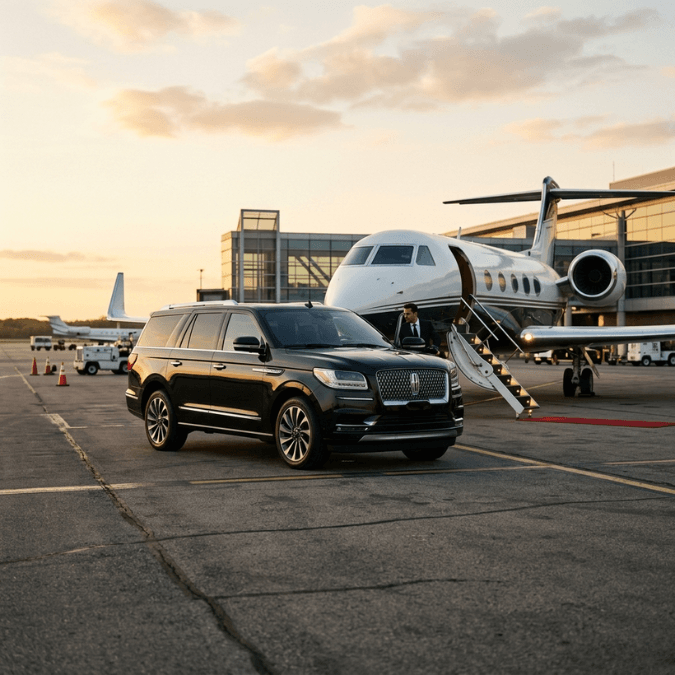
corporate limo service
Booking for Recurring Corporate Travel
Many of the delegations, conference teams, and corporate groups that need Sprinter airport service in Milwaukee aren’t one-time visitors — they’re companies, associations, or organizations that bring groups through MKE, O’Hare, or Midway on a recurring basis: monthly board meetings, quarterly sales summits, an annual conference, or a standing schedule of client delegations.
Why a Standing Account Makes Sense for Recurring Group Travel
Rebooking group transportation from scratch every time a delegation visits means re-explaining the same preferences, re-confirming the same billing details, and re-establishing trust with a new dispatch relationship each time. A standing corporate account changes that:
- A single point of contact who already understands the organization’s typical group size, preferred pickup arrangements, and any standing preferences (a specific MKE pickup location, a preferred vehicle configuration, particular billing requirements)
- Consolidated monthly or quarterly invoicing rather than a separate receipt and payment process for every individual trip, simplifying expense reconciliation for finance and travel-management teams
- Priority scheduling for organizations with predictable recurring dates, so vehicles and drivers are reserved well ahead of the specific booking
- Consistency in service — the same driver or small pool of familiar drivers handling an organization’s trips over time, which matters when delegations include the same repeat visitors trip after trip
What to Set Up for a Recurring Arrangement
Organizations moving toward a standing account typically establish a standard billing arrangement (monthly invoice, purchase order process, or corporate account terms), a go-to contact on both sides, a baseline understanding of typical group size and vehicle needs, and any standing preferences for pickup locations, vehicle type, or scheduling lead time.
Recurring corporate travel doesn’t always mean the same group size every time — a quarterly summit might bring 12 people one quarter and 6 the next. A standing account arrangement makes it easier to scale the vehicle assignment up or down between visits without renegotiating the entire relationship each time.
Standing Sprinter accounts tend to make the most sense for manufacturers or corporate headquarters hosting visiting client delegations on a regular cadence, associations and trade organizations running an annual conference or quarterly regional meetings, companies with a board that convenes in Milwaukee on a set schedule, universities or research institutions hosting recurring visiting-scholar delegations, and event and conference planning firms booking Milwaukee venues repeatedly across a year.
A recurring arrangement streamlines the relationship and the paperwork, but it doesn’t eliminate the value of advance notice for each specific trip. Vehicle availability, especially during Milwaukee’s busier convention and event periods, is still first-come-first-served — the account relationship speeds up confirmation, but it doesn’t manufacture vehicle availability out of nothing on short notice.
Frequently Asked Questions
How many people can fit in a Sprinter van for airport transportation?
A Sprinter configured for group airport transfers typically seats 10 to 14 passengers comfortably, depending on the specific configuration and how much luggage space needs to be preserved for the group.
Can one Sprinter handle a group arriving on different flights?
Yes. Dispatch tracks each flight number in the group separately and builds a pickup sequence around the full set of arrivals, adjusting for delays on any individual flight without disrupting the rest of the group’s pickup.
Do you track flights arriving at O’Hare and Midway, not just MKE?
Yes — flight tracking applies across all three airports, including the additional processing time on international arrivals through O’Hare’s Terminal 5.
How much luggage can a Sprinter actually carry for a 10–12 person group?
A Sprinter’s cargo area generally accommodates 14–18 standard suitcases along with carry-ons, and can be configured to also carry trade show materials, AV equipment cases, or garment bags when flagged in advance.
What happens if our group is split between MKE and a Chicago airport?
This is typically handled as two coordinated pickup legs — one from Milwaukee, one from Chicago — with both converging at the same hotel or venue, rather than trying to run it as a single pickup.
Is it cheaper to book one Sprinter or several individual cars for a group?
For groups of 6 or more, a single Sprinter is generally comparable to or less expensive than booking multiple individual sedans separately, while also removing the coordination burden of managing several vehicles and drivers.
Can we set up a recurring account for a delegation that visits Milwaukee regularly?
Yes — organizations with recurring group travel, from monthly meetings to annual conferences, can set up a standing corporate account with consolidated invoicing and a consistent dispatch contact.
Book Your Milwaukee Sprinter Airport Transfer
Whether you’re coordinating a visiting delegation, a conference team, or a trade show group flying into MKE, O’Hare, or Midway, a single Sprinter removes the complexity of managing multiple vehicles and multiple flight schedules. Pharaoh’s Transportation tracks every flight in your group, plans pickup logistics around your specific airport and terminal, and handles the luggage and equipment load that comes with group travel.
- Explore Sprinter Limo Service for vehicle details
- See Corporate Limo Service for standing account arrangements
- See Airport Limo Service for MKE, O’Hare, and Midway pickup details
Call or text (414) 322-3751 to book your group’s transfer or set up a recurring corporate arrangement.
Related Milwaukee Transportation Services
- Sprinter Limo Service — full vehicle details and capacity
- Corporate Limousine Service — individual executive travel and standing accounts
- Airport Limo Service — MKE, O’Hare & Midway transfers
- Executive Black Car Service — sedans and SUVs for smaller groups or VIP travelers
- Hourly Limousine Rental Service — a driver on call for multi-stop conference or delegation days
- Point-to-Point Car Service — direct single transfers with no hourly minimum
- Our Fleet — see every vehicle option, including the Sprinter’s full specs
- Current Pricing — base rates by vehicle and route
- Milwaukee to O’Hare Route Details — dedicated route page for O’Hare transfers
- Partner With Us — set up a standing corporate account