

If you’ve requested a couple of quotes for a Sprinter limo in Milwaukee already, you’ve probably noticed the numbers don’t line up. One company quotes an hourly rate, another sends a flat package, a third adds a line item you didn’t ask about. None of that means someone’s overcharging you — it usually means you’re comparing two different pricing structures, not two different prices for the same thing.
This guide walks through how Sprinter pricing actually works in the Milwaukee market: what drives the number up or down, what belongs in a quote versus what shows up later, and how to tell whether a Sprinter is even the right vehicle for your group before you start comparing rates.
Short version: hourly Sprinter charter in Milwaukee generally runs $175–$260/hour with a 3–4 hour minimum. A one-way airport transfer is usually flat-rated between $150–$300. Gratuity (18–20%) and tax sit on top of both. The rest of this guide explains why the range is that wide and how to pin down where your booking falls in it.
Step One: Figure Out Which Pricing Structure Applies to You
Before comparing dollar amounts, comparing structures saves the most confusion. Milwaukee operators generally price a Sprinter one of three ways, and which one applies depends entirely on your itinerary — not on which company you call.
You have one pickup and one drop-off:
This is a flat-rate job — most commonly an airport run to Mitchell International (MKE), a hotel-to-venue transfer, or a similar single-leg trip. Flat pricing is built on distance and expected drive time, not a clock, so a delayed flight or heavier-than-expected traffic typically doesn’t change what you owe — assuming the operator is tracking your flight and building in a reasonable wait window. That’s worth confirming directly rather than assuming; not every company handles delays the same way.
Your day has multiple stops or built-in wait time:
This is where hourly charter makes sense — a wedding timeline that moves from hotel to ceremony to photos to reception, or a corporate outing bouncing between an office, a restaurant, and a hotel. Milwaukee operators typically set a 3–4 hour minimum here because the vehicle and chauffeur are committed to your group for the full window, including any downtime between stops.
You need one long one-way trip outside the metro:
Milwaukee to Madison, or out to a venue well outside city limits. Some operators will quote this by mileage instead of time, which can beat hourly pricing when the drive is mostly highway with no waiting involved. The catch: if your plans shift mid-trip and you need an extra stop, most operators convert the remainder to hourly on the spot. Ask how that’s handled before you book if there’s any chance your plans move.
If you’re not sure which bucket your day falls into, ask for your exact itinerary quoted under two structures. A company quoting honestly should be willing to tell you which one actually saves you money, even if it’s not the one they’d prefer to sell.
The Real Reason Groups Choose a Sprinter Over Multiple Cars
Past roughly 8–10 riders, splitting a group across SUVs or rideshares almost always costs more than it looks like it will — not because any single ride is expensive, but because the costs stack: multiple base fares, multiple gratuities, and Friday/Saturday night surge pricing that rideshare apps apply once demand spikes downtown.
| Option (4 hours, 12 riders) | Total | Per Person |
|---|---|---|
| One Sprinter Limo | ~$800–$1,040 | ~$67–$87 |
| 3 Rideshare SUVs, evening/weekend | ~$900–$1,400+ | ~$75–$117+ |
| 3 Sedan Car Services | ~$960–$1,200 | ~$80–$100 |
The per-person math is only part of the story. A single Sprinter means one pickup time instead of four, and nobody arrives separately because a rideshare driver canceled. For a wedding party or a corporate group, that coordination is often worth as much as the dollar difference.
When it doesn’t apply: if your group is under 10, or if people are scattered across pickup points that are genuinely far apart, splitting into smaller vehicles can still be the smarter call. The Sprinter’s advantage shows up specifically when it’s replacing three or more separate vehicles.
To run your own numbers: take the full Sprinter quote (base rate, gratuity, and any known fees) and divide by headcount, then price out how many smaller vehicles you’d actually need for the same trip — gratuity per driver included. Rideshare pricing during Friday/Saturday evenings rarely matches whatever number you checked on the app earlier that day, so build that in.
What’s in the Quote — and What Tends to Show Up Later
A headline hourly or flat rate almost never tells the whole story. Here’s what typically sits on top, and why each one exists:
- Gratuity (18–20%) — goes to the chauffeur, standard across the industry, almost always added separately rather than folded into the base rate.
- Overtime — billed in 30- or 60-minute increments if your event runs past the booked window. Weddings are the most common source of this; building in a buffer at booking is the easiest way to avoid it.
- Cleaning fee — can apply for late-night bookings or spills. What triggers it and how much it costs varies by operator, so ask upfront rather than at drop-off.
- Wait time — most bookings include a grace period (commonly 15 minutes), with charges starting after that in set increments.
- Fuel/administrative surcharge — some operators bundle this into the hourly rate; others break it out, especially on longer point-to-point trips.
- Tax — applied on top of base rate and gratuity, same as any other service purchase.
Before you book, ask for a written breakdown that separates base rate from gratuity, tax, and any potential add-ons. A company that hands that over without being pushed is usually a good sign of how the rest of the booking will go — and it’s the only real way to compare two quotes on equal footing, since a lower headline rate can end up costing more once everything’s added.
Four questions worth asking every operator you’re comparing:
- Is gratuity already in this number, or added on top?
- What’s the overtime rate, and what increment is it billed in?
- Is there a cleaning fee, and what triggers it?
- How much grace period is built into wait time at pickup?
Get the answers in writing — email or text is enough — before you confirm.
Dates That Move the Price
Sprinter rates in Milwaukee aren’t flat year-round. A handful of predictable stretches push both price and availability:
- Brewers and Bucks home games — traffic near American Family Field and Fiserv Forum, plus demand from tailgate and suite groups, tightens availability and lifts pricing, especially on weekend and playoff dates.
- Wedding and prom season (April–June, September–October) — the busiest stretch for Sprinter bookings in the city. Popular Saturdays can sell out weeks ahead, and pricing on what’s left tends to climb as the calendar fills.
- Summerfest and major festival weekends — downtown demand spikes, and last-minute bookings get harder to secure at standard rates.
- Holiday weekends and New Year’s Eve — similar pattern: premium pricing, earlier sell-outs.
Pricing here works more like hotel or airfare pricing than a fixed menu — as a date fills up, the remaining open slots get priced to reflect scarcity. Locking in a date early protects the rate as much as it protects the booking.
The Alternative Cost: Driving and Parking It Yourself
On event days especially, it’s worth weighing the Sprinter against actually driving. Parking near American Family Field or Fiserv Forum on a game day can run $20–$40 or more per vehicle, and that’s per vehicle if your group splits up. Add rideshare surge the moment a game or concert lets out and everyone requests a ride at once, and the gap narrows fast — especially for 10 or more people. There’s also the part that doesn’t show up on a spreadsheet: nobody in the group has to stay sober to drive, nobody’s standing in a parking structure waiting on a delayed ride, and everyone leaves together on one schedule.
Sprinter vs. the Rest of the Fleet
| Vehicle | Capacity | Typical Milwaukee Hourly Rate | Best Fit |
|---|---|---|---|
| Executive SUV | 6–7 | $95–$140/hr | Small groups, airport runs |
| Stretch Limo | 8–10 | $140–$200/hr | Prom, anniversaries, classic look |
| Sprinter Limo | 12–14 | $175–$260/hr | Weddings, corporate groups, nights out |
| Party Bus | 20+ | $225–$350/hr | Large parties, bachelor/bachelorette groups |
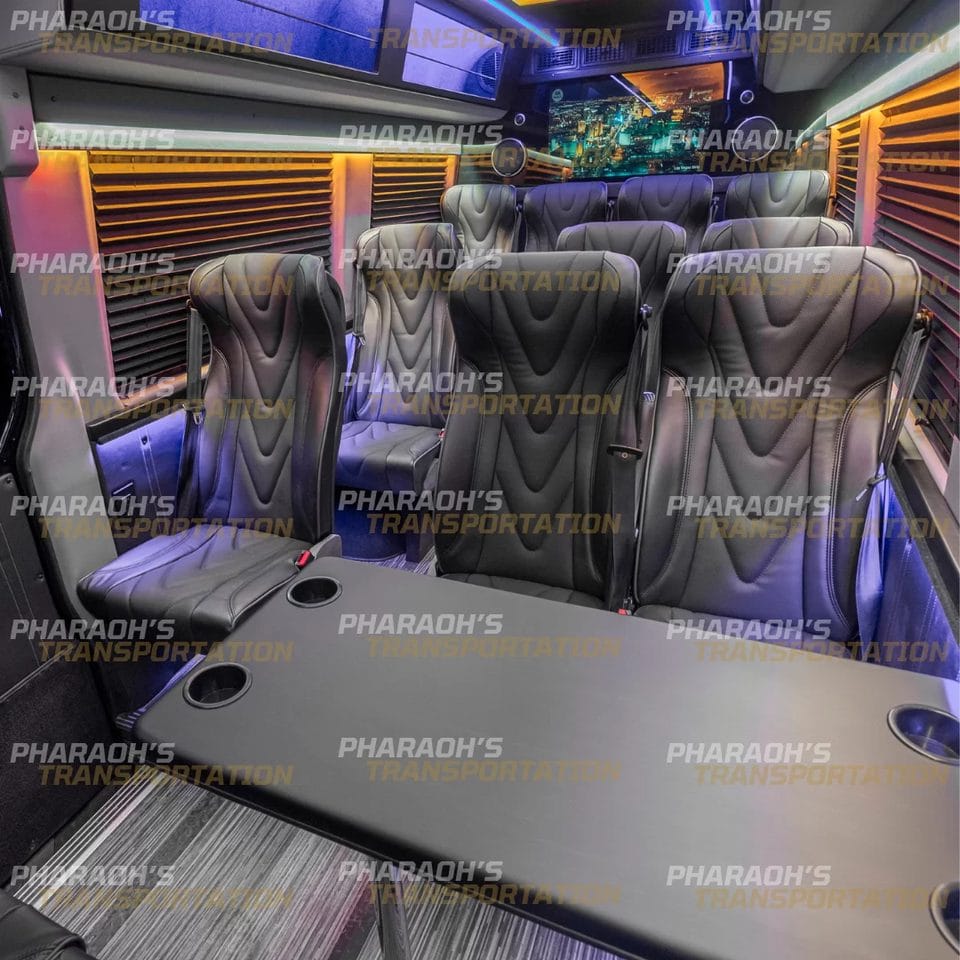
Rule of thumb: 6 or fewer riders, an SUV is usually the practical choice. Want the classic limo look for 8–10 people, a stretch limo fits. From 11–14, the Sprinter is generally the best cost-per-person while still giving you standing room and a genuinely event-ready interior — not just extra seats bolted into a van.
If your count is borderline (9–10, where either a large stretch or a Sprinter could work), ask for both quotes. Which one wins on price depends on the operator’s current fleet and availability that week, not a fixed rule.
What Actually Moves Your Specific Price
- Distance and duration — farther pickup/drop-off points and longer bookings raise the total, whether you’re hourly or flat-rate.
- Day and time — Friday/Saturday evenings are the highest-demand windows; weekday daytime (especially corporate) bookings tend to see more standard pricing.
- Group size at the edge of a vehicle class — 9–10 riders can go either stretch limo or Sprinter; get both quoted.
- Add-ons — decorations, a red carpet arrival, a specific music setup, stocked coolers. None are required, but pricing them in upfront avoids a surprise later.
- Number of stops — a straightforward point A → B → A itinerary prices lower than one with several extra stops, since stops add time and can affect routing. Give your full itinerary when requesting a quote so the number reflects your actual day, not a rough guess.
Three Real Milwaukee Itineraries, Priced Out
These use a mid-range hourly rate to show how the math actually comes together — treat them as a starting point for your own budget, not a locked quote.
Wedding day, 5-hour charter, 12 people:
Hotel pickup, ceremony venue, photo wait time, reception drop-off. At roughly $210/hour: ~$1,050 base, plus 18–20% gratuity (~$190–$210) = ~$1,240–$1,260 before tax. Book 4–6 weeks ahead for a Saturday date. See our wedding transportation page for how we structure day-of timelines.
Corporate offsite, 3-hour charter, 10 people:
Downtown office to an offsite venue and back, fits the standard hourly minimum. At $210/hour: ~$630 base, plus gratuity (~$115–$125) = ~$745–$755. Weekday corporate bookings generally run closer to standard rates than weekend event dates — more on corporate group transportation.
Night out, 4-hour charter with stops, 14 people:
Dinner, two or three bars, home — Saturday night, closer to peak demand. At $230/hour: ~$920 base, plus gratuity (~$165–$185) = ~$1,085–$1,105. Weekend nights in peak season tend to land at the higher end of this range.
Deposits, Cancellations, Payment
Most Milwaukee operators hold your date with a deposit — typically a percentage of the estimated total, not the full amount — with the balance due closer to or on the day of service. Ask what percentage is required and when the rest is due.
Cancellation windows vary by company. It’s common to see a full or partial refund available up to a set number of days out, with the deposit becoming non-refundable closer to the event — worth understanding upfront, especially for outdoor or weather-dependent plans. Most companies take major cards, and some can invoice corporate clients directly through an accounts-payable process; ask early if that’s what you need.
Getting a Quote That’s Actually Accurate
The more detail you give upfront, the tighter the number you get back. “Sprinter for a wedding in June” gets you a rough range. This gets you a real quote:
- Exact date and start time (weekday or weekend)
- Total passenger count
- Full list of pickup/drop-off locations, including stops
- Estimated hours needed, or a rough start-to-finish timeline
- Any special requests — decorations, music setup, coolers, red carpet — priced in from the start
Giving this in your first message, rather than a few emails later, is the fastest way to a firm number instead of an estimate that keeps shifting.
FAQ
Is gratuity included in the quoted price?
Usually not — most Milwaukee operators quote a base rate and add 18–20% gratuity plus tax at checkout. Confirm which number you’re looking at before comparing two quotes side by side.
What’s the minimum booking time?
Most operators, including Pharaoh’s, set a 3–4 hour minimum for hourly charter. Flat-rate trips like airport transfers don’t carry an hourly minimum.
Does a Sprinter cost more than a stretch limo?
Per hour, usually a little more, because of the added capacity and cabin space. Per passenger, a Sprinter is often cheaper once a group passes 8–10 people, since the higher hourly rate spreads across more riders.
How much does overtime cost if the event runs long?
Typically billed in 30- or 60-minute increments at your booked hourly rate, sometimes slightly more after normal business hours. Confirm the increment before your event, and consider padding your window by 30–60 minutes if there’s any chance it runs long.
Are airport transfers cheaper than hourly rental?
For a single pickup and drop-off, yes — you’re not paying for an hourly minimum you don’t need. Hourly makes more sense once you need multiple stops or want the vehicle waiting between locations.
Do prices rise on Brewers or Bucks game days?
Yes, along with prom season and peak wedding weekends — availability also tends to disappear early on those dates. Booking ahead is the reliable way to avoid paying whatever premium-priced availability is left.
What hidden fees should I watch for?
Gratuity, fuel/administrative surcharges, a cleaning fee for late-night or messy trips, and wait-time charges past the grace period. Ask for a written breakdown so you’re comparing full totals, not just headline hourly numbers.
Is one Sprinter cheaper than several SUVs for 12–14 people?
Usually, yes, once you count each SUV’s gratuity and the surge pricing that comes with weekend rideshare demand — plus everyone arrives and leaves together instead of splitting into separate cars.
Is a deposit required?
Most Milwaukee operators require one, typically a percentage of the estimated total, with the balance due closer to your date. Confirm the exact percentage and due date when you book.
Can I get a custom quote instead of using these ranges?
Yes — share your date, headcount, pickup/drop-off locations, and estimated hours, and you’ll get a firm number instead of a market-range estimate.
Ready for an Exact Number?
Every quote we build starts from your actual itinerary, not a package. Reach out with your date, group size, and stops, and we’ll walk you through exactly what’s in the base rate versus what’s billed separately before you commit to anything.